

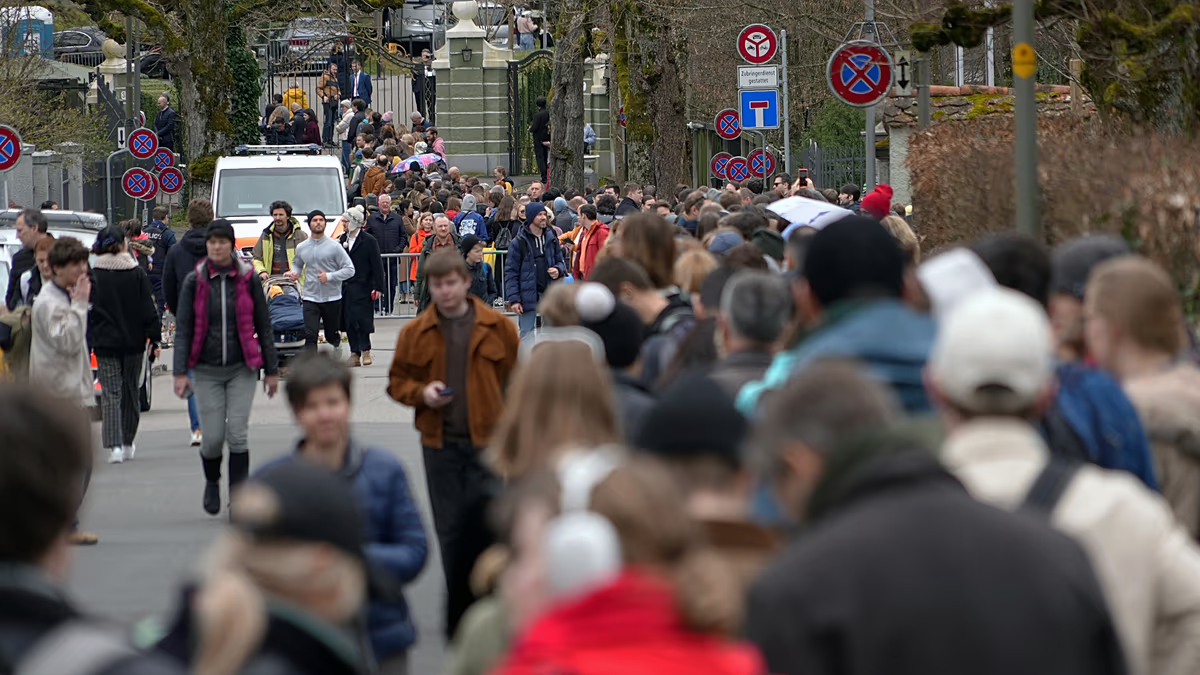
Beneath the crisp spring sky of the Swiss Alps, in the canton of Appenzell Innerrhoden, democracy unfolds not through mailed ballots or digital screens, but in a collective breath of open air. Thousands of citizens gathered in the town square, continuing a tradition that stretches back to the 15th century: the Landsgemeinde. This is no historical reenactment, but a living, breathing act of governance. On this day, the very fabric of community is woven into the process of decision-making, as voters raise their hands to elect local leaders and debate the immediate future of their homeland, from police reforms to road improvements. The scene is a powerful testament to a form of democracy that is tactile and immediate, where a raised hand is both a vote and a visible connection to one’s neighbor.
The atmosphere is one of solemn pageantry intertwined with everyday social life. The event is opened with processions featuring local dignitaries in ceremonial attire, brass band performances, and the unfurling of historic banners, transforming the civic exercise into a communal celebration. Residents and curious tourists alike lean from windows and balconies of the encircling buildings, observing the democratic theater below. This blending of formal tradition with informal gathering reinforces the foundational principle of the Landsgemeinde: that governance is a public, shared responsibility, witnessed by all. The sheer physical presence required—attending, listening, raising one’s arm—fosters a unique sense of collective accountability rarely felt in more anonymous voting systems.
Presiding over this ancient assembly was Landammann Angela Koller, whose role itself marks a historic evolution. Appenzell Innerrhoden was the last Swiss canton to grant women the right to vote in local matters in 1991, making Koller’s leadership a profound symbol of change within continuity. As she guided the discussions, her presence underscored that even the most deeply rooted traditions are capable of growth and inclusion. The Landsgemeinde, while fiercely protective of its history, is not frozen in time; it is a vessel that carries the values of direct democracy forward, adapting to embrace all members of the community it serves.
The mechanics of the vote are deceptively simple, yet demand a high level of civic engagement. There are no private booths; each voter declares their stance in full view of the community. This transparency encourages a culture of informed participation, as citizens must be prepared to publicly stand by their judgments. Debate on the square is earnest, with residents stepping forward to speak for or against proposals. This direct exchange between authorities and citizens, where a compelling argument can literally sway the crowd, embodies a pure form of deliberative democracy. The raised hands become a sea of individual wills merging into a single communal decision, a physical manifestation of the popular will.
However, this idyllic practice also contends with modern challenges. The requirement for physical presence can disadvantage the elderly, the infirm, or those living abroad. Critiques about potential social pressure and the lack of a secret ballot are part of an ongoing dialogue about its place in the 21st century. Yet, its supporters argue that its very vulnerability—the demand for courage, conviction, and community trust—is its greatest strength. It operates on a foundation of earned social cohesion and mutual respect that has been cultivated over centuries, representing a democratic ideal that prioritizes direct responsibility and local sovereignty above convenience.
In an era where democratic systems are often critiqued as distant, fragmented, or mediated by technology, the Landsgemeinde of Appenzell Innerrhoden stands as a profound counterpoint. It is democracy humanized—literally faced, voiced, and gestured. More than just a method of voting, it is an annual reaffirmation of community identity, a ritual that binds the practical work of governance to the shared history and cultural spirit of the canton. As the assembly concludes and the square slowly empties, the decisions made are inseparable from the collective experience of having made them together, under the open sky, in a continuing conversation between past and present.