



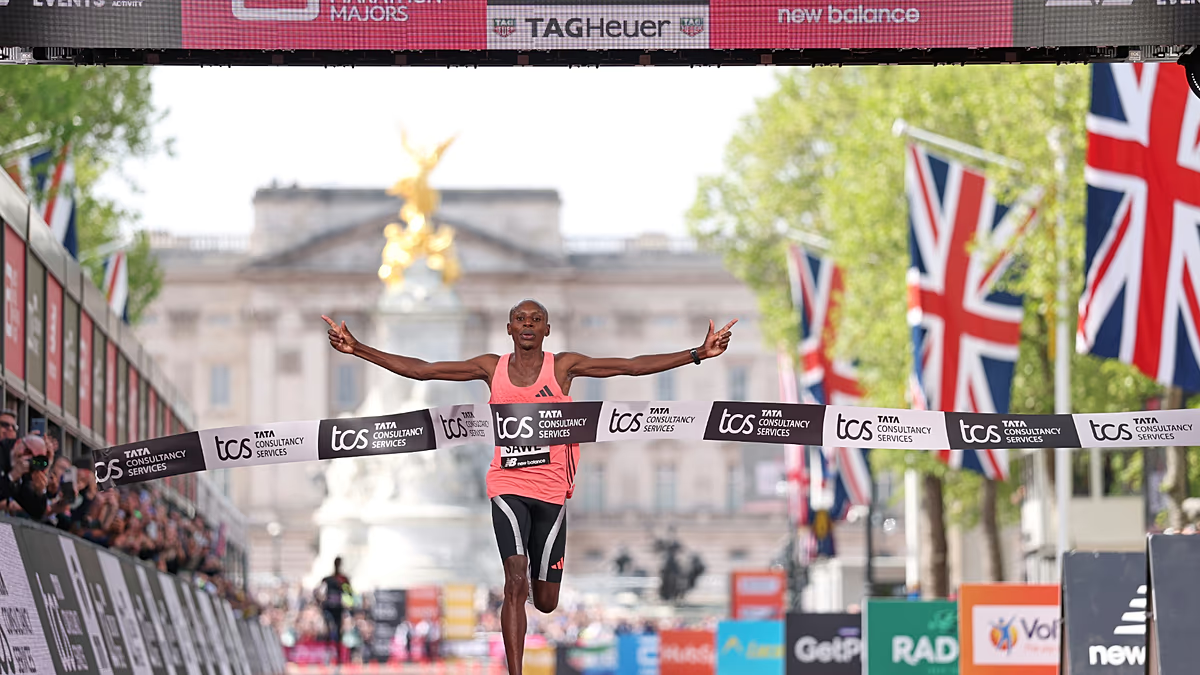
In an extraordinary display of athleticism and human endurance, the London Marathon on April 26, 2026, witnessed a moment many believed would remain a distant dream for generations: the shattering of the two-hour barrier in the marathon. Sabastian Sawe of Kenya etched his name into the annals of sports history, not merely breaking the men’s world record but obliterating a profound psychological frontier with a stunning time of 1:59:30. His achievement, a monumental 65-second improvement on the previous record, was the culmination of decades of evolution in training, nutrition, and technology. Yet, what made the moment uniquely human was its shared nature. As Sawe surged down The Mall in a final, solitary sprint after breaking away from his rival in the last two kilometers, he carried with him the hopes of countless runners. His post-race reflection captured this spirit perfectly: “What comes today is not for me alone,” he said, “but for all of us today in London.” This was more than a personal victory; it was a gift to the sport and a new benchmark for human potential.
The race was not a solo exhibition but a historic duel that produced an unprecedented podium. In a staggering twist, the second-place finisher, Ethiopia’s Yomif Kejelcha, also clocked a sub-two-hour time of 1:59:41 in his very first marathon, showcasing a breathtaking debut. Completing a podium where all three men broke the previous world record was Uganda’s Jacob Kiplimo, who finished in 2:00:28, seven seconds faster than the mark set by Kelvin Kiptum in Chicago in 2023. This trio’s performance signified a seismic shift, suggesting the sub-two-hour marathon was now a competitive reality rather than a once-in-a-lifetime feat. The tactical race saw Sawe and Kejelcha push clear from the pack at the 30-kilometer mark, their partnership in pain setting the stage for Sawe’s decisive, final burst. The image of these athletes, supporting and challenging each other to the very limits, embodies the profound duality of elite sport: fierce competition intertwined with mutual respect and a shared pursuit of the impossible.
While the men’s race captured global headlines with its symbolic breakthrough, the women’s event presented its own narrative of relentless excellence and defending legacy. Ethiopia’s Tigst Assefa delivered a masterclass, defending her London title with a powerful kick in the final 500 meters to win in 2:15:41. This time set a new record for the fastest women’s-only marathon, further cementing her dominance. The race was intensely competitive, with Kenya’s Hellen Obiri a mere 12 seconds behind in 2:15:53 and Joyciline Jepkosgei just two seconds after her in 2:15:55. Assefa’s victory was particularly poignant as she bettered her own course record from 2025, yet her time remained 16 seconds shy of the overall course record set by Britain’s Paula Radcliffe in a mixed-gender race back in 2003. This subtlety adds a rich layer to the history of the sport, reminding us that records are contextual, and Assefa’s achievement stands as a towering landmark in the era of women’s-specific competitions.
The day’s triumphs extended beyond the able-bodied races, offering powerful stories of resilience and dominance in the wheelchair events. Switzerland’s Marcel Hug, a titan of the sport, secured his sixth consecutive men’s London Marathon title and his eighth overall, a streak of consistency that speaks to unparalleled focus and mastery. In the women’s race, his compatriot Catherine Debrunner provided another highlight, successfully defending her crown in a thrillingly close finish against the celebrated American athlete Tatyana McFadden. These races showcase a different, yet equally compelling, dimension of marathon running—one where technology, technique, and sheer upper-body strength converge. The athletes in these events overcome immense physical challenges, and their victories inspire by demonstrating that the marathon’s spirit of endurance and determination is universal, transcending all boundaries.
Stepping back, the 2026 London Marathon will be remembered as a watershed event that redefined the limits of human performance across multiple categories. It was a day where long-standing barriers were not just approached but comprehensively surpassed. Sawe’s sub-two-hour marathon shifts the entire paradigm of distance running, setting a new north star for every elite athlete and aspiring runner worldwide. Simultaneously, Assefa’s commanding victory and the Swiss dominance in the wheelchair divisions underscore the depth and diversity of talent in modern marathoning. Each race, from the lead pack of the men’s event to the razor-thin margins in the women’s and wheelchair contests, was a testament to years of sacrifice, strategic planning, and the unwavering human will to push beyond known frontiers.
Ultimately, the true beauty of this marathon lay not solely in the chronometric records but in the collective human experience it represented. It was a festival of potential, where seasoned champions like Sawe and Hug shared the stage with debutants like Kejelcha, all united by the same 26.2-mile challenge. The cheers that echoed down The Mall were for more than fast times; they were a celebration of perseverance, international camaraderie, and the shared joy of witnessing history. These athletes, through their sweat and striving, did more than win races—they expanded our understanding of what is possible, offering a profound reminder that the greatest barriers we break are often the ones we build in our own minds.