



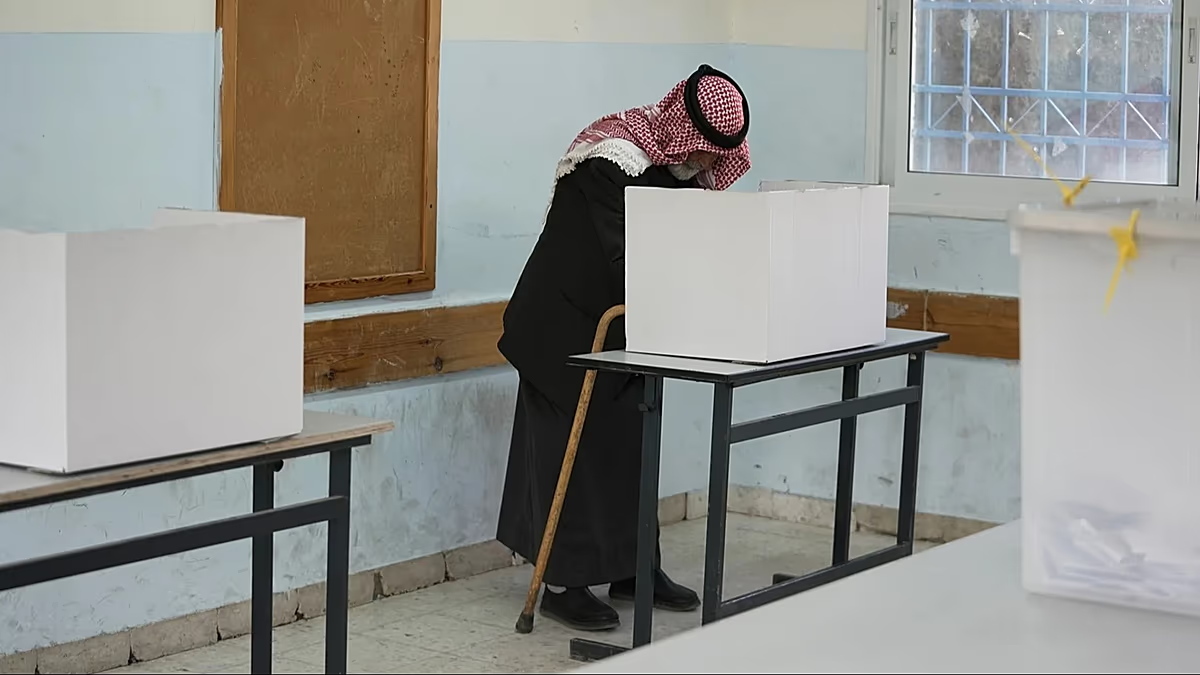
In a significant yet subdued political event, Palestinians in parts of the Israeli-occupied West Bank and in the Gaza Strip went to the polls on Saturday for local elections. These municipal votes, the first of any kind held in Gaza in nearly two decades, spotlight a deeply fragmented political landscape and a populace wrestling with diminished democratic avenues. Since Hamas’s surprising parliamentary victory in 2006, which was followed by a violent split with the rival Fatah movement and Israel’s ongoing blockade of Gaza, national elections have been perpetually postponed. This has left local council votes as one of the few remaining mechanisms for any form of electoral participation, making Saturday’s exercise a poignant, if limited, expression of civic life amid prolonged political paralysis and occupation.
The electoral landscape was marked by notable absences and low engagement. Most candidates were aligned with President Mahmoud Abbas’s secular-nationalist Fatah movement or were independents backed by smaller factions. Hamas, the de facto governing authority in Gaza, was officially absent from the ballot in the single voting district of Deir al-Balah, though some candidates were believed to have informal links to the group. Several other factions chose to boycott the process, protesting conditions set by the Palestinian Authority (PA) for candidate registration. This, coupled with complaints from some aspiring candidates who said they were barred from running, contributed to a climate of skepticism. This sentiment was reflected in the turnout, which remained low throughout the day, with many polling stations reported as quiet and empty, underscoring a widespread disillusionment with the political process.
Despite the muted participation, the elections carried weight for both ordinary Palestinians and the international community. Voters were choosing representatives for municipal and village councils, which hold responsibility for critical everyday services like water, sanitation, and local infrastructure. For residents, this practical dimension offered a glimmer of agency. As one voter told AFP, the hope was to “replace people… who might be better and help develop the community,” acknowledging that while broader political change remains elusive, local improvement is still possible. Another described the act of voting as a symbolic but vital assertion of the people’s “will to live.” For Western and regional backers of the PA, including the European Union which praised the vote as a step toward “broader democratisation,” these elections are a barometer for the PA’s commitment to reforms and governance, which are prerequisites for their continued financial and diplomatic support.
The voting occurred within a profoundly fragmented and constrained environment that severely limits Palestinian political sovereignty. The Palestinian Authority itself, which administers parts of the West Bank, is grappling with a severe financial crisis exacerbated by Israel’s withholding of tax revenues it collects on the PA’s behalf. More fundamentally, Israel maintains overarching control over security, movement, and land in the West Bank, and enforces a strict blockade on Gaza, meaning that even the most local Palestinian decisions are subject to Israeli influence or veto. This reality strips the electoral process of any pretence of normalcy, framing it instead as a administrative exercise conducted under the strict confines of a prolonged military occupation.
Furthermore, the electorate itself is fractured by geography and political status, highlighting the disjointed reality of Palestinian life. While nearly 1.5 million were registered in the West Bank and about 70,000 in the Deir al-Balah area of Gaza, vast swathes of the population were excluded. Palestinians in East Jerusalem, who live under Israeli municipal authority, could not participate. Palestinian citizens of Israel were also ineligible, and the widespread Palestinian diaspora, living in enforced exile, has no voice in such votes. Even within Gaza, only one district was included, meaning most Gazans remain disenfranchised. This patchwork of eligibility underscores that there is no unified Palestinian political body that can represent the entire nation, a core obstacle to self-determination.
In conclusion, Saturday’s local elections represent a paradox: a minor administrative event that simultaneously embodies major political stakes and profound constraints. They function as a pressure valve, offering a sanctioned outlet for limited political expression and a tool for international donors to advocate for reform. Yet, they are undeniably a poor substitute for genuine national representation and self-rule. The low turnout and boycotts speak to a deep-seated public frustration with political divisions, stagnation, and the overarching reality of Israeli control. Ultimately, while the elections manage local affairs like water and roads, they are conducted in the shadow of much larger, unresolved questions of sovereignty, unity, and freedom that continue to define the Palestinian experience.