

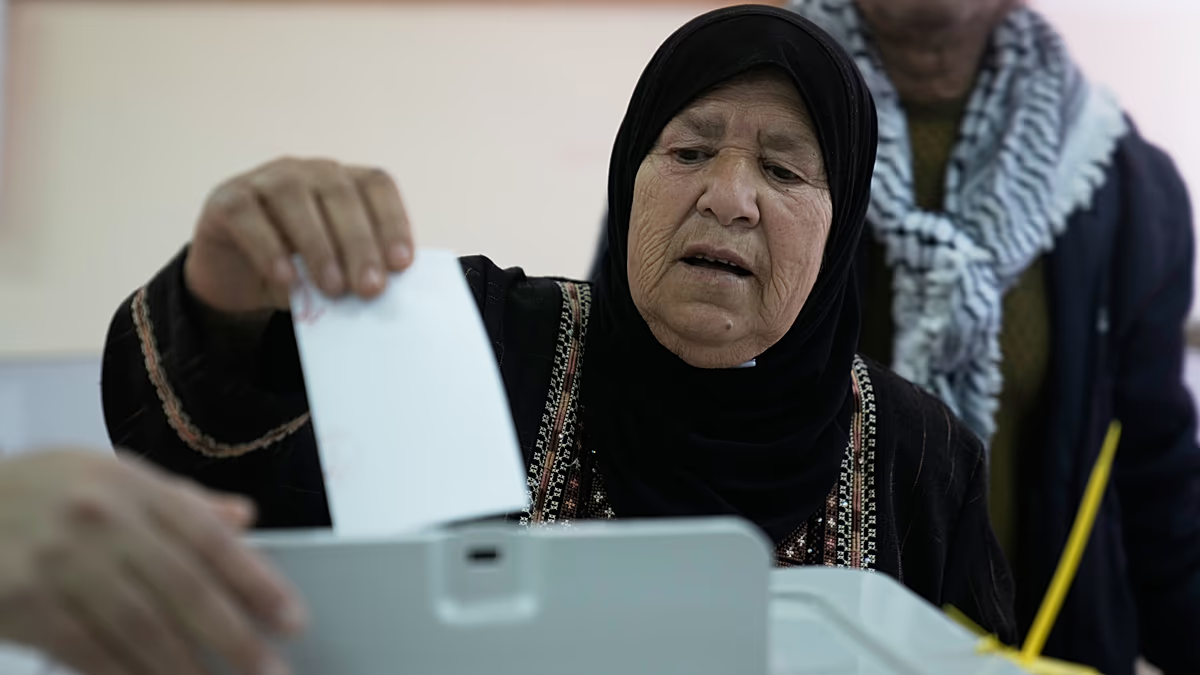
Across the occupied West Bank, from Al-Bireh near Ramallah to cities and towns further afield, polling stations opened their doors at 7 a.m. This was not a vote for a president or a parliament, but for local councils—the bodies tasked with the most fundamental aspects of daily life: ensuring clean water, collecting garbage, repairing roads, and maintaining basic infrastructure. Nearly 1.5 million Palestinians were eligible to cast ballots, a process organized by their own Central Elections Commission. Yet this act of civic duty unfolds under a pervasive and defining reality: Israeli military occupation. The very municipalities being voted on operate within a labyrinth of restrictions, where permits are needed for development projects, and movement is controlled by checkpoints and barriers. This election, therefore, represents a profound paradox—a democratic exercise seeking to address community needs, conducted within a system that fundamentally limits a community’s ability to control its own destiny. For many voters, it is seen as one of the last remaining channels for any form of direct civic participation, a small space for collective voice amidst much larger, unresolved political stalemates.
The picture in the Gaza Strip stands in stark and heartbreaking contrast. Here, the scope of the municipal elections is brutally limited, a direct reflection of the catastrophic conditions following months of intense conflict. Only the area of Deir el-Balah is participating, with approximately 70,449 registered voters—a staggering drop from the roughly 930,000 eligible just three years ago in 2021. This numerical collapse tells a story of immense human suffering: widespread displacement, with families scattered and civil registration systems in disarray; the utter destruction of entire neighborhoods, including major urban centers like Gaza City and Khan Younis, which are entirely excluded from the process. Polling elsewhere in Gaza has been postponed indefinitely, not due to political choice, but because of sheer impossibility—ongoing security crises, a near-total lack of electricity, and the collapse of the administrative capacity needed to organize a vote. The election in Gaza is thus a ghost of what it should be, highlighting absence more than presence, and serving as a grim indicator of how deeply the fabric of daily life and governance has been torn.
Beyond the logistical realities, this local vote carries a heavy symbolic weight for the Palestinian people. It arrives in the shadow of the indefinite postponement of the first planned national elections in over fifteen years, which were cancelled in 2021. That cancellation shattered hopes for a renewed national political mandate and reinforced a deep sense of political stagnation. In this context, the municipal ballot becomes a substitute, a rare opportunity to engage in a collective political act, however locally focused. Yet, the atmosphere is not one of excitement, but often of resignation and doubt. Many voters question the tangible impact their ballots can have when councils are hamstrung by a crippled economy, soaring unemployment, and the overbearing constraints of the occupation. The campaign has been marked by political fatigue, with many seeing the process as an empty ritual that cannot address their most pressing struggles for livelihood, freedom, and national rights.
The political landscape of these elections further underscores their limited nature. Most candidate lists are either directly linked to Fatah, the faction that dominates the West Bank-based Palestinian Authority, or to local independents. Hamas, the governing authority in Gaza before the recent conflict and a major national political force, is not formally participating. In several major West Bank cities, including Nablus, the absence of competitive lists has resulted in uncontested outcomes, where a single slate runs unopposed. This lack of political variety and genuine competition drains the democratic spirit from the exercise, reducing it in some places to a mere administrative formality. It reflects a broader disillusionment with the fractured political system, where longstanding divisions between Fatah and Hamas have paralyzed national governance, leaving local councils as isolated islands of administration, devoid of a unifying national project.
As the voting day progresses, the practical disparities between the West Bank and Gaza are mirrored in the closing of the polls. In the West Bank, stations are scheduled to close at 7 p.m., following a full twelve-hour window. In Gaza, however, the severe electricity shortages and precarious security situation have necessitated an earlier closure. This technical detail is a microcosm of the two starkly different realities Palestinians are enduring: one of entrenched occupation and constrained life, the other of active humanitarian disaster and survival. When the ballots are counted, the results will determine the composition of local councils, but their true test will be their ability to function and serve their constituents. These councils will be expected to provide normal municipal services in profoundly abnormal circumstances, navigating between the demands of their populace and the restrictions imposed upon them.
In the final analysis, these municipal elections are a testament to both resilience and profound constraint. They demonstrate a Palestinian commitment to maintaining the forms and rituals of civic life and self-governance, even under the most difficult conditions imaginable. The very act of holding an election is an assertion of a people’s desire to shape their own community affairs. Yet, the vote is simultaneously framed by inescapable external forces: the occupation’s architecture of control in the West Bank, and the devastation of war in Gaza. The outcomes will likely produce little political change on the national stage, but they will install local officials who bear the immense, day-to-day burden of trying to mend potholes, restore water lines, and collect trash—all while their constituents live in the long shadow of a conflict that shows no sign of abating. Ultimately, this election is less about political transformation and more about the stubborn, often thankless, work of preserving a sense of ordinary life in a reality that is anything but ordinary.