

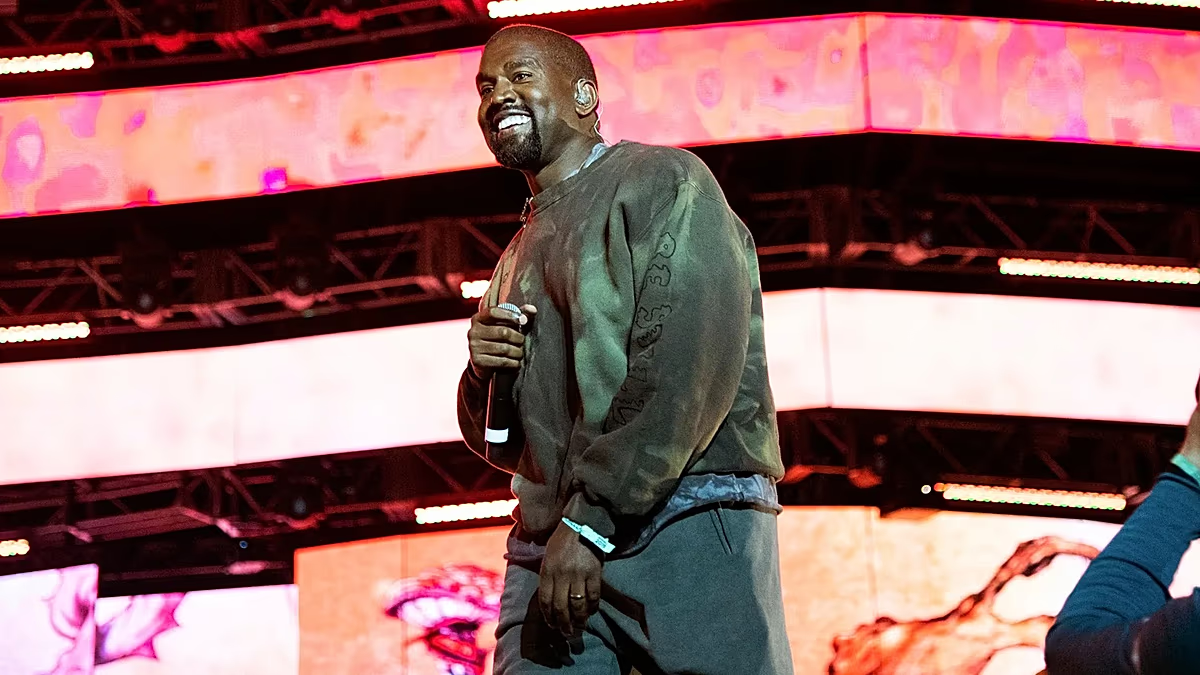
A Controversial Tour: Kanye West’s Path to Portugal
The figure of Kanye West, now predominantly known as Ye, has become inextricably linked with controversy in recent years, casting a long shadow over his musical legacy. His repeated instances of hate speech, particularly anti-Semitic rhetoric, and displays of offensive behavior, including public mistreatment of his wife Bianca Censori, have ignited global condemnation. These actions have had tangible professional consequences, most visibly disrupting his European tour itinerary. Nations, especially those with heightened sensitivities to anti-Semitic sentiment given rising global tensions, have opted to cancel his concerts, reflecting a societal stance against platforming an artist associated with such divisive and harmful ideologies.
Portugal, however, currently stands as a notable exception on his troubled tour map. Despite cancellations in the UK, France, Poland, and Switzerland, his concert scheduled for August 7th at the Algarve Stadium remains confirmed. The event’s organizer, Torcato Jorge of Raya Culture, frames the surrounding debate as “a non-issue” propelled by “misinformation.” He asserts the concert is purely a music event and underscores that Portuguese security services have not identified Ye as a national threat. His confidence hinges on strict adherence to legal procedures, noting that within the EU, no member state has formally vetoed the artist’s entry—the UK’s ban occurred post-Brexit. Jorge acknowledges the situation is becoming “a political issue,” yet maintains that without an official state security report blocking Ye’s entry, the event should proceed as planned.
The organizer’s assurances are robust. He guarantees constant communication with Ye’s team and notes no indication of a voluntary cancellation, unlike the incident in Marseille where the artist withdrew after local political opposition. Jorge highlights the full commitment of local authorities and national tourism bodies, along with the recent approval of the safety project by Civil Protection. To ensure transparency, Raya Culture has proactively reached out to the Ministry of Internal Affairs for any needed clarifications. The Ministry itself has stated it is “closely monitoring the situation,” ready to act should any risk assessment conclude the visit poses a threat to public order or national security. This dance between corporate confidence and governmental vigilance defines the current Portuguese stance.
Despite this administrative smoothness, a significant commercial concern has emerged: domestic ticket sales. Torcato Jorge laments a downturn in Portuguese purchases, attributing it to “speculative doubts with no legal basis” that have made locals fearful of investing nearly €200 for a potentially cancelled event. Interestingly, international interest remains strong, with sales from the UK, Spain, France, and Switzerland compensating. Jorge passionately defends Ye’s place in music, separating the artist’s “mistake” in making anti-Semitic comments from his artistic legacy. He envisions the concert as “the biggest event in the Algarve this summer” and a compelling experience for lovers of music and grand production, hoping to bridge the gap between controversy and craftsmanship.
The contrast with other European nations is stark and instructive. The UK government revoked his entry permit, leading to three cancelled Wireless festival dates. In France, political pressure prompted Ye’s own cancellation. Poland’s Culture Minister explicitly condemned his past statements, declaring they disqualified him from performing in a country scarred by the Holocaust, leading to the formal cancellation of his Chorzów show. Switzerland’s FC Basel stadium declined the project, stating it could not “provide a platform for the artist in question in accordance with our values.” These decisions collectively form a moral and political geography, mapping where communities and governments draw a line against normalizing hatred.
Thus, the upcoming concert in Portugal presents a complex narrative. It is a point of convergence where legal formalism, commercial ambition, artistic appreciation, and global ethical debates meet. The organizer views it through a lens of law and logistics, the government through security and order, and the international community through a prism of values and consequences. As the Algarve prepares for a possible influx of international fans, the event hangs in a delicate balance—not just as a musical performance, but as a case study in how societies navigate the challenging terrain where iconic artistry collides with indefensible ideology. The spotlight on August 7th will illuminate not only the stage, but the ongoing struggle to define the boundaries of tolerance, accountability, and the power of a platform.