


I.
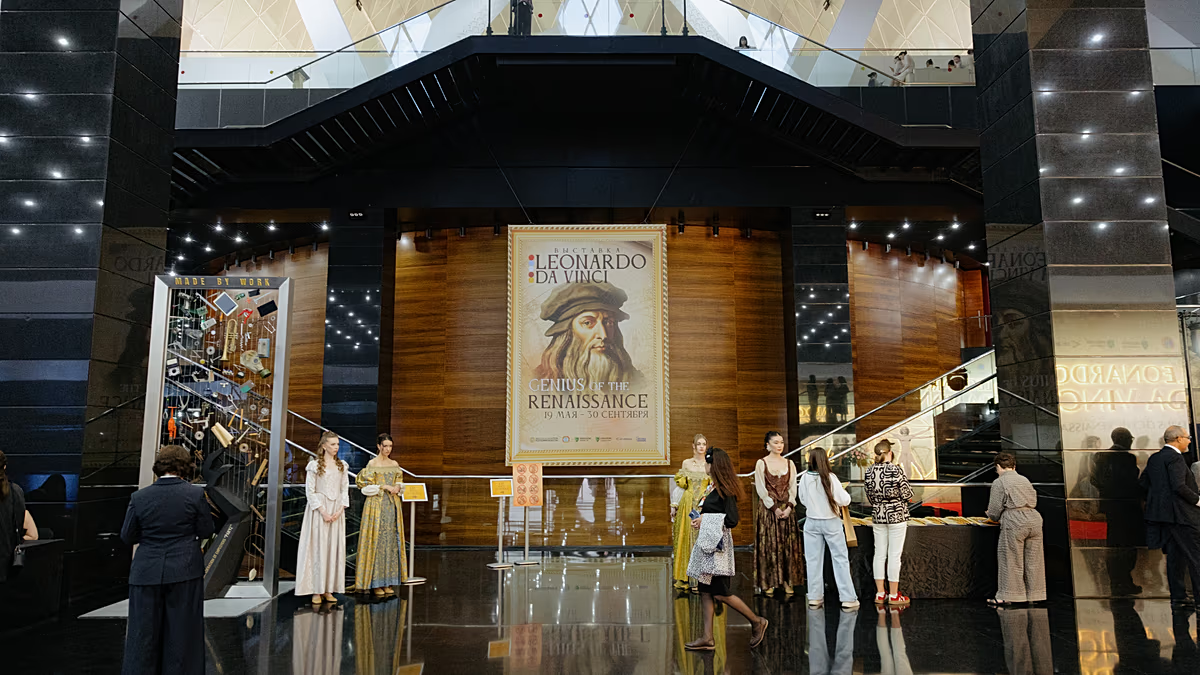
In the heart of Astana, a profound tribute to timeless genius has taken flight. The exhibition “Leonardo da Vinci: Genius of the Renaissance” has opened its doors, offering a rare and tangible journey into the mind of perhaps history’s most brilliant polymath. Far from a simple display of replicas, this gathering brings together over forty life-size mechanical models, each painstakingly reconstructed from the Renaissance master’s own intricate drawings and cryptic notes. Transported from the historic museums of Rome and Florence, these wonders were born from the surviving pages of the Vinci Codices—those thousands of manuscript pages that escaped the erosion of time. As Narima Mukhambetalina, the exhibition’s director, notes, these precious documents are the key to the past; from some 7,000 surviving pages of an original 20,000, specialists have performed a kind of intellectual archaeology, breathing three-dimensional life into designs that existed for centuries only on paper and in Leonardo’s boundless imagination.
II.
Stepping into the expansive halls of the Palace of Peace and Reconciliation, visitors are immediately immersed in Leonardo’s world-view. The exhibition is thoughtfully organized not by chronology, but by the classical elements: air, water, earth, and fire. This thematic layout is deeply fitting, reflecting Leonardo’s lifelong obsession with understanding the fundamental forces of nature. He was not merely an inventor, but a natural philosopher who saw intricate patterns connecting everything from the flow of water to the flight of birds. This exhibition masterfully demonstrates how his relentless observation of the natural world was transformed into engineering concepts so advanced they would not be realized for hundreds of years. Each zone reveals a different facet of his quest to harness these elemental powers, creating a cohesive narrative about a man who sought to comprehend, and then improve upon, the very machinery of the universe.
III.
The section dedicated to air is a testament to one of Leonardo’s most enduring fascinations: human flight. Here, visitors encounter the delicate, skeletal frames of ornithopters—winged machines powered by human muscle—and his famous aerial screw, a helical design of linen, wire, and wood that is widely celebrated as a visionary precursor to the modern helicopter. Nearby hangs his pyramidal parachute, a design of calculated elegance based on his studies of air resistance. To stand beneath these contraptions is to feel the palpable weight of his ambition and the poignant blend of practicality and dreamlike hope they embody. These were not just fanciful sketches; they were detailed proposals for overcoming gravity, born from dissecting birds and studying the wind, representing a daring leap of faith into a realm humanity had yet to conquer.
IV.
Equally compelling are the zones of earth and fire, which reveal Leonardo’s pragmatic, and sometimes turbulent, reality as an engineer for Renaissance lords. The fire section, housing his martial inventions, is, as tour guide Dilnaz Zholdaskhanova notes, a particular source of awe for many. Dominating this space is the iconic armoured vehicle, a daunting, tank-like fortress inspired by a turtle’s shell, designed to protect soldiers as it lumbered across the battlefield. This vision of mobile protection, complete with its own internal weaponry, showcases his ability to reimagine warfare. Meanwhile, the earth zone underscores his revolutionary contributions to fundamental mechanics. Here, one finds the self-propelled cart—an astonishingly complex spring-driven device often called the world’s first concept for an automobile—alongside his sophisticated designs for ball bearings, precision gears, and transmission systems. These unassuming mechanisms form the hidden DNA of modern machinery, proving that his genius was as much in perfecting the basic components of motion as it was in grand, theatrical inventions.
V.
What makes this exhibition particularly vibrant is its seamless fusion of historical reverence with modern engagement. Alongside the beautifully crafted wooden and metal models are LED-lit tunnels, digital projections, and holographic installations that animate Leonardo’s concepts, helping visitors visualize the kinetic principles he described. Digitized, explorable versions of masterpieces like the Mona Lisa bridge his dual legacy as artist and scientist. This interactive approach has proven especially magnetic for younger audiences, who are invited to touch, operate, and directly engage with the models. This interactivity transforms the experience from passive observation into an active dialogue, allowing a new generation to not just learn about Leonardo, but to experience a spark of the hands-on curiosity that drove him. It demystifies the aura of the untouchable genius, revealing instead a relentless tinkerer and problem-solver.
VI.
Ultimately, the exhibition in Astana does more than showcase a collection of fascinating machines; it offers a profound meditation on the nature of human creativity. By walking through the realms of air, water, earth, and fire, we follow Leonardo’s thought process—a process that refused to compartmentalize art, science, engineering, and nature. It reminds us that true innovation often lies at the intersection of disciplines, fueled by obsessive observation and the courage to imagine the impossible. As the exhibition continues at the Palace of Peace and Reconciliation until the end of September 2026, it stands as a powerful invitation. It asks us to look at the world with the same wonder and insatiable questioning that Leonardo did, to see challenges not as barriers but as puzzles waiting for a solution. In bringing his machines to life, we celebrate not just the inventions themselves, but the timeless, human spirit of inquiry that created them.