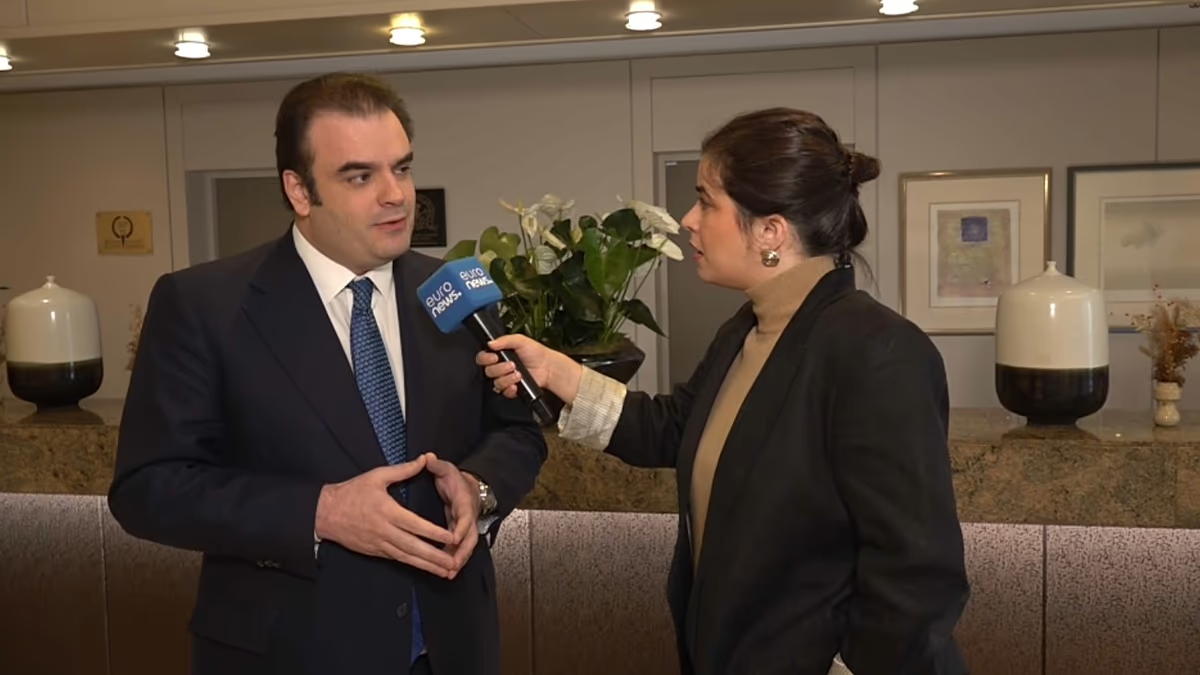




The transatlantic economic relationship, a cornerstone of the global order, stands at another precarious juncture. A hard-won trade agreement between the European Union and the United States is on the cusp of final ratification, yet its future is shadowed by the potential resurgence of a decades-old feud. Bernd Lange, a German Member of the European Parliament who chairs its influential trade committee, has sounded a clear public warning. The delicate implementation of the EU-US Turnberry Agreement, forged in July 2025 by Presidents Donald Trump and Ursula von der Leyen, could be jeopardized if tensions between aerospace titans Boeing and Airbus flare anew. With the European Parliament poised to approve the deal, the expiration of a critical five-year truce in the aircraft subsidy dispute on July 11th looms as an immediate threat. Lange’s concern, expressed to fellow lawmakers and journalists, is that a renewed trade war in the skies could strain broader ties, undermining the fragile stability the Turnberry deal aims to provide.
This anxiety is rooted in a conflict with a long and destructive history. The battle between Boeing and Airbus is not a minor commercial squabble but a two-decade-long saga fought through the World Trade Organization. It began with the United States accusing the European Union of providing illegal subsidies to Airbus, a charge Brussels swiftly reciprocated regarding U.S. support for Boeing. What started as a legal dispute escalated into a full-blown tariff war, with both sides imposing punitive duties on a wide range of everyday products—from French wine and Scottish whisky to American tobacco and cheese. This conflict ultimately ensnared over $11.5 billion in transatlantic trade, hurting businesses and consumers on both sides of the Atlantic. A temporary peace was brokered in 2021, suspending these damaging tariffs for five years, but that ceasefire is now set to lapse without a clear commitment to renewal from either Washington or Brussels.
The timing of this uncertainty could not be more sensitive. The Turnberry Agreement itself represents a painstaking effort to rebuild trust and establish predictable trade rules after a period of significant turbulence. A key pillar of the deal is a mutual pledge to cap tariffs, with the U.S. agreeing not to levy average duties on EU goods above 15%. In exchange, the EU committed to eliminating its own tariffs on American products. European lawmakers, wary of past U.S. tariff actions, fought to embed safeguards into the agreement to protect this ceiling. However, the inherent fragility of this bargain is already being tested. Just last week, the Trump administration threatened to impose new 10% tariffs on EU goods over forced labour concerns. Such a move, layered on top of existing duties, could push average U.S. tariffs beyond the agreed 15% limit, directly challenging the core compromise of the Turnberry deal.
This pattern of using tariffs as a tool of geopolitical leverage, rather than purely trade policy, is a central source of European apprehension. President Trump has repeatedly wielded the threat of tariffs in response to non-trade disputes, from pressuring Europe over the acquisition of Greenland to threatening car tariffs after criticism of U.S. foreign policy. This approach creates a climate of perpetual uncertainty for businesses and diplomats alike. Against this backdrop, the dormant Airbus-Boeing dispute represents a potent catalyst for renewed confrontation. The U.S. Trade Representative has explicitly stated it will decide in July whether to take action to enforce its WTO rights in the aircraft cases. A decision to reimpose billions in tariffs on European goods would not only restart a damaging sectoral conflict but would also provide a powerful pretext for unraveling the broader Turnberry Agreement, as the U.S. could claim the EU had failed to uphold its side of the aerospace truce.
For his part, Bernd Lange embodies the pragmatic hope that cooler heads will prevail. Publicly stating, “I hope this will not blow up,” he underscores a desire to protect the economic stability that the Turnberry deal promises. European Commission officials echo this cautious stance, confirming that discussions with the U.S. are ongoing to “ensure stability and certainty.” The goal is a simple extension of the suspension of countermeasures, a technical step that would prevent an immediate crisis. However, in the current geopolitical climate, even technical steps are fraught with political significance. The coming weeks represent a critical stress test for the transatlantic partnership. Will the shared interest in maintaining a stable trade framework outweigh the political impulses for confrontation and the unresolved grievances of a twenty-year feud?
Ultimately, the fate of the broader EU-US trade relationship may hinge on the resolution of this single, longstanding dispute. The Airbus-Boeing conflict is a microcosm of the challenges facing multilateral trade: disputes over state support, claims of unfair competition, and the temptation to use punitive tariffs as a first resort. Its potential resurgence threatens to act as a lit fuse, igniting tensions that could consume the painstakingly constructed Turnberry Agreement. As European lawmakers prepare to cast their votes, they do so with an eye not just on the text of the deal before them, but on the calendar and the ominous deadline of July 11th. The coming month will reveal whether the transatlantic partnership can secure a lasting peace, or if it is destined to remain trapped in a cycle of truces and tariff wars, where hard-won agreements remain perpetually vulnerable to the disputes of the past.