

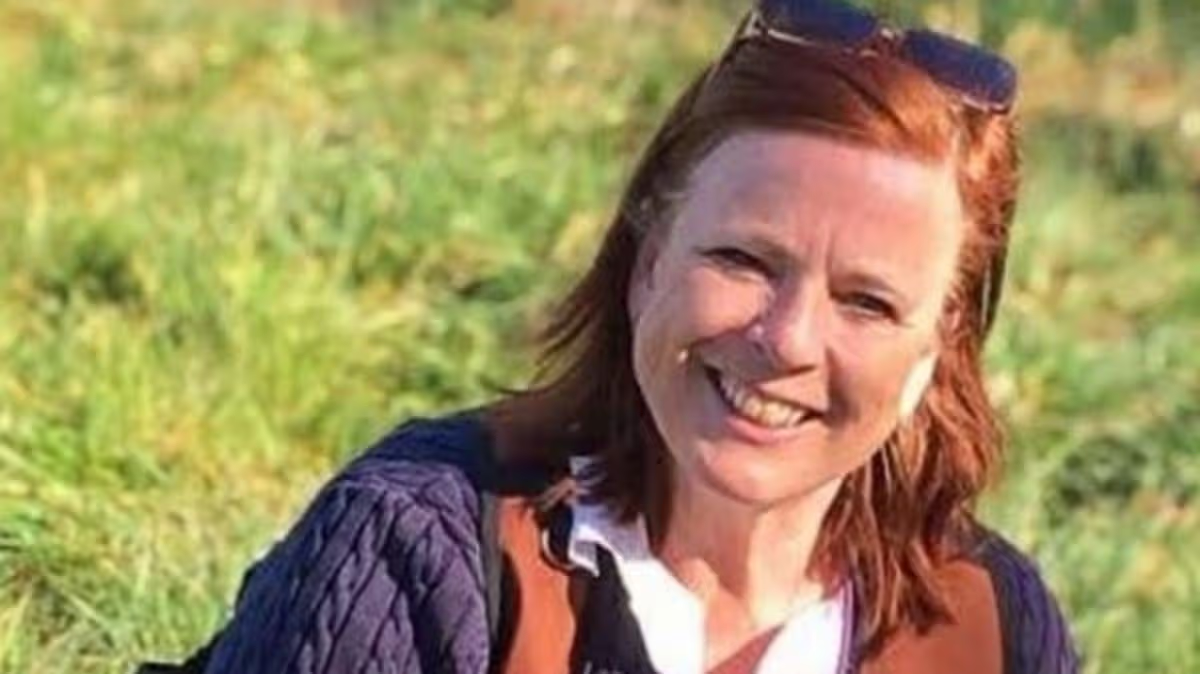
The tragic death of Rachel Chapman-Emms, a 53-year-old legal assistant and mother-of-three, reveals a complex interplay of personal struggle and systemic oversights, culminating in a sudden and devastating loss. Rachel, described by her family as a responsible and forward-looking woman, was found at her home in Pulham Market, Norfolk, in July of last year after she failed to arrive at her job at Leathes Prior Solicitors in Norwich. Her parents, Diana and Michael Emms, made the heartbreaking discovery. While Rachel had a history of depression, for which she was prescribed fluoxetine (Prozac), she had shown recent signs of improvement and was actively making plans for the future, including excitement over a recent promotion and the potential pregnancy of one of her beloved golden retrievers. Her family remains steadfast in their belief that her act was not premeditated, but a catastrophic impulse born of a momentary crisis. As her sister, Joanna Emms, poignantly stated, “There is no way Rachel planned this… Something just snapped in her that morning and the gun was there.”
A critical element in this tragedy was the presence of a legally-owned shotgun, used for Rachel’s hobby of clay pigeon shooting, a passion she shared with her father. While she had properly obtained her shotgun certificate in early 2023, a dangerous disconnect existed between her medical and licensing records. Her general practitioner was unaware she possessed a firearm, a fact confirmed during the inquest at Norfolk Coroner’s Court. The doctor testified that, had he known, he would have advised her to remove the gun from her home and alerted police, given her treatment for depression. This ignorance stemmed from a procedural failure: though her GP practice was consulted during the licensing application and noted it as “pending,” that marker was never updated to “approved” on her medical records, remaining outdated for over three years until her death.
This administrative failure underscores a potentially life-saving gap in communication protocols. Rachel’s family strongly believes that had any professional—her GP or the police—initiated a conversation with her about the intersection of her mental health treatment and firearm ownership, the outcome could have been different. Joanna Emms emphasized her sister’s responsible nature, stating, “She was a responsible gun owner and I have no doubt that had she been asked about it, or told to remove it… then she would have done so.” The family’s anguish is compounded by the belief that Rachel herself was unaware of a known, though rare, side effect of her medication: increased suicidal ideation. They are convinced that had she known this, she would have proactively secured the weapon.
Coroner Johanna Thompson concluded that Rachel died by suicide. The inquest heard that Rachel had experienced a dip in mood following a short-term relationship ending, but she had consistently denied any thoughts of self-harm to her doctors and loved ones. In the days leading up to her death, she appeared to be improving, making the event all the more shocking. This pattern highlights the often unpredictable nature of a mental health crisis, where a fleeting moment of profound despair can overwhelm even a person who is outwardly managing and making future plans. For Rachel, in that instant of acute crisis, a lethal means was tragically accessible.
In the wake of their loss, Rachel’s family has become advocates for reform to prevent similar tragedies. They endorse calls for tighter integration between medical practices and firearms licensing authorities, ensuring that when a person being treated for conditions like depression holds a firearm license, it is actively flagged and reviewed by their doctor. This would facilitate the crucial, potentially life-saving conversations that never happened for Rachel. Joanna Emms stresses that this is not about vilifying a lawful hobby but about introducing prudent safeguards: “Lessons must be learned. We have to live wondering if the outcome could have been different.”
Rachel Chapman-Emms is remembered not as a statistic, but as a cherished daughter, sister, mother, a dedicated professional who had just earned a promotion, and a passionate animal lover. Her story is a sobering reminder of the imperative to bridge informational silos in systems designed to protect public health and safety. It also underscores the importance of open dialogue about medication side effects and secure storage during periods of treatment. While nothing can undo this family’s pain, their hope is that by sharing Rachel’s story, they might spur changes that protect others, ensuring that in a moment of crisis, a readily available lethal means is not the deciding factor between life and death.