

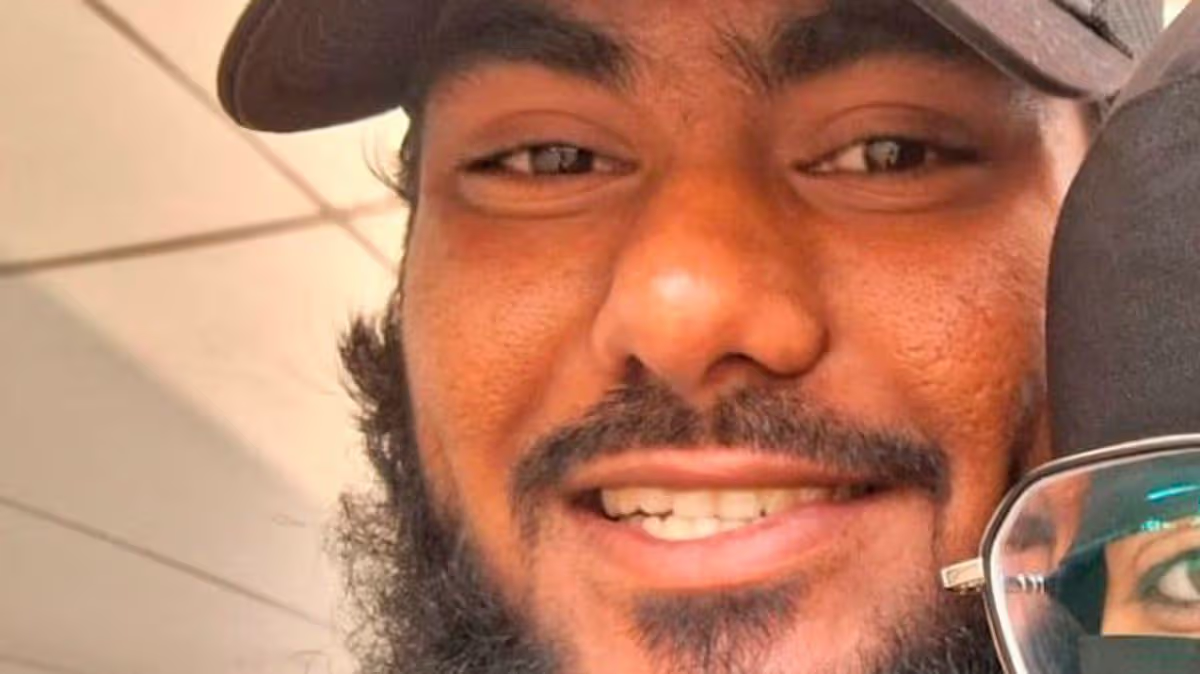
Faizan Rafik was beaming. In a photograph taken just hours before he boarded Air India flight 171 in Ahmedabad, India, the 25-year-old from Leicester stands next to his wife, his face alight with the simple joy of a journey nearly complete. He was on his way home to the UK after a visit, his future vividly mapped out in his mind. He had recently passed his driving test and eagerly spoke of buying his first car upon his return. More profoundly, he was on the cusp of qualifying as a religious scholar, with plans to bring his wife, also a scholar, to Leicester. Together, they dreamed of guiding their community’s youth, of offering an anchor in a world they saw as increasingly turbulent. This image of hope and potential makes the horrific truth that followed all the more devastating. On June 12 of last year, the London-bound plane plummeted into a medical college building less than a minute after takeoff. Faizan, along with 258 others on the aircraft and 19 souls on the ground, lost his life in what became the deadliest aviation disaster in a decade. Only one passenger miraculously survived.
For Faizan’s cousin, Sameer Rafik, 27, the loss has carved a permanent emptiness. The two were more like brothers, their lives woven together by daily rituals in Leicester. Sameer had been the one to drive Faizan to Gatwick Airport for his fateful trip ten days prior, a journey filled with shared dreams and casual conversation. “He hugged me—and if I knew that was his last hug I would never have let him go,” Sameer recalls, his voice thick with emotion. He now mourns the absence of those everyday sounds: the impatient ringing of his doorbell that announced Faizan’s arrival, the familiar sight of him walking past Sameer’s shop. In the year since the crash, the silence has been deafening. “Life is completely empty without Faizan,” Sameer confides. “We don’t have peace in our lives anymore. He always kept a smile on his face. I have never seen a brother like him.”
In his grief, Sameer has sought small consolations, finding a poignant one in the arrangement of Faizan’s final resting place. He recently travelled to the family’s hometown of Diu in Gujarat, India, to visit the grave. There, Faizan lies beside his mother, who had passed away when he was a child. For Sameer, this proximity is a tender, heartbreaking mercy. “He was lucky enough to get a space right next to his mum. They were close. It’s very special,” he says. This physical reunion of mother and son offers a sliver of solace, a sense of completed circle amidst the brutal suddenness of Faizan’s departure. It is a quiet corner of the world where love, rather than tragedy, feels like the prevailing truth.
Determined to channel his anguish into purpose, Sameer has embarked on a mission to honour Faizan’s legacy by embodying the compassion his cousin planned to dedicate his life to. He is in the process of launching a charity in Faizan’s name, currently self-funding donations to causes that reflect his cousin’s spirit. This includes contributing to care packages for families in Gaza, funding the construction of wells in an impoverished region of Pakistan, and offering support to vulnerable members of his own community in Leicester. “Doing this work, I feel like Faizan is still with me—not physically, but emotionally,” Sameer explains. “No one can bring him back, so maybe by doing this he might get some reward, and I will remember my brother.” On the anniversary of the crash, he plans to spend the day helping others, a direct tribute to the life of service Faizan was about to begin.
However, the path of mourning has been strewn with additional pain due to a profound sense of institutional abandonment. Sameer feels bitterly let down by what he perceives as a lack of support and transparency from Air India and both the Indian and UK governments. “Faizan was a taxpayer in this country, but nobody came to our property to support us when this happened,” he states. “It makes you feel like you’re just a piece of paper to them.” This sentiment is echoed in the experiences of many other grieving families. US attorney Mike Andrews, who represents over 100 families affected by the crash, describes a process of being “stonewalled” and “victimised” all over again. Families have faced obstacles in obtaining basic information, a bureaucratic ordeal that compounds their trauma. “Grief is not linear,” Andrews notes. “Every day is a new day of grief in some way. It is very much an emotional rollercoaster for these families trying to pick up the pieces while they’re still looking for answers.”
Those answers remain officially elusive as the first anniversary arrives. International regulations stipulate that investigators should aim to provide a final report within a year, or at least issue a substantive update. The world, and most urgently the families, still await a definitive explanation for why the aircraft fell from the sky. Mike Andrews, working tirelessly on the case, is convinced the cause was a technical failure—an electrical or systems issue—rather than any pilot action. For Sameer Rafik and hundreds of others, closure is a distant prospect. Their grief now exists in two parallel realms: the deeply personal act of remembering a beloved smile, a shared dream, a final hug; and the frustrating, public battle for accountability and truth. Faizan Rafik’s life was one of luminous potential, cruelly cut short. His memory now lives on in the flowers on his grave, in the water flowing from a well built in his name, and in a cousin’s relentless pursuit of both kindness and justice.