



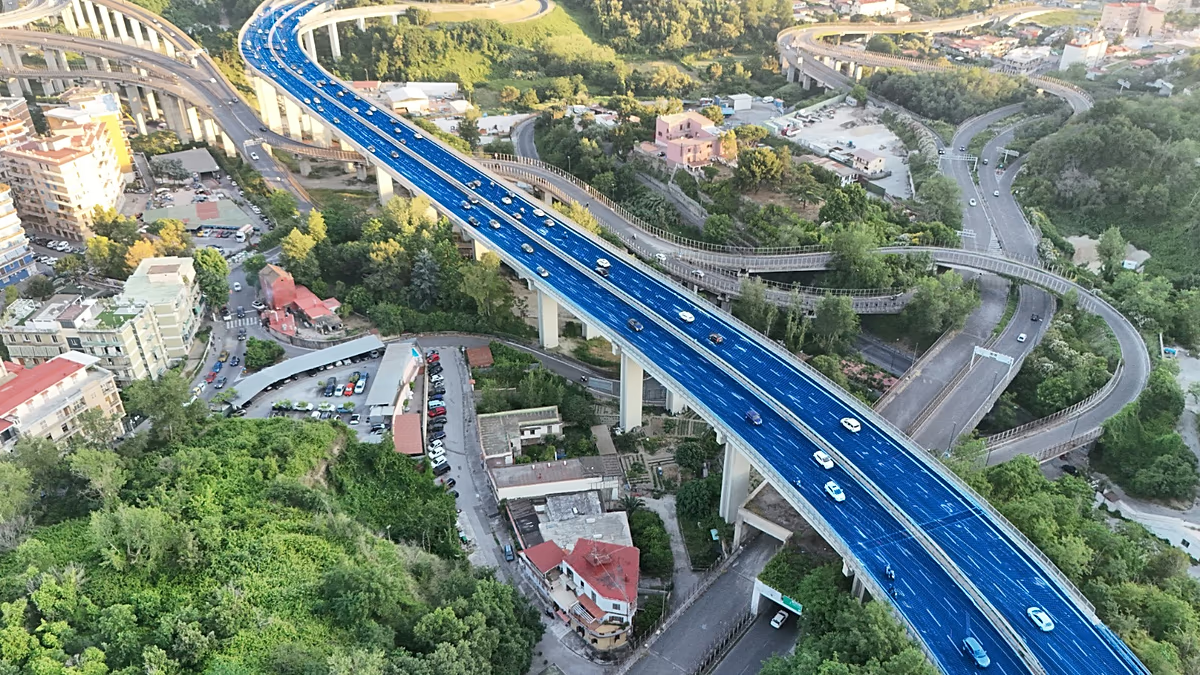
Italy has taken a significant leap into the future of transportation, and the starting point for this national revolution is the bustling city of Naples. The Tangenziale di Napoli, a vital 22-kilometer urban ring road, has officially become the country’s first government-certified “Smart Road.” This landmark designation, awarded by the Ministry of Infrastructure and Transport, is far more than a ceremonial title. It formally recognizes the highway’s transformation into a living, communicating digital ecosystem. By integrating advanced sensors, real-time data analytics, and direct communication links with vehicles, this project turns a key southern Italian artery into a national blueprint for how infrastructure can enhance safety, efficiency, and sustainability. This milestone is a collaborative triumph, born from the partnership between the road’s operator (part of the Autostrade per l’Italia Group), the Ministry, the National Centre for Sustainable Mobility, and Movyon, the group’s technology hub. Their shared vision was to create an infrastructure capable of not just carrying traffic, but intelligently managing it by collecting, processing, and sharing critical information the moment it’s generated.
To earn the prestigious Smart Road certification, the Tangenziale di Napoli had to meet three stringent technological pillars defined by national regulations. The first is intelligent traffic monitoring. A network of sensors deployed along the entire route provides a constant stream of data on vehicle flow, density, and speed. This information is fed into advanced traffic models, empowering control room operators with a powerful decision-support tool. Instead of merely reacting to emergencies, they can now identify growing congestion or potential bottlenecks and intervene proactively. This predictive approach aims to smooth traffic waves, reduce overall congestion, and prevent minor issues from escalating into full-blown crises, making every journey more reliable.
The second pillar addresses environmental safety through real-time weather and hydrogeological monitoring. Italy’s diverse terrain and climate make this a critical concern. The smart highway is equipped with specialized weather stations and sensors that constantly track rainfall intensity, road surface conditions (like ice or water buildup), and even water levels in surrounding areas. The system is programmed to recognize patterns that indicate rising risks, such as potential flooding or landslides. When safety thresholds are exceeded, it instantly alerts operators, enabling swift preventative actions like variable speed limits or lane closures. This transforms the road from a passive piece of pavement into an active guardian against natural hazards.
The third, and perhaps most revolutionary, pillar is seamless communication between the infrastructure and vehicles. This is achieved through Vehicle-to-Infrastructure (V2I) technology. For drivers in connected cars, the road itself becomes an informative co-pilot. It can broadcast direct alerts to the dashboard about accidents ahead, active roadworks, unexpected obstacles, slippery conditions, or adverse weather. It can even suggest an optimal speed to harmonize traffic flow and prevent tailbacks. Conversely, vehicles can transmit data back to the infrastructure—like precise location and speed—creating a rich, immediate, and incredibly detailed picture of live traffic conditions. This two-way dialogue allows for truly proactive management, where the system can anticipate and mitigate problems before drivers even encounter them.
The physical scale of this digital transformation is impressive. Along the 22-kilometer span, engineers have installed a dense web of hardware that forms the project’s central nervous system. This includes 217 smart cameras, 15 traffic-detection gantries, 8 advanced weather stations, and 40 communication antennas using both dedicated short-range (ITS-G5) and cellular (Cellular V2X) technology. All the data harvested by this array converges on Movyon’s central C-ITS platform. Here, information from the road is fused with external sources to maintain a continuous, holistic monitor of the traffic environment. This system can pinpoint individual vehicles, track their speed and direction, and use that intelligence to provide targeted warnings to drivers, thereby elevating both safety and the overall quality of the travel experience.
The project is already moving from theory to practical application, most notably in the testing of autonomous vehicles. On a segment between the Vomero and Fuorigrotta districts, a groundbreaking Italian trial took place where a self-driving vehicle successfully adjusted its speed in real time based solely on instructions received from the road infrastructure. Currently, 30 connected vehicles are operating on the Tangenziale, constantly exchanging data with the network. The system is actively warning these drivers of dangers like stationary vehicles, sudden weather changes, or roadworks, while suggesting the best speed to maintain fluid traffic. As Arrigo Giana, CEO of Autostrade per l’Italia, stated, this achievement is a pivotal result that positions the group as a trailblazer. The Tangenziale di Napoli is no longer just a road; it is a dynamic testing ground where the synergies of technology and collaboration are paving the way for the sustainable, intelligent, and safe mobility of Italy’s future.