



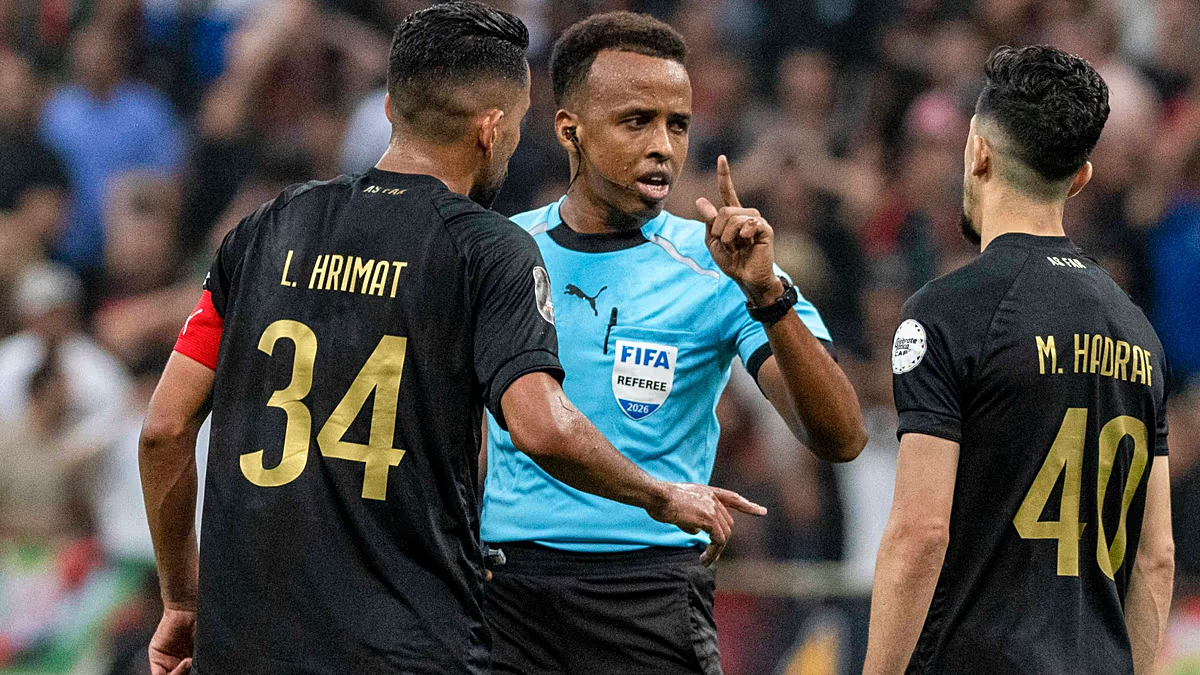
In a powerful testament to resilience and the unifying spirit of sport, Somali football referee Omar Artan has been appointed to officiate one of European football’s most prestigious matches, just weeks after a deeply disappointing and very public setback. Artan, who was controversially denied entry to the United States for this summer’s FIFA World Cup, will now take charge of the UEFA Super Cup final on August 12th in Salzburg, Austria. The match will see the champions of Europe, Paris Saint-Germain, face Aston Villa, the winners of the Europa League. This appointment, announced by UEFA after consultation with the African football confederation (CAF), is not merely a routine assignment but a profound statement of support and recognition for Artan’s skill and character, effectively redirecting a narrative of rejection into one of celebrated triumph.
The background to this moment makes UEFA’s decision all the more significant. Omar Artan, the reigning CAF Men’s Referee of the Year for 2025 and regarded as one of the world’s elite officials, had been living his professional dream. He was en route to officiate at his first-ever World Cup, a pinnacle for any referee, when that dream was abruptly halted at Miami International Airport. U.S. border authorities detained him for eleven hours of questioning before declaring him “inadmissible due to vetting concerns” and placing him in a holding cell. Despite holding what he described as the “right papers” and the “right visa,” Artan was ultimately flown to Istanbul, his World Cup journey over before it began. In a heartfelt interview, he expressed his devastation, stating simply, “I’m just a referee who’s trying to live his dream, the biggest dream of my life.”
Yet, what followed was a remarkable display of global football solidarity and personal dignity. Upon his forced return to Mogadishu, Artan was met not with pity, but with a hero’s welcome. A swarm of fans, supporters, and photographers greeted him at the airport, celebrating not a failure, but a compatriot who had reached the world stage. This homecoming signaled that his achievement in becoming a World Cup-level referee was not diminished by the bureaucratic ordeal he endured. The incident sparked international headlines and conversations about fairness and the barriers faced by individuals from certain nations, even those with impeccable professional credentials. Artan handled the situation with public grace, focusing on his love for the game rather than voicing bitterness.
Recognizing both the injustice and the opportunity to make a stand, European football’s governing body, UEFA, acted decisively. By appointing Artan to the high-profile Super Cup final, UEFA President Aleksander Čeferin sent a clear message. He praised Artan as an “excellent young but already experienced referee,” and directly linked the appointment to the earlier incident, stating, “Football is made to connect people, and UEFA wants to show its respect to Omar and his outstanding officiating skills.” This move transcends a simple consolation prize; it is a deliberate act of sporting diplomacy. It affirms that merit and excellence, as recognized by CAF’s highest honor, are the true currencies of the global game, and it positions UEFA as an institution willing to champion those values in a tangible way.
The symbolism of this story extends far beyond the touchline. For Somalia, a nation often associated in global media with conflict and instability, Artan’s journey is a point of immense national pride. He represents a different narrative—one of professionalism, excellence, and positive global engagement. His success on the international stage, now capped by a major European final, serves as an inspiration. Furthermore, his experience highlights the often-arbitrary hurdles that can stand between talented individuals from certain regions and their global aspirations, prompting necessary reflection within international systems that govern travel and participation.
As the football world now turns its eyes to Salzburg in August, the focus will rightly be on the players of PSG and Aston Villa battling for a season-opening trophy. But in the center of that pitch, controlling the flow of the game, will be a figure embodying a far richer story. Omar Artan’s whistle will start the match, but his presence will speak to themes of perseverance, the redress of disappointment through recognition, and the power of sport to offer a form of justice and connection that transcends borders. His path from a holding cell in Miami to a hero’s welcome in Mogadishu and now to a European final is a compelling human drama, reminding us that while dreams can be deferred, determination and solidarity can help rebuild them on an even grander stage.