




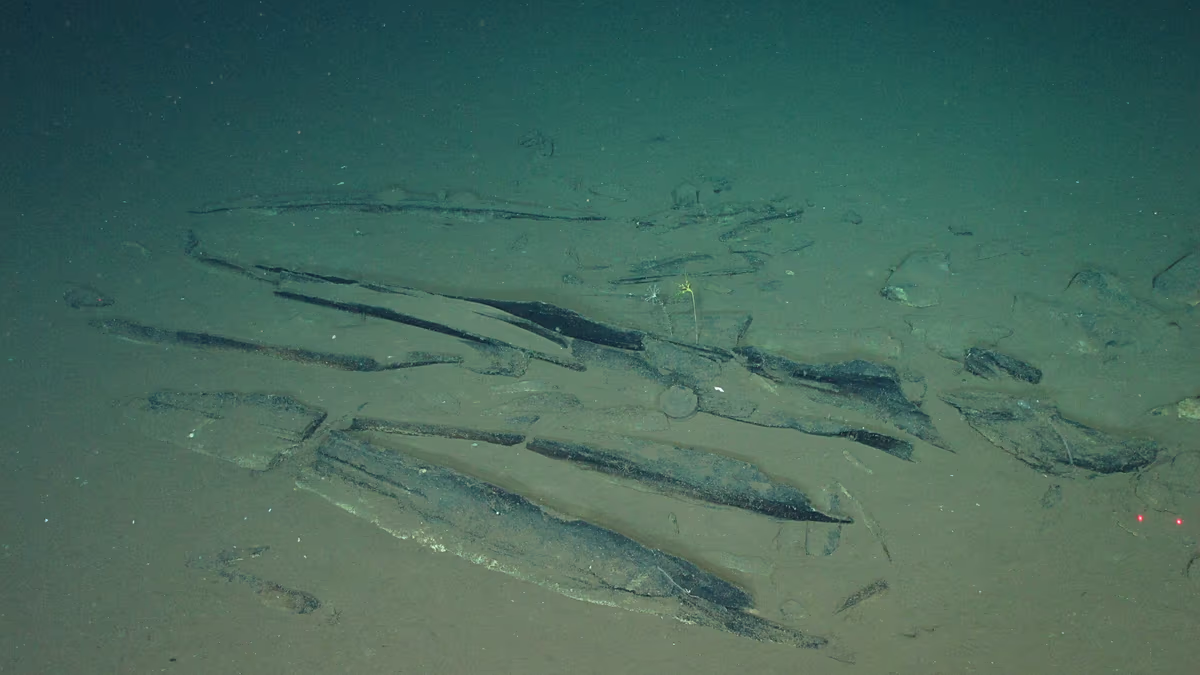
Deep in the silent, sunless world of the ocean’s abyss, a profound and ancient secret has been unearthed. Scientists, piloting submersibles through the crushing darkness seven kilometers beneath the Indian Ocean’s surface, have discovered a breathtaking whale graveyard of unparalleled scale. This site, believed to be the deepest, oldest, and largest of its kind, is not a morbid scene of decay but a vibrant, thriving metropolis of life. The remains of beaked and baleen whales, some dating back an astonishing 5.3 million years, rest on the seabed, having become the foundation for a remarkable ecosystem that challenges our understanding of survival in Earth’s most extreme environments. This hidden necropolis transforms our perception of the deep sea from a barren void into a realm of sustained, cyclical life, where death fuels existence over geological timescales.
The graveyard’s inhabitants form a complex community sustained entirely by the monumental gift of the whale falls. As these colossal carcasses sank through the water column millennia ago, they delivered a sudden, rich bounty of nutrients to a world starved of conventional food sources. Today, researchers have documented a bustling assemblage of creatures—from delicate jellyfish and spindly brittle stars to hearty sea cucumbers and specialized squat lobsters—all flourishing on and around the skeletal remains. Perhaps most intriguing are the numerous species, including unique tubeworms and saltwater clams, that may be entirely new to science. This ecosystem persists for centuries, as biologist Xikun Song notes, thanks to the whales’ enormous size and the unique, oil-rich chemistry of their bones, which provide a slow-release feast that can sustain generations of deep-sea life.
What makes this discovery even more extraordinary is the pristine preservation of the bones themselves, surviving millions of years in an environment where most organic matter is quickly recycled. The study suggests a perfect confluence of protective factors: the bones are so dense they resist consumption by bone-devouring worms, their profound depth shelters them from being buried by sediment, and a thin, mineral coating from the seawater has acted as a natural preservative. This exceptional conservation offers palaeontologists a window into the distant past. As Stephen Godfrey, a palaeontologist not involved in the study, observed, “The potential number of specimens is just astounding.” Each skeleton is a time capsule, holding clues about ancient whale species, their biology, and the historical conditions of the deep ocean that we have only begun to decipher.
A compelling mystery remains: why did so many whales congregate in this final resting place? Researchers propose several poetic possibilities. This region may have been a fertile feeding ground where whales naturally lived and died over eons. Others may have succumbed to the physical toll of their deep-diving lifestyles, falling exhausted or ill to the seabed below. The local geography itself might have served as a gentle funnel; the V-shaped contours of the seafloor could have passively channeled descending carcasses into this common gathering place across millions of years. Unraveling this mystery is more than an academic pursuit—it helps us understand population dynamics, migration pathways, and even ancient causes of whale mortality, painting a fuller picture of life in the prehistoric oceans.
Beyond its palaeontological significance, the graveyard is a living laboratory demonstrating extreme biological resilience. Studying these communities, as co-author Giovanni Bianucci explains, is crucial for understanding adaptation to conditions devoid of light and oxygen and under pressures a thousand times greater than at sea level. The organisms here have evolved sophisticated symbioses and metabolic tricks to harvest energy from chemicals seeping from the bones, a process akin to life supported at hydrothermal vents. This discovery underscores that biodiversity thrives in the planet’s most remote recesses, fundamentally altering our perception of where life can persist. It suggests that similar ecosystems could exist on other ocean worlds in our solar system, where lightless, high-pressure environments are the norm.
Ultimately, this deep-sea graveyard is a powerful testament to the interconnectedness and continuity of life. It reveals a hidden cycle where the end of one majestic life form sparks the beginning of countless others, sustaining a fragile web of existence in perpetual darkness. The findings champion the importance of exploring and protecting our deep oceans, reminding us that vast, unknown wildernesses still exist on our own planet, holding stories of survival, history, and resilience. As we look to the stars for signs of life, discoveries like this humble and inspire us, proving that even in the most unforgiving corners of Earth, life not only endures but flourishes with breathtaking ingenuity.