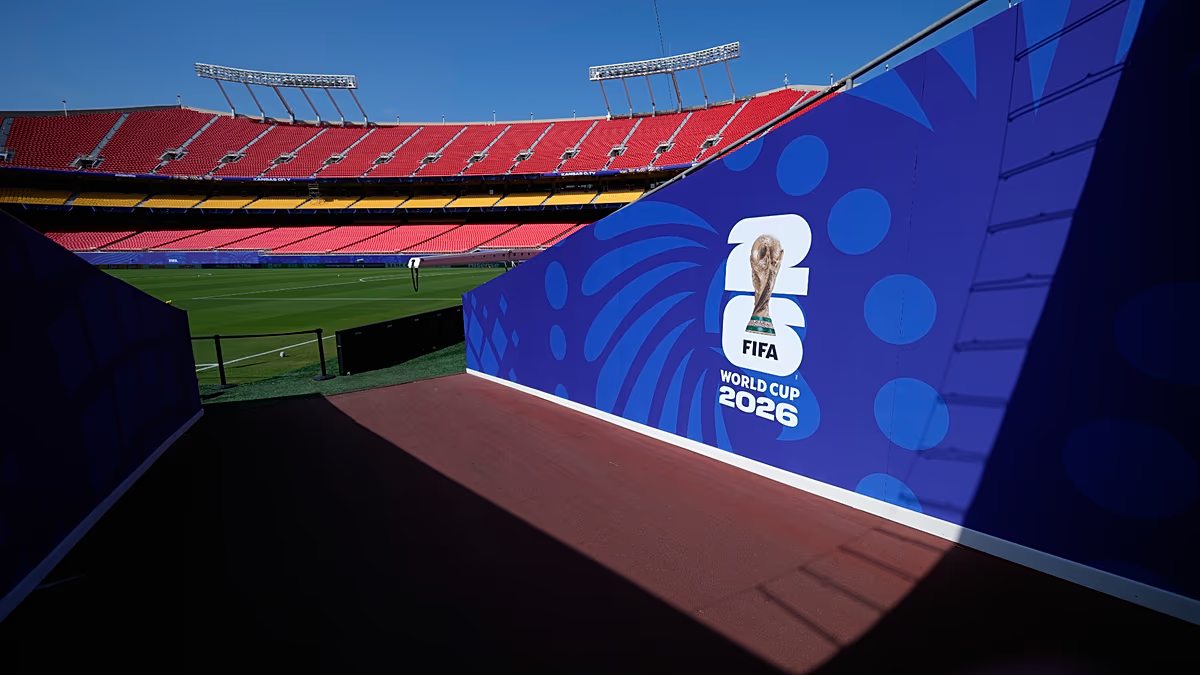





As the football world turns its gaze toward the unprecedented 48-team FIFA World Cup, jointly hosted by the United States, Canada, and Mexico, the ritual of prediction is in full swing. Amidst the fervent speculation from pundits and fans alike, one voice claims a particular authority: the supercomputer. The Opta Analyst, leveraging its vast sports statistics database, has run 25,000 simulations of the tournament, producing a data-driven forecast that both confirms conventional wisdom and offers intriguing nuances. According to this digital oracle, the path to glory is most likely to run through Spain, with La Roja emerging as the statistical favorite to lift the trophy.
Delving into the numbers, Spain’s projected dominance is clear. The supercomputer assigns them a 16.1% chance of winning outright, the highest of any nation. Their journey is painted in probable steps: a 75.3% likelihood of winning their group, a near-certain (98.5%) chance of advancing to the knockout stages, and a greater-than-even (52.1%) probability of reaching the quarter-finals. From there, they are given a 39% shot at the semis, a 25.6% chance at the final, and that culminating 16.1% to win it all. This paints a picture of a team deemed consistently formidable and resilient, expected to navigate the tournament’s expanded format with assured composure. They are followed closely by footballing powerhouses France (13%), England (11.2%), and the defending champions, Argentina (10.4%), each commanding a double-digit percentage chance and embodying the relentless pursuit of football’s ultimate prize.
This leads to the supercomputer’s most striking, if perhaps unsurprising, revelation: history heavily favors history. When the probabilities for all former world champions are tallied—Spain, France, England, Argentina, Brazil (6.6%), Germany (5.1%), and even Uruguay (1.7%)—they command a combined 64.1% chance of victory. This starkly contrasts with the collective 35.9% chance shared among the 41 teams who have never won the tournament. It underscores a perceived gulf in tournament pedigree and big-stage mentality, suggesting that while the field is larger, the summit may still be reserved for the traditional elite. Yet, within that 35.9% lies the tantalizing hope for nations like Portugal (7%), the Netherlands (3.6%), and others dreaming of a historic breakthrough.
Beyond the favorites, the data sketches a broader landscape of ambition and realism. Teams like Belgium, Colombia, and the ever-resilient Croatia are given a puncher’s chance, ranging from 1.6% to 2.4%. The analysis is also blunt about the longest of long shots, assigning a literal 0% chance of victory to five nations: DR Congo, Qatar, Cape Verde, Haiti, and Curaçao. The hosts receive varied fortunes: the United States (1.2%) and Mexico (1%) sit respectably within the top 20, while Canada, perhaps surprisingly, is given the same 0.5% chance as Austria, a figure that still bests nations like Sweden and the Czech Republic. These numbers are not declarations of destiny but a quantification of the immense challenge facing these squads.
The human element, of course, remains gloriously unpredictable, as echoed by legends who have lived the tournament. France’s Robert Pirès expressed faith in his nation’s “great squad” and the managerial acumen of Didier Deschamps, emphasizing the intangible necessities of “sacrifice, discipline, [and] respect.” Italy’s Marco Materazzi pointed to Argentina’s champion status but wisely cautioned about the threat posed by “very good and tough” sides like Portugal and Spain, and the potential for a surprise from a team like Morocco. Their insights remind us that while data models collective strength, tournaments are won in moments of individual brilliance, tactical mastery, and unshakeable team spirit—variables no computer can fully capture.
Ultimately, Opta’s supercomputer provides a fascinating, probability-based framework for understanding the 2026 World Cup. It anoints Spain as the front-runner, reinforces the enduring might of football’s traditional powers, and maps the steep climb awaiting the chasing pack. Yet, the beauty of the beautiful game lies in its defiance of logic. A 0% probability does not mean a 0% possibility. Over 25,000 simulations, the numbers will trend toward the likely, but on the green pitches of North America, only one narrative will unfold—a story of passion, pressure, and unparalleled drama where any prediction, digital or human, awaits its glorious confirmation or its most thrilling rebuttal.