


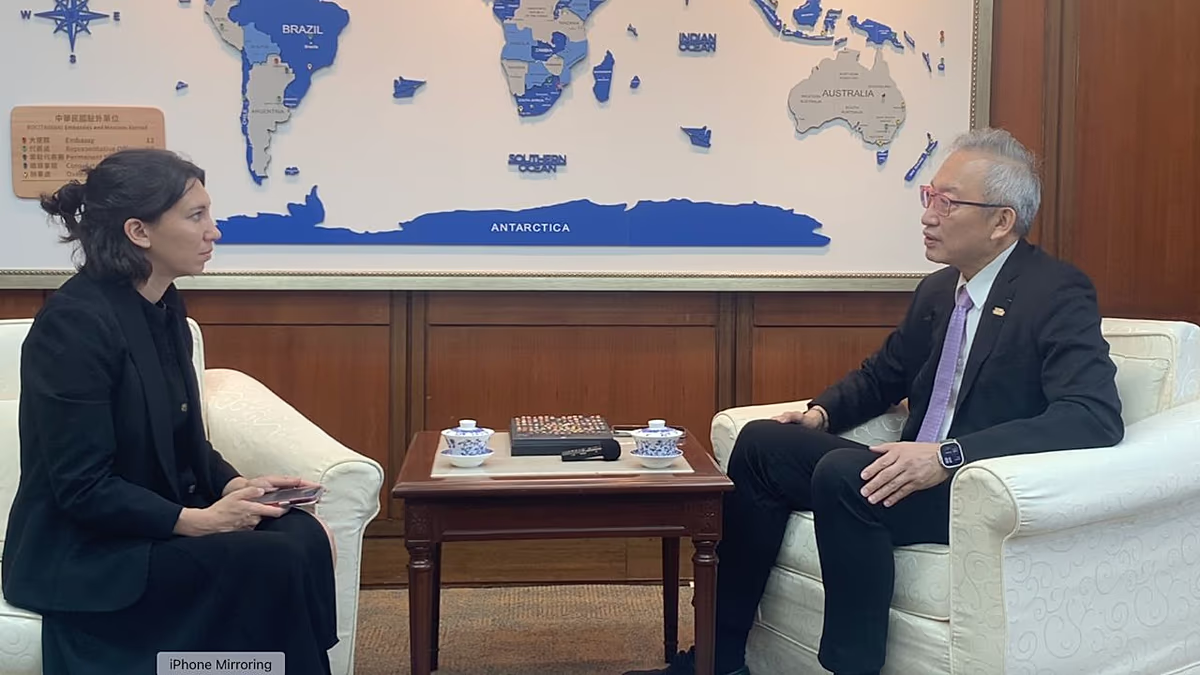
The serene stability of the Pacific Rim is a cornerstone of global security and prosperity, yet one of its most critical pillars rests on a foundation of enduring tension. For many in Europe, Taiwan may seem a distant geopolitical concern, but as Deputy Foreign Minister François Chih-chung Wu articulates, the ramifications of a Chinese takeover would resonate far beyond its shores, sending profound shockwaves from Washington to Tokyo and across the European continent. He presents a stark warning: “If China attacks Taiwan, France, Europe, the United States, and Japan will all be affected. Taiwan will be in a terrible situation — but so will you.” This statement reframes the Taiwan Strait not as a remote Asian waterway, but as a central nervous system of the modern world. The dispute stems from the unresolved conclusion of the Chinese civil war in 1949, with Beijing maintaining its claim over the island and never renouncing the use of force, while Taiwan functions as a self-governing entity officially known as the Republic of China. Minister Wu challenges the simplicity of China’s historical narrative, pointing to the island’s complex past under Dutch, Spanish, Qing, and Japanese rule, arguing that brief periods of administrative control do not equate to an unbroken sovereign claim. This contested history sits at the heart of a modern dilemma with global implications.
The scale of those implications becomes clear when examining Taiwan’s irreplaceable role in the global technology ecosystem. The island is not merely a manufacturing hub; it is the beating heart of the digital age. Through a company like the Taiwan Semiconductor Manufacturing Company (TSMC), over 90% of the world’s most advanced semiconductors are produced. These microscopic chips, vital for everything from artificial intelligence and smartphones to military systems, form what has been termed a “silicon shield.” As Nvidia’s CEO recently noted, Taiwan is the “epicentre of the AI revolution.” This dominance is not easily replicated; it is the result of decades of accumulated expertise in precision engineering. Minister Wu highlights the astonishing density of this innovation: “In one square centimetre of semiconductor, the size of a fingertip… the Taiwanese are able to fit more than 10 billion chips. That is our know-how.” This technological sovereignty provides Taiwan with a form of defensive leverage, as its capabilities are woven into the economic and security infrastructures of democracies worldwide, creating a profound mutual dependency.
This interdependence extends powerfully into the realm of global commerce and European industry. The Taiwan Strait is one of the world’s busiest maritime corridors, with an estimated volume of container traffic dwarfing that of the Suez and Panama Canals combined. A blockade or conflict would instantly cripple supply chains on a planetary scale. Furthermore, as Minister Wu explains, Taiwan’s silicon shield is itself a pan-European creation: the advanced photolithography machines come from the Netherlands, the precision optics from Germany’s Zeiss, the industrial gases from France’s Air Liquide, and chip design tools from Belgium. “All of Europe is inside that one square centimetre of silicon,” he observes. This synergy is active and growing, evidenced by partnerships like that between Taiwan’s Foxconn and France’s Thales. Therefore, stability in the Strait is not an Asian concern alone; it is, as Wu frames it, a “global responsibility.” European nations have vital Indo-Pacific interests, and protecting them necessitates engagement with Taiwan, not out of historical obligation, but out of contemporary strategic and economic necessity.
It is precisely this growing web of international partnerships and Taiwan’s flourishing democratic prosperity that, in Minister Wu’s analysis, intensifies Beijing’s anxiety. The perception that Taiwan is being permanently lost to the democratic world fuels what he describes as a relentless campaign of pressure, rooted in a mindset of “once Chinese, always Chinese.” Despite this seven-decade-long threat, Taiwan has not only survived but thrived, its stock market now ranking among the world’s largest. “Fear, in a way, is not a bad thing,” Wu reflects. “Because we are afraid, we prepare.” This resilience is central to Taiwan’s story. He notes that even high-level diplomacy between the US and China does not fundamentally alter the reality of American support or Taiwan’s determination. The challenge, however, lies in navigating a world that often, in striving for neutrality, inadvertently tilts in China’s favor due to its sheer economic and political weight.
Building equitable connections under these asymmetrical pressures is Taiwan’s constant diplomatic struggle, especially in Europe. China exerts immense effort to block Taiwan’s international participation, making normal dialogue a significant challenge. “A country as important as Taiwan should normally have the opportunity to discuss all important issues with you in a normal way, but we cannot do that,” Wu concedes. Yet, through human ingenuity and low-profile engagement, avenues for cooperation persist and even expand. Crucially, Minister Wu clarifies Taiwan’s position: it is not seeking a formal declaration of independence, nor is it comparable to Hong Kong, as it maintains its own democratic government, army, and independent foreign policy. The goal is to sustain a delicate balance—vigorously defending its democracy without provocation, and fostering relationships that acknowledge its substantive, if not always formally recognized, sovereignty.
Ultimately, the appeal from Taiwan to Europe is not a call to arms, but a call to friendship. Minister Wu employs a poignant analogy: “When you get married, you do not ask your spouse whether they are prepared to die for you. You build a relationship. You work together. And a natural force grows from that.” This is the foundation he seeks—a relationship built on shared values, mutual interest, and respect for the vibrant, resilient society Taiwan has built. It is a relationship that recognizes the island not as a abstract geopolitical flashpoint, but as a critical contributor to global stability, innovation, and democratic life. The Taiwanese story is still being written, a narrative of perseverance in the face of immense pressure, and its next chapters will undoubtedly be shaped by the depth and sincerity of the connections it forges with partners around the world, including in Europe.