




Of course. Here is a humanized and expanded summary of the incident, crafted into six paragraphs as requested.
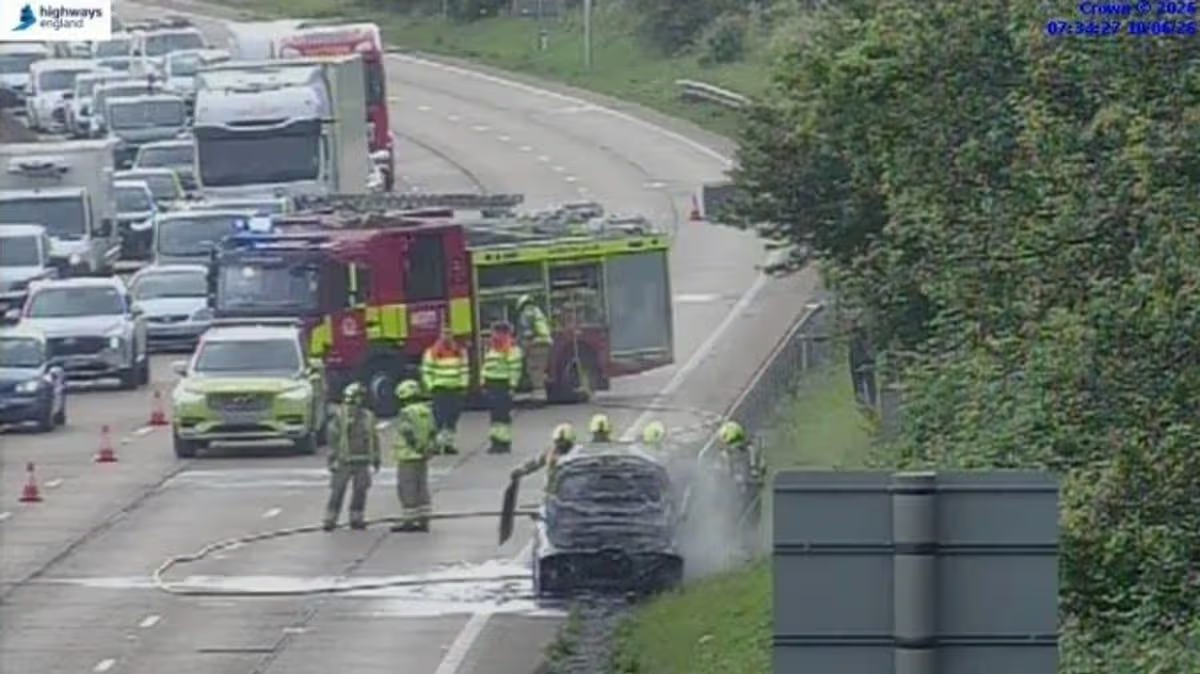
The familiar, relentless hum of the M25, London’s orbital motorway and a vital artery for countless journeys, was abruptly shattered on a stretch running anticlockwise between the junctions for Enfield and Potters Bar. What began as a routine commute or delivery run transformed in an instant into a scene of danger and disruption. A vehicle, the specific type unknown but carrying within it the potential for calamity, had succumbed to fire. Flames and acrid, black smoke would have erupted, forcing the driver to a desperate halt on the hard shoulder, or worse, in a live lane. This sudden eruption of chaos on a road where speeds are high and attention is divided created an immediate and severe threat to all in the vicinity, turning a piece of critical infrastructure into a potential trap.
In response to this emergency, the protocols designed for such crises swung into action. A spokesperson for National Highways, the government company responsible for England’s motorways, provided the crucial, if clinical, confirmation: “On the M25 anticlockwise between J25 (Enfield) and J24 (PottersBar) traffic has been held due to a vehicle fire.” The term “held” is the operational jargon for a full, deliberate stop of all traffic. This is not a simple slowdown; it is a protective barrier created with vehicles themselves, a frozen river of metal imposed upstream of the incident to create a sterile safety zone for the responders and to prevent a catastrophic chain-reaction collision.
The most urgent figures on the scene were undoubtedly the crews of the fire service, who the spokesperson confirmed were in attendance. Their arrival signalled the shift from crisis management to active resolution. These firefighters would have approached the burning vehicle with trained caution, aware of the risks of exploding tyres, hazardous fluids, or, in a worst-case scenario, a loaded goods vehicle. Their primary goals were twofold: first, to ensure any occupants had escaped and were receiving medical attention if needed, and second, to aggressively attack and extinguish the blaze before it could cause structural damage to the road surface or spread to other vehicles caught in the held traffic.
While the fire service battled the physical flames, the consequences of the incident began rippling outward, measured in the cold metrics of modern travel. The National Highways spokesperson quantified the knock-on effect: “There are delays of 30 minutes and 4 miles of congestion on the approach.” This brief sentence encapsulates a significant amount of frustration and logistical strain. Four miles of stationary and slow-moving traffic represents thousands of individuals—truck drivers facing missed deadlines, families embarking on holidays, commuters heading home after a long day—all suddenly and involuntarily paused. The 30-minute delay is an estimate, a best-case scenario that relies on a swift resolution, but for those trapped in the queue, each passing minute would have felt elongated by uncertainty.
The human impact of such an event stretches far beyond the immediate safety of those involved in the fire. Each red brake light in that four-mile tailback tells a story of inconvenience and anxiety. Appointments will be missed, childcare pick-ups will be late, and precious hours of rest or leisure will be eroded. For professional drivers, this isn’t just an inconvenience; it’s a direct blow to their livelihood and compliance with tightly regulated driving hours. The incident also serves as a stark, unwelcome reminder of our collective vulnerability on the road. It underscores how the complex system of modern travel, for all its efficiency, is fragile—dependent on the mechanical reliability of every single vehicle sharing the tarmac and on the swift, professional response of emergency services when that reliability fails.
Finally, as the last of the smoke clears and the burnt-out vehicle is towed away, the process of recovery begins. The “held” traffic would be released slowly, often guided by police or traffic officers, as the congested river gradually begins to flow again. The 30-minute delay will start to shrink, but the congestion will take time to fully dissolve, often lingering long after the incident site is clear. For the travelers, the journey resumes, but with a story to tell. For the authorities, the reports are filed, and the motorway returns to its normal state of busy purpose, the only evidence of the drama being perhaps a patch of scorched tarmac—a temporary scar on the road, and a lasting memory for those caught up in the unexpected halt on their journey around the capital.