



In Belfast, a city still healing from decades of conflict, a single act of violence has opened deep societal wounds, igniting a volatile and dangerous situation. The victim of a horrific knife attack on Monday evening has been identified by his local community as Stephen Ogilvie, a man in his forties. As of Tuesday, he remains in a serious condition in hospital, suffering from significant injuries to his face, neck, and back. The attack, which unfolded on Kinnaird Avenue in north Belfast, was captured in harrowing footage that circulated widely online, showing bystanders bravely intervening—one even wielding a hurling stick—to restrain the assailant as he continued his assault. A kitchen knife was recovered at the scene. While the immediate physical trauma is borne by Mr. Ogilvie, the psychological and communal impact of the incident is now rippling across Northern Ireland, exposing simmering tensions.
In the aftermath, police swiftly arrested and charged a 30-year-old man with attempted murder, possession of a bladed article, and making threats to kill. The suspect, a Sudanese national, is scheduled to appear before Belfast Magistrates’ Court. Authorities have provided details of his immigration status, noting he entered Northern Ireland via the Irish border in February 2023 after flying to Dublin from Paris. He lodged an asylum claim upon arrival and was formally granted leave to remain in the UK until 2028 the following September. Crucially, detectives have stated there is no indication that the attack was terror-related. Nevertheless, the specific details of the suspect’s background have become a focal point in a city already grappling with complex social and political fractures, overshadowing the human tragedy of the victim and the bravery of those who came to his aid.
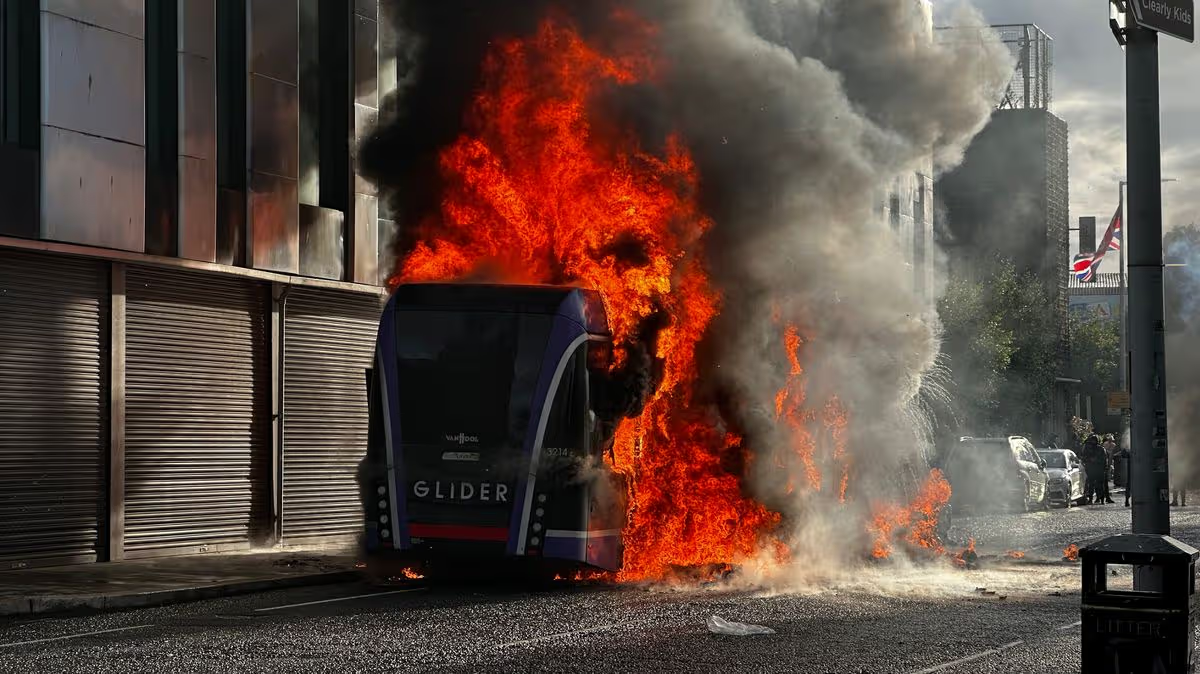
The attack has acted as a catalyst, triggering large-scale and often violent anti-immigration protests across Belfast. What began as public outrage over a violent crime has been channelled into targeted civil unrest. Protesters have filled the streets, with images showing masked individuals setting vehicles and properties ablaze, including on Lendrick Street near the Newtownards Road. The violence has extended to attempts to intimidate and drive out migrant families from their homes, creating an atmosphere of fear and hostility. These actions represent a dangerous escalation, moving from protest to what political leaders are describing as attempted mob rule, threatening the safety of entire communities and challenging the rule of law in a society still sensitive to sectarian conflict.
Confronted with this deteriorating situation, senior police officers and political leaders from across the spectrum have issued urgent calls for calm and restraint. Northern Ireland’s First Minister, Michelle O’Neill, took to social media to deliver a unequivocal condemnation, stating that “groups of masked men burning families out of their homes is nothing less than disgusting cowardice.” Her words underscore the gravity of the response, which has shifted from addressing the original criminal act to confronting a wave of orchestrated intimidation. The fear among authorities is that these protests, fueled by misinformation and pre-existing grievances, could spiral further into sustained sectarian or ethnic violence, undoing years of fragile peace-building efforts in a city all too familiar with conflict.
This crisis exposes a dangerous and simplistic conflation of two separate issues: a brutal, individual criminal act and the broader, politically charged topic of immigration and asylum. The attack on Stephen Ogilvie is first and foremost a grave crime, and the judicial process must be allowed to proceed without prejudice. However, the response has morphed into a widespread backlash against migrant communities as a whole, exploiting the incident to advance a particular agenda. This not only unjustly vilifies entire groups of people but also diverts attention from supporting the victim and understanding the specific circumstances of the case. It creates a binary, “us versus them” narrative that ignores the shared humanity and vulnerability of all residents, and the reality that criminality is not defined by nationality or immigration status.
The path forward for Belfast is fraught but clear. It requires unwavering leadership to de-escalate tensions and a firm commitment to justice on two fronts: for the victim of the stabbing and for the communities now under threat from retaliatory violence. Law enforcement must continue to protect all citizens equally and prosecute those responsible for both the initial attack and the subsequent riots and intimidation. Simultaneously, community and political leaders face the immense task of bridging divides, combating misinformation, and reaffirming the shared values of safety and respect for all. The bravery shown by the bystanders on Kinnaird Avenue—who stepped in to save a life without regard for identity—offers a powerful model. The hope for Belfast now lies in whether that spirit of direct, compassionate intervention can be scaled to guide the entire city away from the brink of further chaos and toward a resolution built on justice, not collective punishment.