


(Paragraph 1)
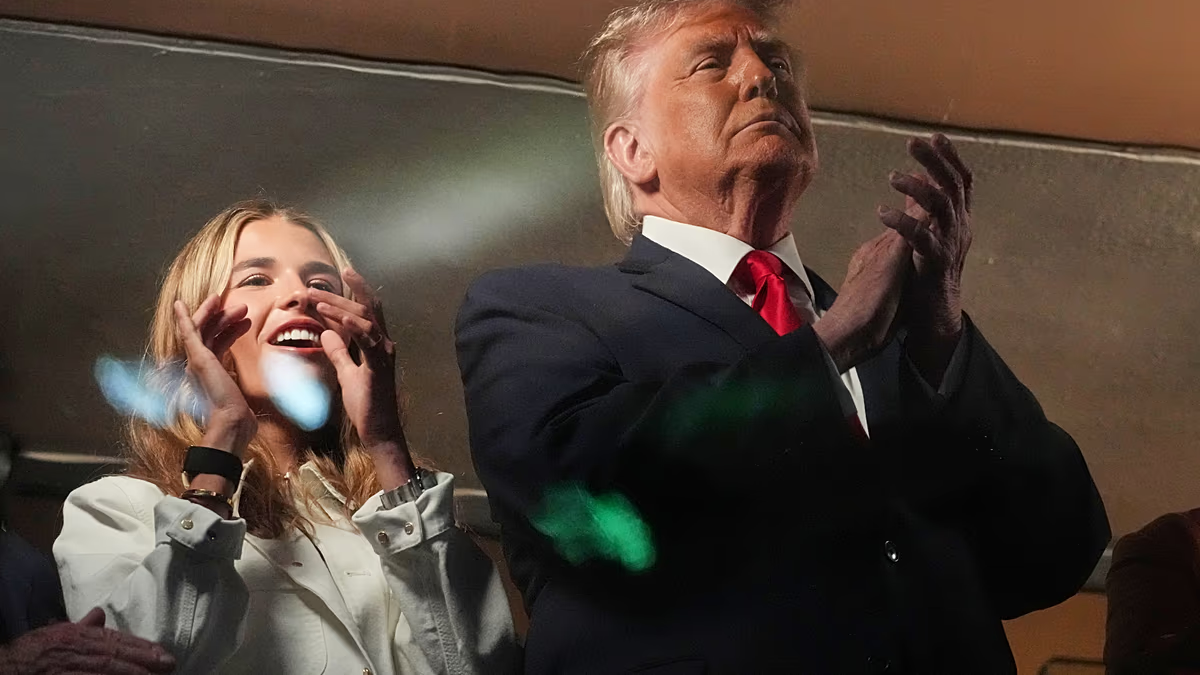
The NBA Finals, a showcase of peak athleticism and national unity, took an unexpected political turn during Game 3 at New York City’s iconic Madison Square Garden. On the evening of June 9, 2026, as the hometown Knicks prepared to face the San Antonio Spurs, the customary pre-game ritual of the national anthem became the backdrop for a moment of public discord. Into this arena of sporting passion walked former U.S. President Donald Trump, a figure whose presence has long polarized the American public. His arrival, coinciding with the solemn strains of “The Star-Spangled Banner,” was met not with uniform reverence but with a audible wave of boos that rippled through a significant portion of the crowd, weaving a thread of political tension into the very fabric of the night’s entertainment.
(Paragraph 2)
The reaction was a stark, real-time reflection of the deep cultural and political divisions that continue to define the American landscape. Madison Square Garden, located in the heart of a city that voted overwhelmingly against Trump in his previous elections, served as a microcosm of a nation grappling with its identity. For many in attendance, the boos were not merely about partisan politics but an expression of profound disagreement with his conduct in office, his rhetoric, and the lasting impact of his presidency on the nation’s social fabric. The moment transcended sports, becoming a spontaneous public referendum on a man who, regardless of one’s personal view, commands an unparalleled ability to attract both fervent loyalty and intense opposition.
(Paragraph 3)
Yet, to view the moment solely through a lens of division is to miss its more complex, almost contradictory, human element. The boos were notably interspersed with cheers, a reminder that the crowd itself was a mosaic of perspectives. Furthermore, the very act of the anthem proceeding—of everyone, critic and supporter alike, rising to their feet—highlighted a shared, albeit strained, civic tradition. In that brief, charged minute, the American experiment was laid bare: a diverse populace, fiercely disagreeing yet still participating in a common ritual, bound by the same symbols even as they contest their meaning. It was a messy, unscripted display of democratic expression, as authentic as any poll or pundit’s analysis.
(Paragraph 4)
The incident also speaks to the evolving, often uncomfortable, relationship between sports and politics in modern America. Arenas like Madison Square Garden are no longer neutral zones; they have become modern public squares where social issues are contested. From civil rights protests of the past to recent debates over national anthem demonstrations, athletes and audiences alike have used the platform of sports to make statements. Trump’s visit and the crowd’s reaction are part of this continuum, confirming that the basketball court, like the football field or the baseball diamond, is now an accepted arena for the nation’s ongoing political and cultural conversations, whether everyone is comfortable with it or not.
(Paragraph 5)
Beyond the immediate political reading, there’s a simpler, more universal story here about the expectation of a shared experience. Thousands of fans had gathered, investing not just money but emotional energy, for a night of escape and athletic drama. The sudden intrusion of a figure guaranteed to dominate the next day’s headlines disrupted that collective purpose. For some, it was an unwelcome distraction; for others, it became the night’s defining event. This tension between the desire for pure sporting celebration and the inescapable reality of a politicized world is a modern friction point, illustrating how difficult it has become to compartmentalize our lives into neat categories of entertainment and civic life.
(Paragraph 6)
Ultimately, the boos that echoed under the Garden’s famous rafters were more than just a reaction to one man. They were a raw, auditory snapshot of a country in a continuous, often noisy, conversation with itself. The moment was neither entirely heroic nor wholly disgraceful; it was simply human. It reflected the passions, the disagreements, and the enduring engagement of a citizenry that feels strongly about its leaders and its direction. As the final notes of the anthem faded and the game finally began, the basketball itself—a unifying language of skill and competition—resumed center stage. But the brief, discordant prologue served as a powerful reminder that in today’s America, even a moment dedicated to national unity can reveal the complex and unvarnished truths of a nation still figuring itself out.