



A Close Call in Siberia: Training Flight Ends in Emergency Landing
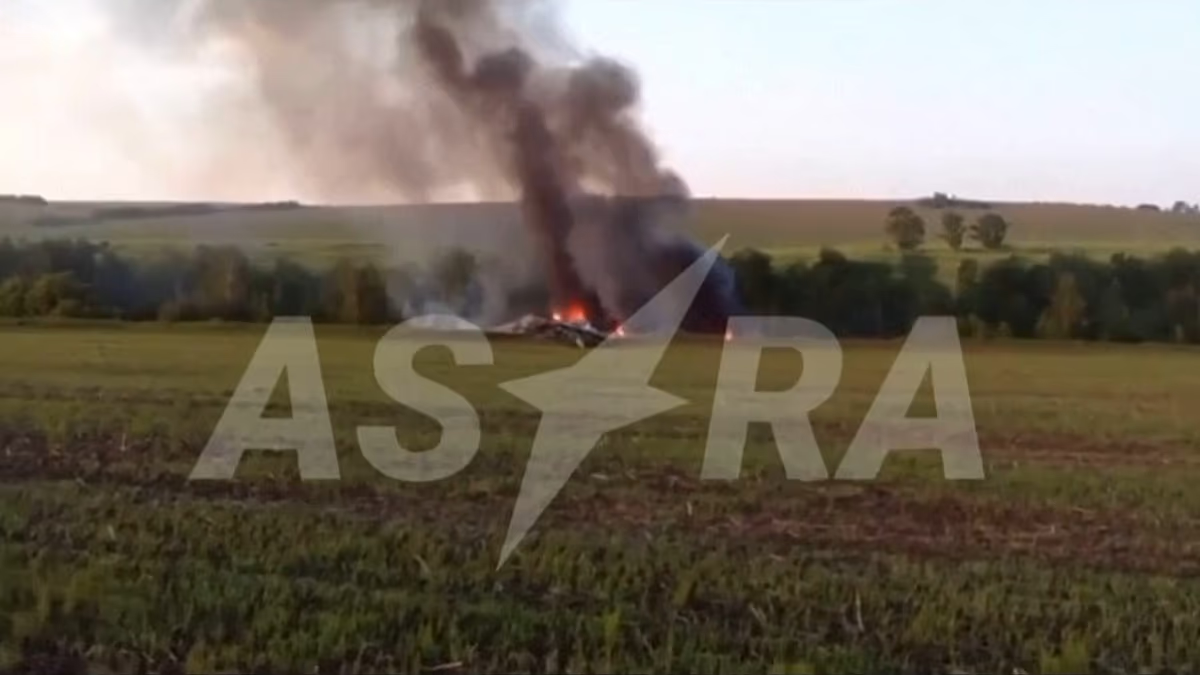
On a seemingly routine training day in the vast expanse of Siberia, a Russian Tu-22M3 strategic bomber, a formidable and iconic aircraft of the Cold War era, encountered catastrophic engine failure. The incident, occurring in the Irkutsk region—a remote area known for its harsh landscapes and sparse population—forced the highly trained crew into an immediate life-or-death decision. This was not a combat mission; the aircraft, as confirmed by the Russian Defence Ministry, was not carrying any live weapons. Its purpose was purely instructional, a testament to the continuous and demanding cycle of readiness that military aviation requires. The sudden mechanical betrayal of one of its powerful engines transformed a standard exercise into a desperate scramble for survival, highlighting the ever-present risks that aircrews accept as part of their duty, even far from any battlefield.
The Human Element: Ejection and Survival
In the critical moments following the engine failure, the crew’s extensive training took precedence. With their aircraft becoming an uncontrollable, multi-ton mass hurtling toward the earth, they initiated the ejection sequence—a violent but life-saving maneuver that propels crew members clear of the doomed plane. It is a procedure practiced countless times in simulators, yet nothing can fully replicate the brutal physics and sheer terror of the real event. Miraculously, and thanks to their skill and the equipment’s functionality, all crew members successfully ejected from the stricken bomber. They parachuted down into the Irkutsk terrain, where they were swiftly located. The immediate aftermath saw all four aviators transported to a medical facility for evaluation and care. The ministry’s terse statement, “the crew ejected safely,” belies the profound physical and psychological ordeal they endured, a harrowing experience that will undoubtedly leave a mark long after any minor injuries have healed.
The Machine: The Tu-22M3 “Backfire”
To understand the gravity of the event, one must consider the machine involved. The Tu-22M3, NATO reporting name “Backfire,” is not merely a plane; it is a symbol of aerial strategic power. Developed in the Soviet Union, this variable-sweep wing supersonic bomber was designed to penetrate enemy air defenses and deliver stand-off missiles. Its distinctive silhouette and formidable capabilities have made it a mainstay of Russian long-range aviation for decades. While modernized over the years, the airframe itself is aging, raising inevitable questions about maintenance cycles, parts availability, and the stresses inherent in keeping such complex legacy systems airworthy. An engine failure on an aircraft of this size and mission profile is a significant event, not just a minor mechanical hiccup. The loss of the aircraft itself represents a costly blow, both financially and in terms of operational capacity, even if, as in this case, it thankfully did not also mean the loss of life.
The Broader Context: Safety and Scrutiny
This incident does not occur in a vacuum. It enters a public consciousness already attentive to the state of Russia’s military aviation fleet, particularly following the strains of recent conflicts. Training flights are the bedrock of military proficiency, but they are statistically where many accidents happen, as crews push aircraft to their limits in simulated combat scenarios. An engine failure during such a flight prompts a rigorous investigative process. Specialists will pore over maintenance records, examine debris, and interview the crew to determine if the cause was a specific technical flaw, a maintenance oversight, or an unforeseen operational stress. For the military command, each such incident is a data point in an ongoing calculus of safety, readiness, and resource allocation. For the public, it is a stark reminder of the dangers servicemen and women face daily in peacetime, risks that are often overshadowed by headlines from active war zones.
The Weight of a “Safely” Landed Crew
The word “safely” in the official report carries immense weight. It means families will welcome their loved ones home. It means commanders will retain their experienced personnel. It means the crew will live to fly again, their invaluable expertise preserved. However, “safely” after an ejection is a relative term. Ejection seats are essentially controlled explosions that subject the human body to tremendous G-forces, often resulting in spinal compression, bruising, and other injuries. The psychological impact—the shock of the emergency, the violent exit, the parachute descent into uncertainty—can be profound, sometimes leading to conditions like post-traumatic stress. Their journey to full recovery, both physical and mental, is just beginning. Their safe ejection is the best possible outcome of a terrible situation, a victory of procedure and technology, but it is the start of a new chapter of convalescence and reflection, not merely a clean end to the story.
Reflection on Risk and Resilience
Ultimately, this event in the Irkutsk region is a narrative of both fragility and resilience. It underscores the fragility of even the most powerful machines and the thin margin between normalcy and disaster in high-stakes military aviation. Simultaneously, it highlights the resilience of the human spirit and body—the crew’s cool-headed response under extreme duress, the effectiveness of their survival training, and the rapid response of the rescue teams. As the investigation unfolds and the crew recovers, the crashed bomber will serve as a silent, metallic testament to a fundamental truth: in the profession of arms, the commitment to preparedness is a perpetual dance with danger. This training flight, ending in a snowy Siberian field rather than on a runway, reminds us that the price of readiness is paid not only in budgets and resources but in the unwavering courage of those who strap themselves into these magnificent, yet fallible, machines.