

The Unlikely Hero and a Nation’s Dream: Cape Verde’s World Cup Debut
In what will surely be remembered as one of the most charming and improbable stories in World Cup history, yesterday’s match between Spain and Cape Verde carved out a special place in football lore. The result itself—a gritty 0-0 draw—was astonishing enough, pitting the reigning European champions and tournament favorites against a tiny island nation of just half a million souls. Yet, the true magic of the game extended far beyond the scoreline, introducing the global audience to a team and a player whose journey to this stage defies every convention of modern football. It was a match that celebrated resilience, clever scouting, and the profound power of national identity, proving that on football’s greatest stage, heart and organization can rival even the most glittering of pedigrees.
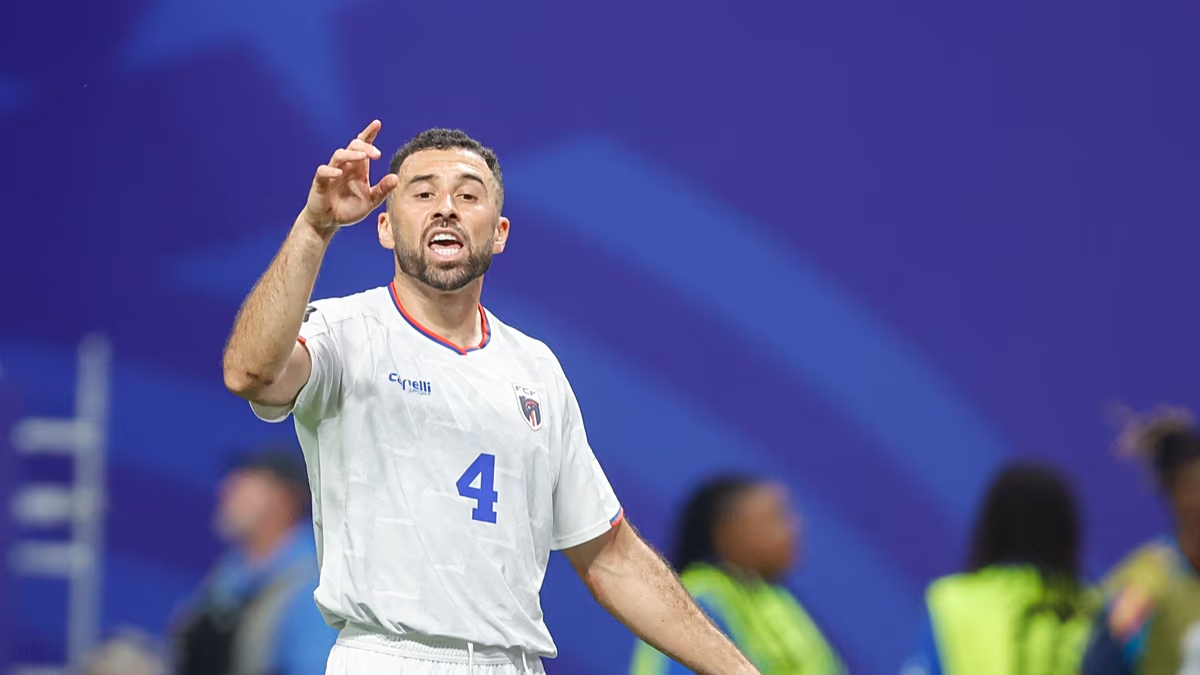
At the center of this fairy tale is a man whose name became instantly iconic: Roberto “Pico” Lopes. A 32-year-old central defender for Ireland’s Shamrock Rovers, Lopes embodies the globalized and digital age of the sport. Born in Ireland to an Irish mother and a Cape Verdean father, his path to the World Cup was anything but traditional. In a twist that seems almost too perfect for a movie script, his call-up to the national team arrived not via a scout’s visit or an agent’s call, but through a LinkedIn message in 2018. Initially dismissing the Portuguese-language message as spam, he ignored it. It was only nine months later, when the national team manager followed up in English, that Lopes realized the opportunity was genuine. Accepting the “offer,” he debuted for the Tubarões Azuis (Blue Sharks) in 2019 and yesterday found himself marshaling the defense in Cape Verde’s historic first-ever World Cup match, holding the mighty Spain at bay.
The historical significance of the game, however, is not solely due to Lopes’ remarkable recruitment story. Against all expectations, Cape Verde produced a masterclass in disciplined, respectful defending. Many anticipated a match defined by desperate, physical challenges to stop Spain’s fluid attackers. Instead, the islanders delivered what is statistically the cleanest defensive performance in World Cup history, committing only a single foul throughout the entire ninety minutes. This record-breaking feat highlights a tactical brilliance and composure that belied their underdog status. It was a display of pure defensive intelligence, proving their qualification was no fluke and earning them a heroic point against one of the world’s best teams.
Yet, for all the glory of the draw, the Blue Sharks’ journey is far from over, and their task remains monumental. They face a daunting week ahead with matches against Uruguay and Saudi Arabia. The question now is whether Lopes and his teammates can replicate this monumental effort and organization to navigate a path out of a fiercely competitive group. Their campaign is a testament to a long-term dream, captured by the team’s unifying motto: “10 islands, one nation, one dream.” This dream crystallized on October 13, 2025, when a 3-0 victory over Eswatini in Praia sealed their first World Cup qualification, prompting a national bank holiday. Few could have imagined that dream would grow even brighter on the world stage itself, challenging a nation ranked 64th by FIFA to believe in the impossible.
Understanding Cape Verde’s achievement requires a look at their unique national context. Since gaining independence from Portugal in 1973, the nation has built a modest economy supported by a massive diaspora spread across Europe and beyond. This reality has directly shaped its football identity. For years, the nation struggled to attract top-tier talent; players of Cape Verdean descent, such as Nani or Nelson Semedo, often chose to represent Portugal. This challenge sparked innovative thinking from the football federation. Turning to LinkedIn to recruit Roberto Lopes was not a gimmick but a necessity, a pragmatic embrace of their global community. Lopes proved to be a trailblazer; today, the national team is a mosaic of professionals scattered across clubs in Europe, the United States, the Middle East, and Africa, united by heritage and a shared purpose.
In the end, the story of Spain versus Cape Verde transcends a single match result. It is a celebration of how football connects identity across oceans, how technology can bridge gaps in untraditional ways, and how sheer tactical discipline can humble a giant. Roberto Lopes, the part-time LinkedIn recruit turned World Cup stalwart, symbolizes this new era. For Cape Verde, this tournament is already a victory, a validation of their “one dream” that has inspired not just their islands but football fans everywhere. As they prepare for their next challenges, they carry with them the knowledge that they have already made history, reminding us all that in football, the most compelling stories are often written by the most unexpected heroes.