

Here is a summary and humanization of the provided content, expanded to meet your request.
Paragraph 1
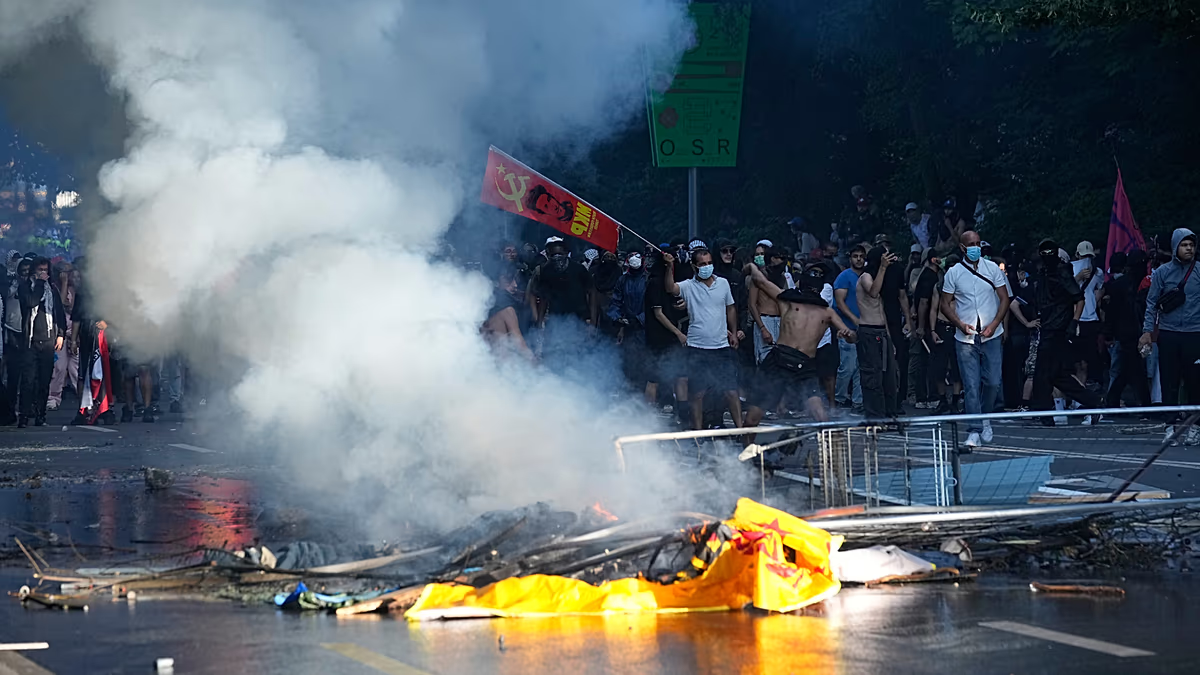
On Monday, near Los Angeles, the spectacle of Iran’s first match in the 2026 World Cup qualification cycle unfolded not just on the pitch, but powerfully in the streets and parking lots outside the stadium. The event became a vivid tableau of the profound tensions within the global Iranian community. As fans in the national team’s jerseys streamed toward the gates, their path was lined by dozens of demonstrators waving the pre-revolutionary Iranian flag—the iconic lion-and-sun banner—and chanting slogans calling for political change in Tehran. This created a striking, visible dichotomy: two distinct visions of Iran, embodied in two different flags, converging at a single sporting venue. The scene underscored how, for many, international football is never just a game when it involves nations with deep internal conflicts; the stadium becomes an arena where identity, memory, and politics are performed alongside athletic support.
Paragraph 2
The protests were a direct reflection of long-held grievances. Many demonstrators argued that the current Iranian national football team is inextricably linked to, and often used as a tool by, the country’s leadership. They see the team not as a pure representation of the Iranian people or their footballing passion, but as an entity co-opted by the state. This perspective has been reinforced by incidents in recent years where players have faced pressure from authorities, and where moments of silent protest by athletes on the field have resonated internationally. For these protesters, supporting the team under its current flag feels like an endorsement of a system they oppose. Their display of the pre-revolutionary flag was, therefore, a poignant act of symbolic resistance—a reclaiming of a historical emblem they associate with a different Iran, and a public insistence that the team belongs to the nation, not solely to its government.
Paragraph 3
Conversely, the fans heading into the stadium wearing the green, white, and red of the modern Iranian kit offered a different, though no less heartfelt, narrative. For many, their focus was deliberately on the athletes themselves—the players who had trained and sacrificed to represent their country on one of football’s biggest stages. They expressed a desire to separate the sport from the political arena, to create a space where national pride could be about collective achievement and shared passion for the game. “We are here for the players, not the politics,” was a common sentiment. This stance represents the universal struggle of sports fans in politically charged environments: the longing to cheer for one’s home team as a simple, joyous act of communal support, unburdened by the weight of geopolitical dissent.
Paragraph 4
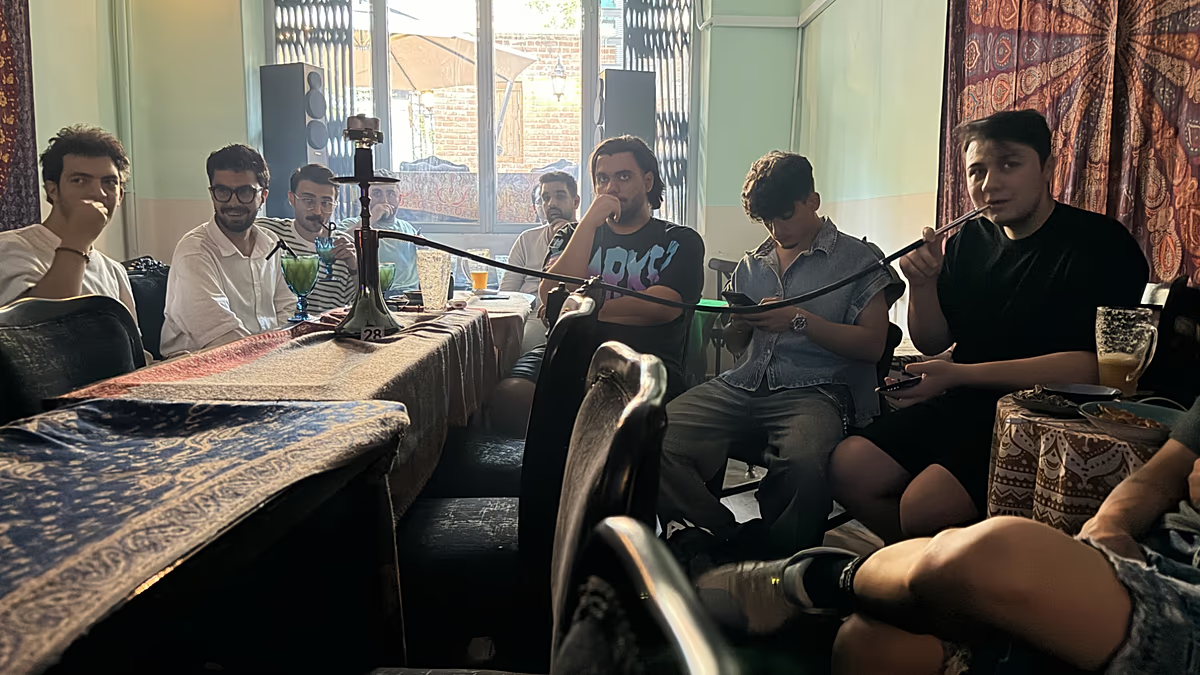
The location of this clash of symbols was particularly significant. Southern California, especially Los Angeles, hosts the largest Iranian diaspora community outside of Iran itself. This means the stadium was not just a neutral host site; it was a microcosm of the exile community’s own long-standing divisions. The diaspora is a tapestry woven from individuals with vastly different experiences, traumas, and hopes regarding their homeland. Some are fervent opponents of the current regime, while others maintain a more nuanced or ambivalent connection focused on culture and shared heritage. The World Cup match acted as a catalyst, pulling these diverse threads into a single, highly visible point. The event highlighted that for diasporic communities, international sports can serve as powerful, emotional focal points where internal debates about identity, loyalty, and the future are publicly enacted.
Paragraph 5
The drama was further intensified by a legal ruling just hours before kickoff. A judge upheld FIFA’s ban on the pre-revolutionary lion-and-sun flag inside World Cup venues themselves, citing the organization’s regulations on maintaining political neutrality within stadiums. This ruling attempted to draw a firm line between the external public space—where protest is generally protected—and the internal sporting arena—where FIFA seeks to keep the focus on football. However, the boundary proved porous. Despite the ban, reporters noted that some of the historic flags were still visibly carried into the spectator stands by attendees. This illustrated the difficulty of completely policing symbolism when it is charged with such deep personal and collective meaning. The flags inside became quiet acts of defiance, demonstrating that for their carriers, this emblem was not merely a political statement but a core part of their personal and national identity, inseparable from their support for the team.
Paragraph 6
Ultimately, the day near Los Angeles was a profound example of how modern international football transcends athletics. Iran’s match against New Zealand became a layered event: a contest of skill on the field, and a contest of narratives off it. It revealed the struggle within a diaspora to define what “Iran” means in a global context—is it the current state, the historical nation, the cultural heritage, or the collective of its people? The competing flags and chants were not just background noise; they were the central story for many, telling of unresolved history, ongoing pain, and divergent dreams for the future. While the players inside competed for a win and a path to the 2026 World Cup, their community outside, and among the spectators, was engaged in a deeper, more enduring competition over memory, representation, and the very soul of a nation. The final score of the football match was recorded, but the score of this symbolic match remains very much unsettled.