



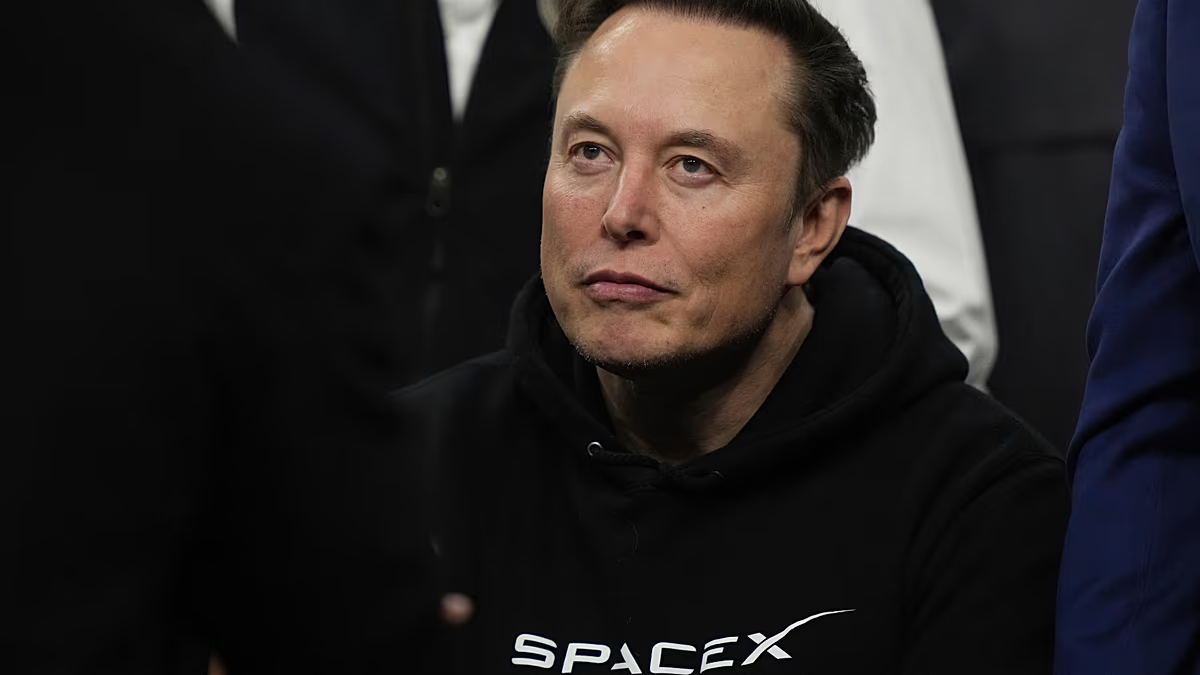
In a bold strategic expansion that signals a profound shift in its corporate identity, SpaceX, the pioneering rocket company founded by Elon Musk, has announced its most significant acquisition to date: a colossal $60 billion all-stock deal to purchase the artificial intelligence startup Anysphere, creator of the widely acclaimed Cursor AI coding assistant. The announcement, made just one week after SpaceX’s own blockbuster market listing, represents far more than a mere corporate transaction; it is a decisive move to plant the company’s flag firmly in the fertile and fiercely competitive terrain of enterprise artificial intelligence. By acquiring Anysphere, SpaceX is not merely adding a software tool to its portfolio; it is integrating a core technological capability aimed at automating and revolutionizing the very process of software creation, directly challenging established AI giants like OpenAI and Anthropic who have carved out early leads in the commercial sphere. This merger, structured through a SpaceX subsidiary merging into Anysphere to leave Cursor as a wholly owned unit, underscores Musk’s ambition to evolve SpaceX from a pure-play aerospace innovator into a multifaceted technology conglomerate with deep roots in both the physical and digital frontiers.
The staggering scale of this deal—valued at €51.7 billion—is a testament to the perceived value and explosive growth of Anysphere’s flagship product. Founded in 2022, Cursor has rapidly become an indispensable tool for developers, using advanced AI to understand, edit, and generate code, thereby automating substantial portions of the software development lifecycle. Its commercial traction has been remarkable, with the company reporting roughly $2.6 billion in annualized business-to-business revenue, a figure that undoubtedly made it a prime target for acquisition. The transaction follows a strategic option SpaceX secured back in April, which presented a clear fork in the road: either acquire Cursor outright for the full $60 billion or enter a more limited, $10 billion partnership for compute resources. SpaceX’s choice to pursue the full acquisition reveals a confident, long-term conviction in the symbiotic potential between AI-driven software development and its core engineering missions, suggesting that Cursor’s technology will be leveraged not just as a commercial product but as an internal accelerant for SpaceX’s own astronomically complex coding challenges.
This acquisition is also a pivotal chess move in the broader, high-stakes game being played among AI’s leading entities. Anysphere was not a blank slate; it had previously raised over $3 billion from heavyweight backers including the chipmaking titan Nvidia and, notably, OpenAI—SpaceX’s now-direct rival in the enterprise AI market. The purchase effectively transfers this valuable asset and its intellectual lineage into Musk’s ecosystem. Furthermore, it has profound implications for xAI, Musk’s separate chatbot venture, which was formally merged into SpaceX earlier this year. While xAI has made waves with its Grok chatbot, it has been perceived as trailing in the specialized domain of AI-assisted coding. The integration of Cursor’s sophisticated, developer-centric platform could instantly catapult xAI to a position of strength in this critical arena. Conversely, Cursor stands to gain immeasurably from the transaction through virtually limitless access to SpaceX’s (and by extension, xAI’s) computational infrastructure, a vital currency in the AI arms race where processing power is a key determinant of a model’s capability and speed.
From a financial markets perspective, the timing and structure of the deal are masterful. Coming hot on the heels of SpaceX’s own initial public offering, where shares debuted at $135, the announcement injected fresh momentum into the stock. In premarket trading following the news, SpaceX shares surged more than 4%, pushing past $200 and marking a roughly 50% increase from the IPO price. This investor enthusiasm highlights a powerful narrative: the market is rewarding SpaceX not just for its proven dominance in aerospace but for its aggressive and credible expansion into software’s most lucrative future markets. Analysts noted that if such gains held through the trading session, SpaceX was poised to overtake retail behemoth Amazon in terms of market capitalization, a symbolic milestone that would cement its status as one of the world’s most valuable and dynamic technology companies. The all-stock nature of the deal also preserves SpaceX’s cash reserves while aligning Anysphere’s founders and team with the long-term success of the combined entity.
Looking ahead, the practical integration roadmap is clear, with the merger expected to be finalized in the third quarter of this year, pending regulatory approvals. The real intrigue lies in how Cursor’s technology will be deployed. Within SpaceX, it promises to accelerate the development of flight software, simulation systems, and ground control operations, potentially shortening development cycles for Starship and other next-generation vehicles. Externally, Cursor will continue to serve its enterprise customers, but now with the formidable backing and resources of SpaceX, enabling it to scale its offerings and compete more aggressively for large corporate contracts. This dual-path strategy—using AI to fuel internal innovation while simultaneously capturing external market share—creates a powerful virtuous cycle. The vast, real-world engineering data generated by SpaceX’s operations could also be used to refine and train Cursor’s AI models on problems of unparalleled complexity, creating a product uniquely attuned to mission-critical software development.
In conclusion, SpaceX’s acquisition of Anysphere is far more than a headline-grabbing financial figure; it is a definitive statement about the future trajectory of one of the world’s most innovative companies. It marks the maturation of SpaceX from a revolutionary aerospace disruptor into a full-spectrum technology leader, blurring the lines between building machines that traverse the stars and crafting the intelligent code that guides them. By bringing Cursor into its fold, SpaceX gains a commanding toolset to dominate the enterprise AI software market, bolsters the competitive position of its xAI division, and equips itself with an internal catalyst for unprecedented engineering productivity. This $60 billion bet is ultimately on the belief that the next giant leap in human progress—whether in space exploration or terrestrial software—will be authored not just by human engineers, but by powerful, collaborative partnerships between human creativity and artificial intelligence, with SpaceX now positioned at the very nexus of both worlds.