


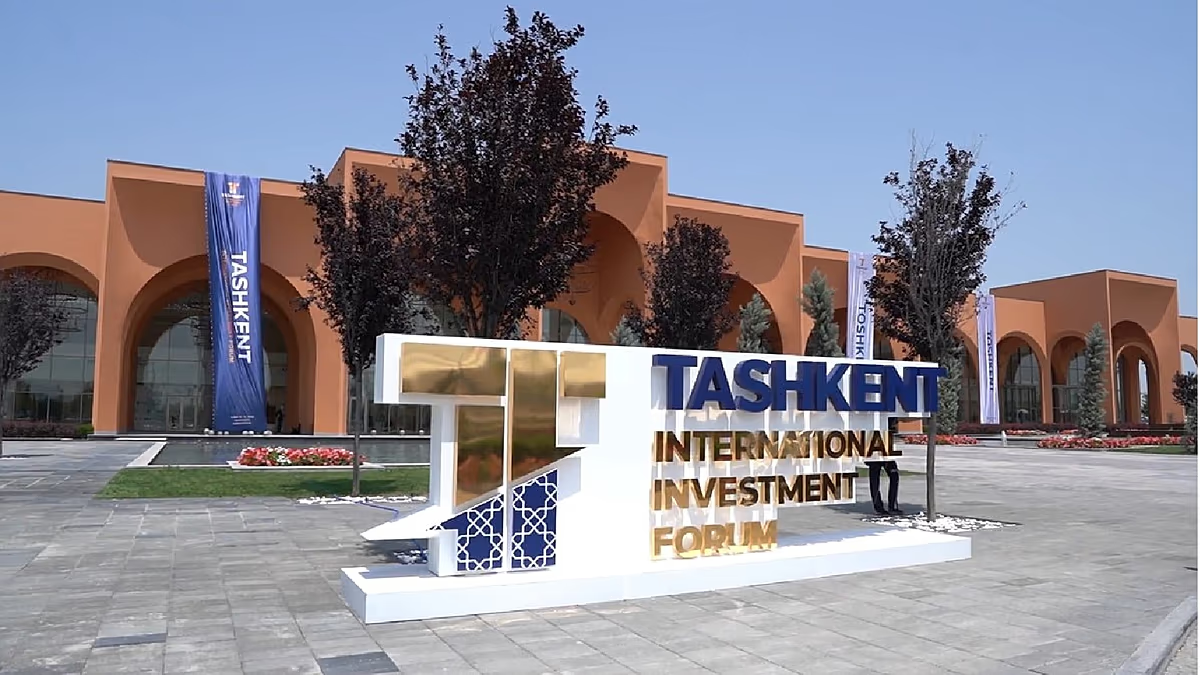
The Tashkent International Investment Forum (TIIF) for 2026 represents a monumental moment in Uzbekistan’s economic development and a significant signal of Central Asia’s rising prominence on the global investment stage. At its core, the forum is built around an extraordinary portfolio of investment projects worth approximately €75 billion, which Uzbek authorities, in collaboration with regional and private sector partners, will present to the world. This staggering figure underscores a strategic and ambitious vision to transform the nation’s economy across pivotal sectors including green energy, transport and logistics, digital infrastructure, and industrial development. The scale of this proposal reflects Uzbekistan’s confidence in its reform trajectory and its determination to position itself not merely as a regional player, but as a compelling destination for long-term international capital seeking sustainable growth and diversification.
A critical factor in this ambitious endeavor is the remarkable caliber and volume of attendees converging on Tashkent. The forum expects over 3,400 foreign delegates from 102 countries, alongside a powerful constellation of development banks, sovereign wealth funds, and multinational corporations representing a combined asset base of over $42 trillion. This record-breaking participation, including a notably strengthened contingent of around 120 US companies and senior representatives from key American financial institutions, signals a profound and growing international confidence in Uzbekistan’s potential. The presence of global giants like BlackRock, JPMorgan, Airbus, and Meta transforms the forum from a local showcase into a genuine nexus of global finance, where discussions carry the weight to mobilize capital on a transformative scale.
The thematic focus of TIIF 2026, “Investment Sustainability: New Horizons, New Partnerships,” strategically aligns with contemporary global economic shifts. In an era where nations and corporations are urgently reassessing supply chains, securing access to critical raw materials, and pursuing green transitions, Uzbekistan is positioning its offerings with precision. The agenda spotlights not only traditional infrastructure but also advanced technologies, artificial intelligence, and the entire value chain of agribusiness and pharmaceutical innovation. Furthermore, the forum’s design facilitates direct connection through sector-specific pitch sessions and a dedicated digital platform, moving beyond broad presentations to enable tangible dialogues between international investors and the Uzbek entrepreneurs and officials driving specific, bankable projects.
Perhaps the most visionary aspect of the forum is its emphasis on transcending national borders to mobilize capital for large-scale regional integration projects. Uzbek officials have explicitly stated their intent to present major initiatives requiring cooperation and financing from multiple partners across Central Asia and beyond. Projects such as the China-Kyrgyzstan-Uzbekistan railway, cross-border electricity grids linking Central Asia to the South Caucasus, hydropower developments involving Tajikistan and Kyrgyzstan, and the strategic Trans-Afghan transport corridor are on the agenda. By championing these regional endeavors, Uzbekistan is positioning itself as a central hub in the revitalized “Middle Corridor,” aiming to attract sovereign funds and institutional investors whose appetite and capacity are suited for these monumental, landscape-altering undertakings.
Concurrently, the forum serves as a crucial platform for dialogue on the regulatory and legal reforms essential to securing and sustaining this incoming investment. The concurrent Fourth Plenary Session of the Foreign Investors Council, incorporating feedback from 75 major international companies already operating in the country, is tasked with refining a roadmap for improvements in taxation, legislation, and land use. The anticipated passage of laws establishing the Tashkent International Financial Centre and revising frameworks for Special Economic Zones and alternative investment instruments represents a proactive effort to modernize the financial ecosystem. These reforms aim to introduce sophisticated mechanisms like venture capital and private equity, directly addressing investor needs for clarity, protection, and diversified exit strategies.
Ultimately, TIIF 2026 is a high-stakes test of credibility and execution for Uzbekistan. Officials proudly note that the nation absorbed about €39 billion in investments in 2025 alone, with a significant portion of previously signed projects now under implementation—a track record they will leverage to build trust. The key question hovering over the bustling conference halls and negotiation rooms will be the conversion rate: how many of the discussions, pitches, and expressions of interest will crystallize into signed financing agreements and shovels in the ground. For Uzbekistan, the forum is an unparalleled opportunity to showcase both its vast project pipeline and its commitment to becoming a more open, streamlined, and partnership-driven economy. For the global investment community, it is an invitation to help shape the next chapter of a dynamic region poised for growth, with Uzbekistan ambitively seeking to be at its very center.