


A Contraction Emerges: The UK Economy Feels the Weight of Global Conflict
The UK’s tentative economic recovery, a source of cautious optimism in recent months, hit a significant snag in April 2024. According to data released by the Office for National Statistics (ONS), the nation’s Gross Domestic Product (GDP) contracted by 0.1% for the month. This marked the end of a consecutive run of monthly growth stretching back to the previous summer. While a single month’s data does not constitute a trend, this dip is widely interpreted as a clear signal that the protracted and volatile conflict between the United States and Iran is beginning to materially weigh on British economic output. The distant geopolitical tensions are no longer just headlines; they are translating into tangible strain on businesses and household budgets at home.
Sectoral Strains and a Glimmer of Resilience
Delving into the sectoral performance reveals where the pain is most acute. Services, the colossal engine of the British economy accounting for around 80% of output, contracted by 0.2% in April. Within this broad category, consumer-facing services were particularly hard-hit, falling by 0.5%, with retail trade alone down a sharp 1.3%. The most dramatic single decline came from the sports, amusement, and recreation sector, which plunged by 9.1%. The ONS explicitly linked part of this collapse to the cancellation of numerous sporting events in the Middle East, which directly impacted the revenues of UK-based event management, broadcasting, and hospitality businesses. This illustrates how global instability can have direct and unexpected ripple effects. In contrast, the production sector was flat, construction saw a minuscule 0.1% rise, and manufacturing emerged as a rare bright spot, growing by 0.4% thanks to strength in pharmaceuticals and basic metals.
Interpreting the Mixed Signals and the Shadow of Stagflation
Despite April’s setback, it is crucial to view this data within a slightly broader timeframe. Over the three months leading to April, the UK economy still expanded by a respectable 0.7%, representing the fifth consecutive period of quarterly growth. This nuance underscores the fragile and inconsistent nature of the recovery. Economists like Stuart Clark of Quilter caution that the stronger growth seen in the first quarter of the year now “is looking very much like a false dawn.” The persistent failure of diplomatic resolutions in the Iran conflict suggests “conditions are going to remain tough for longer still.” Furthermore, the economic picture is acquiring an uncomfortable “stagflationary” feel—a portmanteau describing the worst of both worlds: stagnant growth alongside persistent inflation. This creates a profound dilemma for economic policymakers, caught between a weakening economy and rising prices.
The Inflationary Vice Tightens on Businesses and Households
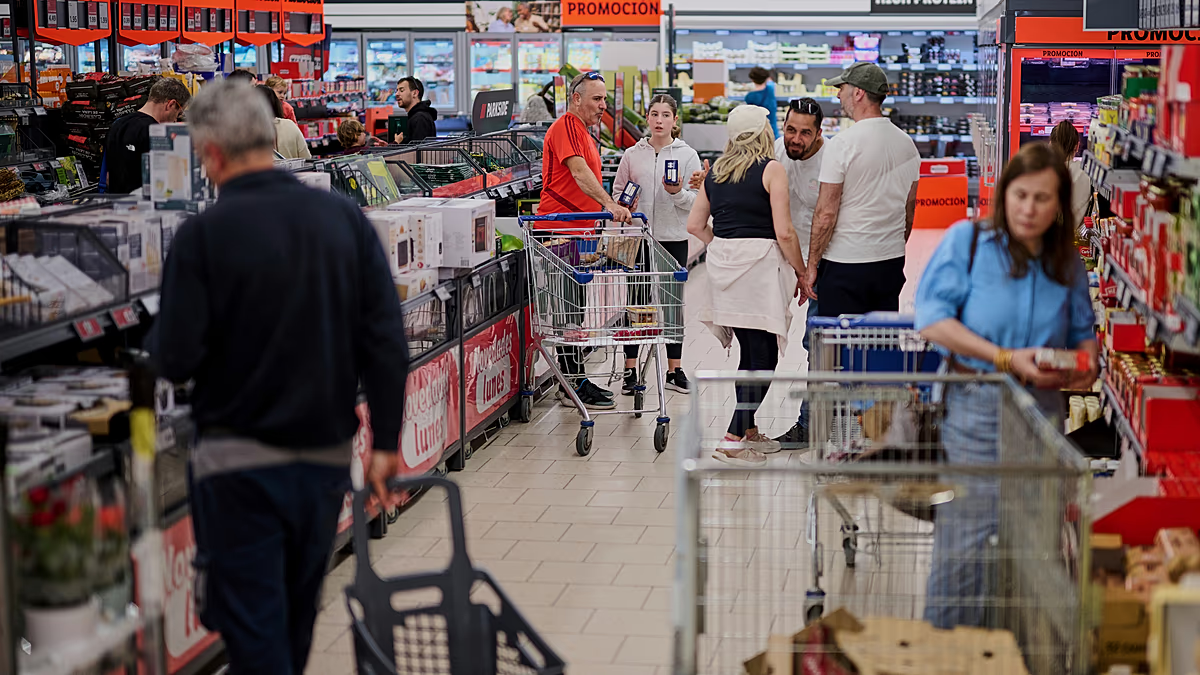
Compounding the growth concerns are robust signs of renewed inflationary pressure, a problem the UK has struggled to fully tame. In a separate survey, the ONS found that a striking 40% of trading businesses reported increases in the prices of goods they purchased in April—the highest proportion since December 2022. This indicates that cost pressures are intensifying for companies across the supply chain. For consumers, the pinch is being felt directly at the petrol pump and in energy bills. Deutsche Bank’s chief UK economist, Sanjay Raja, noted that fuel consumption was down nearly 10% in April, a clear sign of consumers pulling back in the face of higher prices. “As the Iran conflict unfolds, it’s clear that the energy shock is starting to catch up with households and businesses,” Raja observed. The rise in manufacturing, he suggested, might paradoxically reflect firms stockpiling inputs “amid elevated geopolitical uncertainty,” a strategy that adds to short-term demand but is not sustainable.
The Bank of England’s Impossible Dilemma
This confluence of slowing growth and stubborn inflation presents a growing headache for the Bank of England (BoE). Its primary mandate is to maintain price stability, targeting a 2% inflation rate. With business costs soaring and energy prices feeding into broader inflation, the pressure to continue raising interest rates to cool demand and curb price rises is significant. However, higher interest rates also risk choking off economic growth by making borrowing more expensive for businesses and mortgages more costly for households. As Stuart Clark notes, “the last thing [the Bank] wants to be doing is to raise interest rates” into a softening economy, yet financial markets are anticipating precisely that because inflation remains the more immediate threat. The BoE’s next interest rate decision, therefore, is fraught with complexity, balancing the risk of doing too little against inflation with the risk of doing too much to a fragile recovery.
Navigating a Challenging Path Forward
Looking ahead, the outlook is one of constrained optimism tempered by clear and present dangers. Economists like Sanjay Raja warn that “activity will continue to slow as real incomes get squeezed by higher energy prices and higher market rates start to eat further into household budgets.” The modest monthly contraction in April may be a precursor to a more pronounced slowdown in the coming months. Despite these headwinds, some institutions, including Deutsche Bank, maintain a forecast of 1% growth for the UK economy in 2024. If achieved, this would likely outpace most other G7 nations, reflecting a degree of underlying resilience. Ultimately, the UK’s economic trajectory in the near future appears inextricably linked to the winding path of a distant war. The nation’s recovery hinges not only on domestic policy but on the unpredictable tides of global geopolitics, demonstrating once again how interconnected and vulnerable the modern economy remains to international conflict.