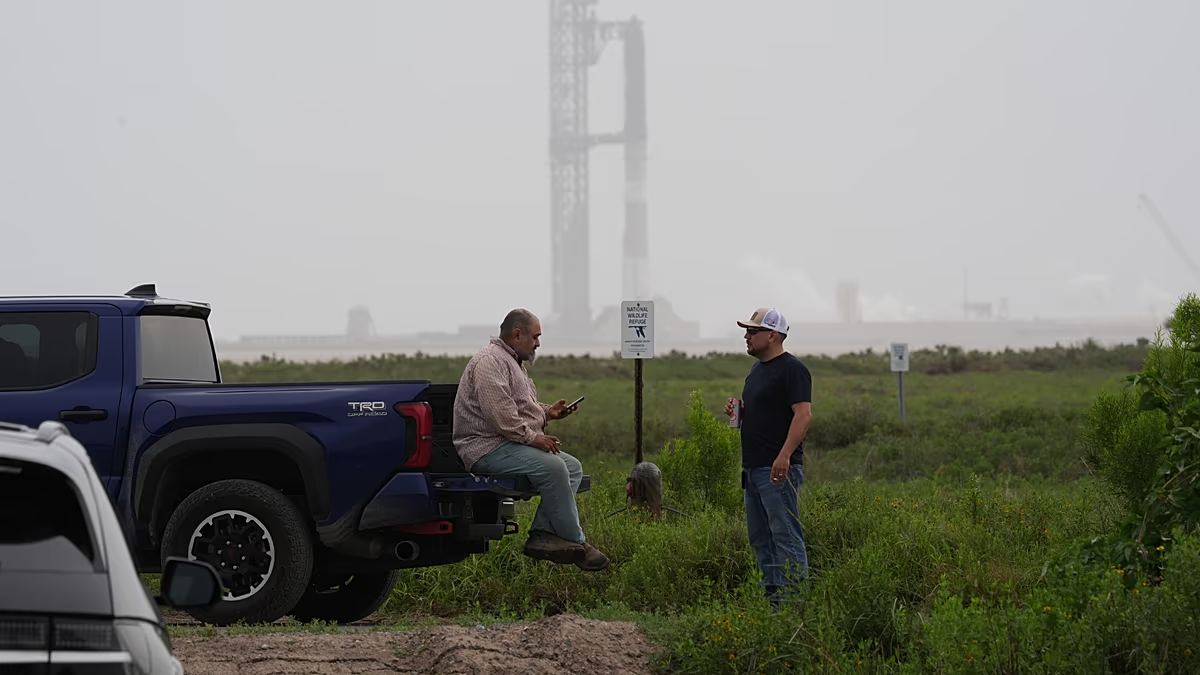




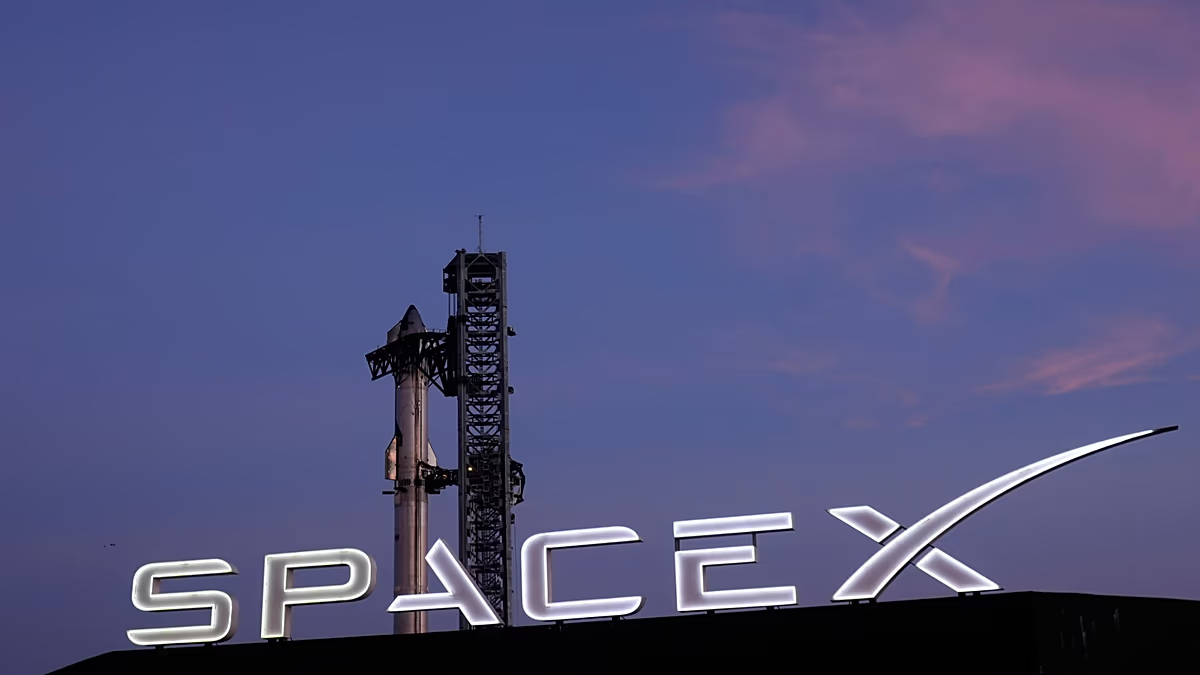
The dawn of a new era in both finance and technology is upon us as SpaceX, the pioneering rocket company founded by Elon Musk, prepares for the largest stock market debut in history. On Friday, trading begins on the Nasdaq under the ticker SPCX, following a share pricing of $135 that successfully raised a staggering $75 billion. This values the aerospace and artificial intelligence conglomerate at an eye-watering $1.75 trillion, comfortably surpassing the previous record set by Saudi Aramco. The offering has been met with unprecedented enthusiasm from everyday investors, with retail orders through platforms like Robinhood and Fidelity exceeding $100 billion—more than the entire fundraising target. This tidal wave of demand underscores the public’s fascination with SpaceX’s vision, yet beneath this historic moment, significant and complex risks are flashing warning signs that potential investors must carefully consider.
The first and most glaring question is whether SpaceX’s monumental valuation is justified. At $1.75 trillion, the company is being priced at roughly 94 times its 2025 annual revenue of $18.7 billion. This dwarfs the valuation metrics of even the market’s most prized tech giants like Nvidia. Independent research from firms like Morningstar, which values SpaceX at a more conservative $780 billion, labels the IPO price as “significantly overvalued.” Financial models suggest that to sustain such a valuation, SpaceX would need to grow its revenues to over $100 billion by 2030—a feat requiring a compound annual growth rate exceeding 40%. Historical data from IPO expert Jay Ritter adds a note of caution, showing that while flashy debuts often see first-day pops, their returns over the subsequent three years are far more modest. This disconnect between current financials and future expectations places a tremendous burden of proof on SpaceX’s growth narrative.
Adding to the valuation complexity are unique market mechanics surrounding the offering. A relatively tiny fraction of SpaceX’ Wage—just 3% to 4%—will be available for public trading initially, with over 75% of the offering allocated to insiders and existing investors. This small “float” means the company’s staggering market cap will be determined by trading in a sliver of its equity, potentially amplifying volatility. Furthermore, the company’s expected rapid inclusion in major indexes like the Nasdaq 100, facilitated by recent rule changes, has sparked controversy. While index inclusion could funnel an estimated $22-$27 billion from passive funds into the stock, potentially supporting the price, critics argue it forces millions of investors to gain exposure to a highly speculative asset sooner than traditional timelines would allow. This creates a scenario where early trading may be more reflective of artificial scarcity and index-fund demand than of a consensus on the company’s intrinsic worth.
Financially, SpaceX presents a paradox of soaring revenues alongside deep, mounting losses. The company’s prospectus reveals an accumulated deficit of $41.3 billion and a net loss of $4.27 billion for just the first quarter of 2026—a stark increase from the previous year. The core launch and Starlink satellite internet businesses are profitable, with revenue climbing 33% to $18.7 billion in 2025. However, the February merger with Musk’s artificial intelligence company, xAI, has dramatically altered the financial picture. xAI alone recorded an operating loss of about $6.4 billion in 2025, as it spends aggressively to build AI infrastructure. Supporters frame these losses as a strategic choice to capture a dominant future market, but skeptics, including Morningstar, warn that the AI unit “poses a material threat of value destruction,” noting its Grok chatbot has yet to win significant market share.
The heart of the investment thesis, therefore, rests on a massive gamble around AI-driven growth. Bulls argue that SpaceX is not merely a rocket company but a vertically integrated powerhouse uniquely positioned at the nexus of connectivity, data, and computing. Beyond its dominance in launches and its over nine million Starlink subscribers, the new growth engine is its AI data-centre business. Recent mega-contracts, including a $920 million monthly deal with Google and a $1.25 billion monthly agreement with Anthropic, promise combined annualized compute revenue of around $26 billion. Supporters hail this as proof of rapid monetization capability. However, a dose of skepticism is warranted; these contracts contain 90-day termination clauses after late 2026, and Google itself has referred to the arrangement as “bridge capacity.” This highlights the risk that this burgeoning revenue stream, while impressive, may not yet be fully secure or indicative of long-term demand.
Finally, investing in SpaceX is inextricably linked to investing in Elon Musk himself—a figure who embodies both unparalleled vision and substantial risk. The company’s governance structure cements this dependence, with Musk’s super-voting shares granting him approximately 85% control, leaving public shareholders with minimal influence. This “key-person risk” is a major concern for institutional investors, with some, like Denmark’s AkademikerPension, blacklisting the stock over its “catastrophic” governance. Furthermore, Musk’s polarizing public profile injects political and regulatory risk into the investment, as noted by critics like Senator Elizabeth Warren. While supporters argue that such concentrated control allows for relentless long-term focus, akin to other tech giants, it undeniably means that the fortunes of this $1.75 trillion enterprise are hitched to the judgment and stability of a single individual. As the countdown to Friday’s launch begins, the world watches to see if this record-shattering IPO will soar to the heavens or serve as a cautionary tale about hype, valuation, and the concentration of future-defining power in the hands of the very few.