



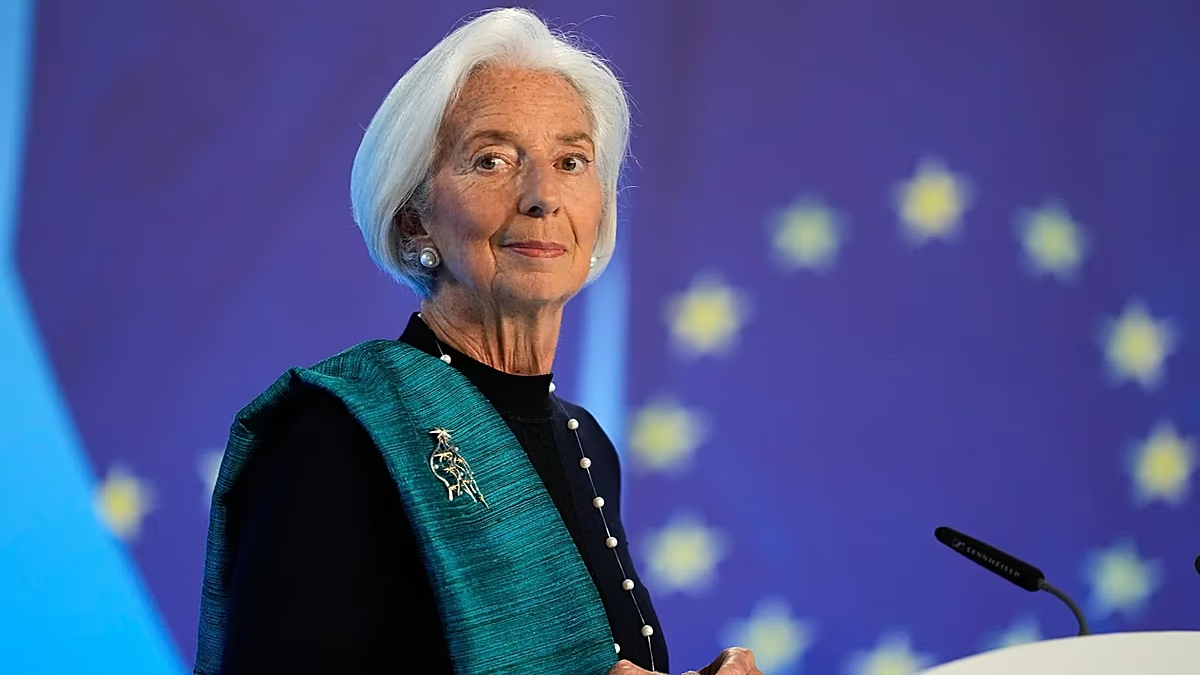
On Thursday morning, the financial world is holding its breath, its gaze fixed on Frankfurt. The European Central Bank (ECB) is widely expected to announce an increase in its key interest rates, a move that could mark a significant pivot in the battle against inflation across the continent. Investors are bracing for a 25-basis-point hike, which would bring the main rate from 2.0% to 2.25%. Yet the specific number is almost secondary; the market’s true anxiety lies in the question that will follow. What comes next? The guidance from ECB President Christine Lagarde will be parsed for any hint—hawkish or dovish—about the path forward. Will this be the first of several hikes, or a cautious, one-off adjustment? Firms like ING predict a “hawkish tone” but note the high bar for surprising markets, suggesting that investor expectations are already set on a series of increases. This anticipation hangs over European exchanges, tempering reactions to other global events.
Amid this tense wait, European stock markets presented a picture of cautious resilience as trading began. The pan-European Stoxx 600 index hovered near flat, but major national benchmarks like Germany’s DAX and France’s CAC 40 posted solid gains of around 1%, while the UK’s FTSE 100 led with a 1.2% rise. This muted positivity stood in stark contrast to the turbulence that had swept through Asian and American markets just hours before. It was a reminder that while connected, regional markets can sometimes dance to different tempos, with local factors like impending central bank decisions providing temporary insulation from storms elsewhere.
That storm had brewed on Wall Street and rolled across the Pacific. On Wednesday, a sharp sell-off in the red-hot artificial intelligence (AI) sector sent major U.S. indices tumbling, with the S&P 500 falling 1.6% and the tech-heavy Nasdaq dropping 2%. This decline marked the first consecutive loss in three weeks, unsettling investors who had grown accustomed to the sector’s meteoric rise. The rout continued to ripple through Asian markets on Thursday, pulling Japan’s Nikkei and South Korea’s Kospi into negative territory. The trigger was a dramatic plunge in shares of companies like Super Micro Computer, which nosedived 28% after announcing plans to raise capital—a move often seen as taking advantage of high share prices but one that can dilute existing holdings. Even giants like Nvidia, the nearly $4.9 trillion cornerstone of the AI boom, fell 3.7%, acting as the single biggest weight on the S&P 500.
This AI-driven volatility is more than a simple correction; it represents a profound moment of reckoning for a market narrative that has dominated for over a year. Investors are now forced to ask a difficult question: is this a healthy pause that cools an overheated sector, or the first crack in a speculative bubble? The extreme swings in stocks like Micron Technology—which has seen wild daily gyrations but remains up over 200% this year—epitomize this uncertainty. Furthermore, some pressure may be strategic, as investors potentially shift capital to prepare for major upcoming events like a possible initial public offering for SpaceX. The sell-off underscores a shift from unbridled optimism to a more sober evaluation of which companies possess sustainable business models amid the AI revolution.
Adding another layer of complexity to the global financial landscape is the persistent rise in oil prices, fueled by escalating geopolitical tensions. Brent crude climbed above $93 a barrel after a warning from the U.S. President regarding Iran, as conflict threatens a critical chokepoint for global oil shipments. This surge directly impacts companies with massive fuel bills, pulling down airline and cruise stocks like United Airlines and Carnival. More broadly, expensive oil acts as a powerful accelerant for inflation worldwide. This was underscored by a recent U.S. report showing consumer prices rising at their fastest annual pace in three years. Consequently, traders are increasingly betting that the Federal Reserve, like the ECB, may be forced to consider further interest rate hikes later this year to cool the economy and contain prices.
As the trading day unfolds, all these threads—the ECB’s decision, the AI reckoning, and the oil-price inflation nexus—are intertwining to shape the market’s direction. Higher interest rates, while aimed at taming inflation, carry their own economic cost by potentially slowing growth and squeezing corporate profits. They also make high-flying, speculative investments less attractive, which could exacerbate the downturn in tech stocks. In the currency markets, the euro held steady against the dollar, while gold—a traditional safe haven—saw a slight dip. The collective scene is one of a financial system at a crossroads, balancing between the necessary medicine of higher rates and the fear of triggering a broader downturn. The decisions made in Frankfurt and the subsequent reactions on trading floors from New York to Hong Kong will write the next chapter in this ongoing story of global economic adjustment.