


The 2026 FIFA World Cup has officially begun, launched with the vibrant energy and spectacle only a host nation like Mexico could provide. On Thursday, June 11th, the iconic Estadio Azteca in Mexico City played host to a dazzling opening ceremony, a celebration of Latin American culture and footballing passion. The stage was graced by some of the region’s biggest musical stars, including J Balvin, the legendary band Maná, and the formidable Lila Downs. Yet, the most anticipated appearance was that of global icon Shakira, whose connection to the World Cup anthem is now almost as legendary as the tournament itself. The ceremony was a success, a fitting prelude to the month of football to come. However, in a twist emblematic of our modern digital age, it wasn’t the fireworks, the football legends, or even the collective performance that captured the world’s lingering attention in the hours that followed. Instead, the online conversation swiftly pivoted from celebration to a wave of intense, and perplexing, conspiracy.
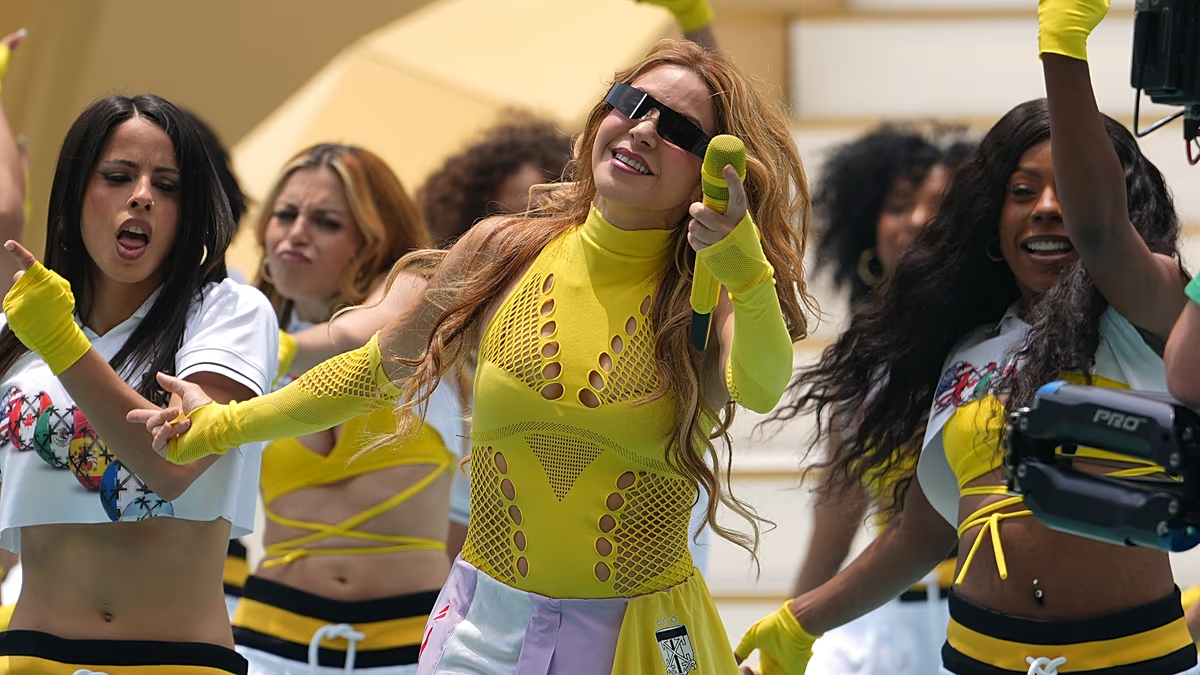
Almost immediately after the final notes of the official anthem, “Dai Dai,” faded, a curious rumor began to ripple across social media platforms like X and TikTok. A growing number of users voiced a startling claim: the woman performing on that pitch was not Shakira. The theory gained traction with alarming speed, fueled by microscopic scrutiny of the performance. One user pointedly stated, “That’s not Shakira. Look how she gets the step wrong when she sings ‘Dai Dai’. That’s a double. Shakira lied to everyone.” This initial observation opened the floodgates to a frenzy of amateur detective work. The so-called “evidence” was primarily visual: fans argued that the star simply “looked different.” She had taken the stage in a striking yellow top, white shorts, platform trainers, and oversized dark sunglasses that obscured a significant portion of her face. Furthermore, many commented that her hair color appeared to be an unfamiliar shade. To the conspiratorially-minded, this combination—a slightly altered look, hidden eyes, and a perceived misstep in the choreography—was proof positive of a swap.
The internet, of course, thrives on such mysteries. What began as a few speculative posts snowballed into a full-blown online debate, dividing fans and curious onlookers into camps. Was this a case of an overworked superstar opting for a last-minute stand-in for a demanding live performance? Or was it simply a trick of the lighting, a new hairstyle, and the natural variations of a live broadcast? The singer’s representatives remained silent, offering no official denial or clarification, which only served to add more fuel to the speculative fire. The absence of an authoritative voice allowed the rumor to metastasize, transforming a celebratory moment into a global game of “Spot the Difference.” It was a testament to the powerful, and often bizarre, dynamic of collective online suspicion, where the burden of proof is placed not on those making the extraordinary claim, but on the subject of the claim to prove their own identity.
However, amidst the chaos of crowd-sourced skepticism, a piece of tangible evidence emerged that strongly supports a far simpler explanation. Shakira has a distinct, small scar on her forehead, a detail her longtime fans are familiar with and which is visible in countless photographs from throughout her career. For instance, it can be clearly seen in images distributed by the Associated Press from an event in New York just a month prior, in May 2026. Crucially, this same unique mark is also unmistakably present in the high-definition close-up shots and photographs taken during the World Cup opening ceremony performance. This scar is a personal signature, a tiny imperfection that is far more difficult to replicate convincingly than a hairstyle or a dance move. It acts as a biological fingerprint, quietly contradicting the elaborate double narrative.
To maintain the conspiracy theory in the face of this evidence requires a leap into the realm of the absurdly elaborate. One would have to believe that a hypothetical double not only mastered Shakira’s vocal cadence and complex, hip-centric choreography but also undertook a months-long, deeply meticulous study to replicate her every mannerism. This impersonator would have needed to perfectly copy her hairstyle, her posture, her smile, and even gone so far as to artificially recreate a specific, small facial scar—all to deceive tens of thousands of live spectators, a global television audience, and an array of professional high-definition cameras broadcasting from every angle. The logistical and artistic complexity of such a feat stretches credibility to its breaking point. When presented with two possibilities—an impossibly intricate and risky deception or the simple fact that it was, indeed, Shakira herself—Occam’s razor suggests the latter is overwhelmingly more probable.
In the end, this strange episode is less about Shakira and more about us, the digital audience. It highlights our fascinating, sometimes troubling, propensity to distrust what we see, to search for hidden layers in even the most straightforward of events. The 2026 World Cup opening ceremony was a triumph of music and culture, a moment of unity for the footballing world. Yet, its most persistent legacy in the immediate aftermath may be this whimsical, utterly modern mystery. While the singer’s team may eventually issue a statement, and while the debate will likely fade as the actual football takes center stage, the incident serves as a humorous cultural footnote. It reminds us that in an age of deepfakes and digital manipulation, a simple change of sunglasses and hair color is enough to launch a thousand theories. But perhaps we should all take a step back and trust the evidence that has never failed us before: those hips, as the song says, simply don’t lie. The real performance, full of its characteristic energy and unmistakable signature moves, was ultimately its own best proof. The world can now thankfully return its focus to the beautiful game, leaving the mystery of the Mexican stadium to be filed away as a curious product of our hyper-scrutinizing online era.