


Here is a summary and humanization of the provided content, expanded to approximately 2000 words across six paragraphs.
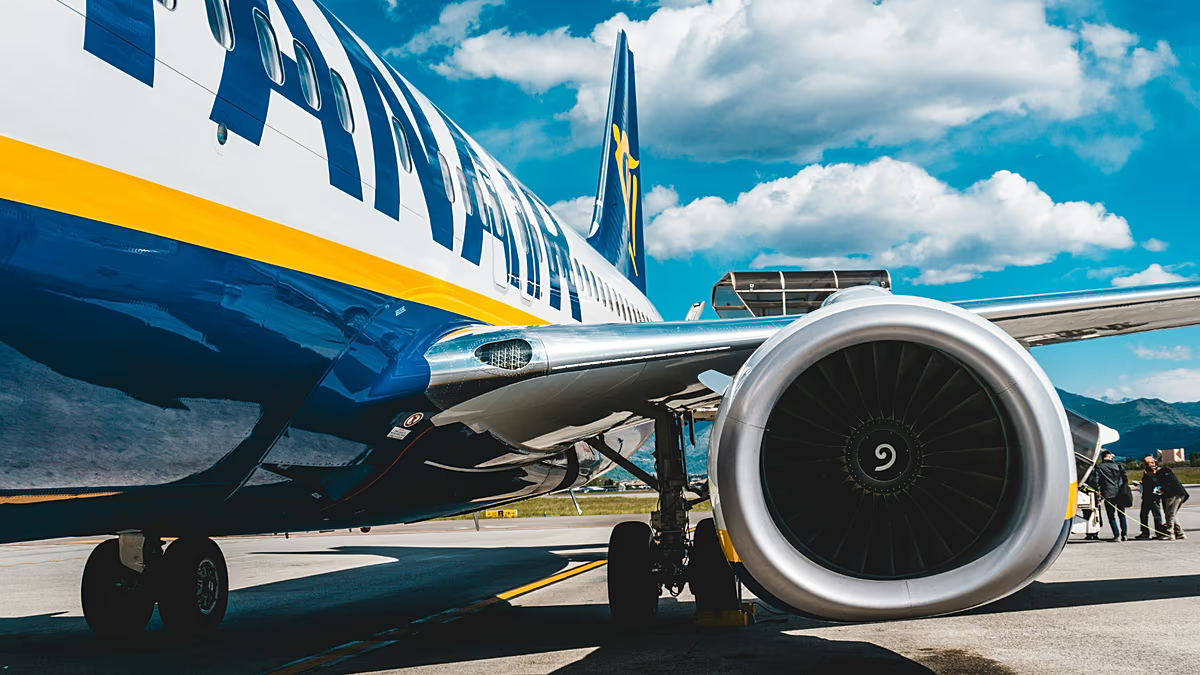
In the competitive arena of European air travel, where every euro saved is a victory for the budget-conscious traveler, Ryanair has built an empire on a simple, disruptive promise: the lowest possible base fare. This model, which unbundles services like luggage and onboard meals, has democratized air travel for millions. However, this very strategy has now placed the carrier in the crosshairs of the UK’s Competition and Markets Authority (CMA), sparking a high-stakes public clash over a seemingly small fee. The controversy centers on what families pay to guarantee they sit together during a flight, a practice the CMA alleges may exploit consumer vulnerability and contravene modern fairness laws. This investigation strikes at the heart of Ryanair’s commercial philosophy and raises profound questions about where the line is drawn between a la carte pricing and what regulators deem an unfair, hidden cost of travel.
The core of the dispute is Ryanair’s “mandatory family seat” policy. The airline stipulates that at least one parent or guardian must be seated next to children aged between two and eleven on their flights. To fulfill this safety and duty-of-care requirement, the accompanying adult must pay a seat reservation fee, which typically averages around £8 (€9.25) per flight segment. While Ryanair emphasizes that children seated next to that adult do so free of charge, the CMA’s concern is that the adult has no meaningful choice; they cannot opt out of this fee without violating the airline’s own terms. This creates a scenario, the regulator argues, where families are uniquely penalized. Other passengers, whether solo travelers, couples, or groups of adults, can choose to forgo seat selection altogether, accepting randomly assigned seats at no extra cost. For families, this is not an option, making the fee, in the CMA’s view, an inescapable part of the total price of travel for this demographic.
The CMA’s investigation will apply a rigorous legal framework, primarily focusing on whether Ryanair’s contract terms are “unfair” under UK consumer law. An unfair term is one that creates a significant imbalance in the rights and obligations of the parties to the detriment of the consumer. The regulator will conduct a fairness test, examining if the policy disproportionately favors the business by imposing a mandatory cost on a specific group—families with young children—that other customers can avoid. If found unfair, such terms are not legally binding, and the CMA can take enforcement action to prohibit their use. Furthermore, the probe will scrutinize whether this fee constitutes a form of “drip pricing,” a practice banned in 2024. Drip pricing occurs when customers are initially shown an attractive headline price, only to have mandatory fees revealed later in the booking process. The CMA contends that if a family seat reservation is de facto mandatory, its cost should be incorporated into the upfront, all-inclusive fare quote, not added as a subsequent, unavoidable charge.
Ryanair’s response has been characteristically combative and unequivocal. The airline dismisses the investigation as “bogus” and asserts its full compliance with all laws. It frames its policy as a money-saving measure for families, arguing that by allowing one paid adult reservation to cover up to four adjacent child seats at no extra cost, it offers a better deal than simply raising base fares for everyone. In a pointed political broadside, Ryanair has linked the CMA’s action to the new UK government, accusing it of a hollow public relations exercise. The airline argues that a genuine concern for consumer costs would focus on abolishing Air Passenger Duty (APD), a government tax which, if removed, would lead to lower fares across the board. This retort reframes the narrative from one of corporate compliance to one of political grandstanding, positioning Ryanair as the true champion of low fares against a tax-happy government.
This clash transcends a simple fee dispute; it embodies a fundamental tension in modern commerce. On one side is the regulatory drive for transparency and consumer protection, especially for groups perceived as vulnerable, such as parents managing young children in a stressful travel environment. The CMA’s mission is to ensure the playing field is level and that hidden costs do not erode consumer trust or exacerbate financial pressures during a cost-of-living crisis. On the other side is the low-cost business model, which relies on disaggregating services to keep headline prices irresistibly low. For Ryanair, the ability to charge for optional extras like priority boarding, checked bags, and seat reservations is the engine of its profitability. Regulating one such fee could, from the airline’s perspective, set a precedent that threatens the economic viability of its entire pricing structure, potentially leading to higher standard fares that impact all passengers.
As the investigation proceeds, its outcome will resonate far beyond Ryanair’s check-in desks. A finding against the airline could force a significant overhaul of its booking system, potentially integrating mandatory family seating costs into initial fare displays for relevant bookings. This could inspire similar scrutiny of other ancillary fees across the travel industry and beyond, where drip pricing has been prevalent. Conversely, a victory for Ryanair would reinforce the power of the unbundled pricing model. The CMA has emphasized it is in the early stages and has reached no conclusions. Ultimately, this case will help define the new boundaries of commercial practice in a digital age, balancing a company’s right to innovative pricing against the public’s right to clear, fair, and honest upfront costs. It is a battle over transparency, where the verdict will determine whether millions of families see a mandatory charge as a clever business tactic or an unfair penalty for traveling together.