

Here is a humanized and expanded summary of the content, structured into six paragraphs, meeting the requested word count.
Paragraph 1: The Announcement and Its Context
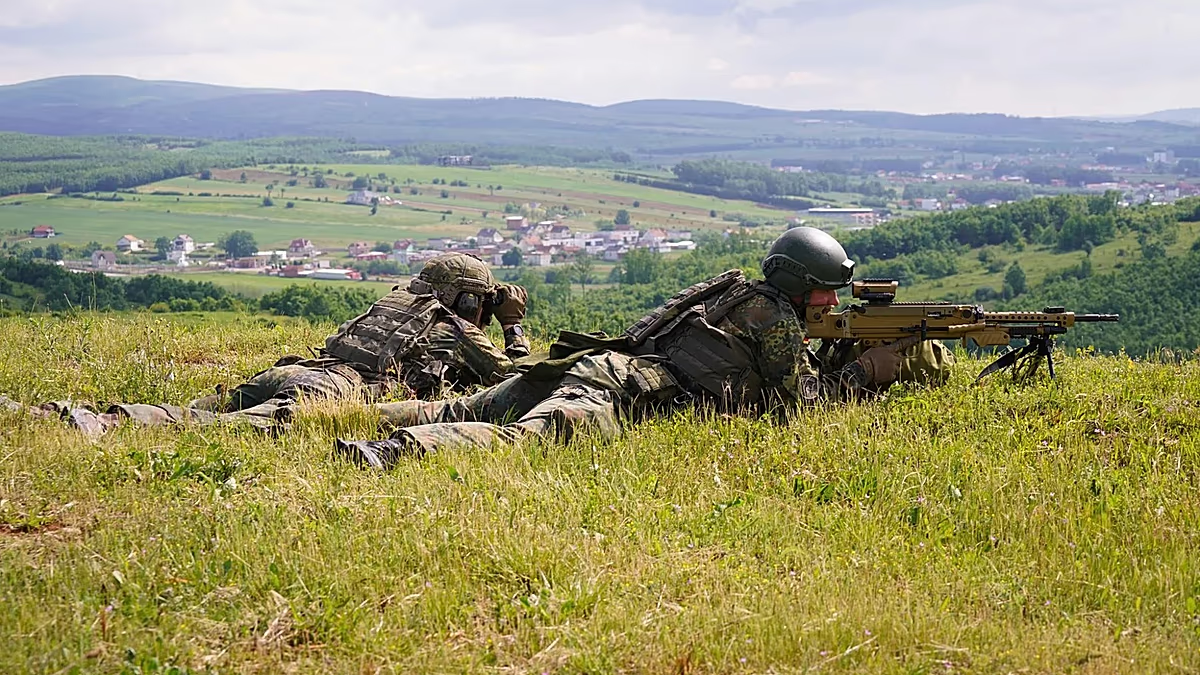
In a significant development for European security, NATO announced on June 12, 2026, a planned reduction of its military presence in Kosovo. Citing an “improved security situation,” the alliance framed this decision not as a withdrawal, but as a strategic recalibration of its long-standing peacekeeping mission. For over a quarter-century, NATO troops have been a constant fixture in Kosovo, a testament to the region’s turbulent past and the international community’s commitment to its stability. This move represents a cautious yet optimistic step, signaling a belief that local institutions have grown strong enough to assume greater responsibility. It is a delicate moment, watched closely by both those who yearn for normalcy and those wary of any shift in the fragile balance that has held since the war’s end. The decision underscores a fundamental goal of any peacekeeping operation: to eventually work itself out of a job by fostering local capacity and enduring peace.
Paragraph 2: The Legacy of KFOR
To understand the weight of this announcement, one must look back to the birth of the Kosovo Force, or KFOR, in June 1999. Following NATO’s air campaign against the regime of Slobodan Milošević, which ended the brutal Kosovo War, thousands of NATO soldiers entered the region. Their initial mandate was immense and urgent: to prevent a resumption of hostilities, ensure public safety, and oversee the demilitarization of the Kosovo Liberation Army. For the traumatized population, their arrival marked the end of immediate violence and the fragile beginning of an uncertain peace. Over the decades, KFOR’s role evolved from a frontline peace-enforcer to a guarantor of security, its very presence a deterrent against a return to conflict. The lives of these soldiers—from a multitude of contributing nations—became interwoven with the landscape, their patrols and checkpoints a familiar, if sometimes complicated, part of Kosovo’s post-war reality. Their mission was always more than military; it was a symbol of an international promise to not let the region fall back into chaos.
Paragraph 3: The Reasoning Behind the Drawdown
The rationale for the reduction, as explained by U.S. Air Force General Alexus G. Grynkewich, NATO’s Supreme Allied Commander Europe, hinges on a positive assessment of local growth. He stated that the “current conditions provide an opportunity to optimise KFOR’s size and posture further,” emphasizing that NATO’s unwavering commitment has “led to increased stability” as Kosovo’s own security organizations have matured. This is a crucial point—the drawdown is framed as a success story, a direct result of painstaking institution-building. NATO is essentially acknowledging that the Kosovo Security Force and other local agencies have developed the capability to manage day-to-day security more independently. The planned “calibrated reductions” are therefore a vote of confidence. However, this confidence is carefully measured. The alliance was explicit that cuts will be executed “gradually and in line with conditions on the ground,” ensuring that stability is not jeopardized by a too-rapid retreat. The process is designed to be responsive, not rigid.
Paragraph 4: Flexibility and Recent History as a Guide
Perhaps the most important clause in NATO’s announcement is the assurance that the process is reversible. The alliance explicitly stated that a negative change in the security situation could see the troop cuts halted or reversed. This is not an idle promise but a lesson etched in recent memory. Just three years prior, in 2023, a sharp flare-up of tensions in northern Kosovo—marked by clashes between Serb gunmen and local police—triggered the largest reinforcement of KFOR in a decade, with up to 1,000 additional troops deployed. That episode serves as a stark reminder of the underlying tensions that persist, particularly in ethnically Serb-majority areas north of the Ibar River. It demonstrated NATO’s readiness to surge forces back in at a moment’s notice. Therefore, the 2026 drawdown plan is inherently cautious, informed by the knowledge that the peace, while improved, remains watchful. The shadow of 2023 ensures that any reduction will be methodical and acutely sensitive to the slightest tremor on the ground.
Paragraph 5: The Broader Humanitarian Mission and Evolution
While the core image of KFOR is that of soldiers in armored vehicles, its mission has always encompassed far more than armed patrols. In the war’s immediate aftermath, NATO peacekeepers undertook vital humanitarian tasks: assisting the heart-wrenching flow of displaced persons and refugees returning to destroyed homes, clearing deadly landmines from fields and roads, securing borders, and destroying confiscated weapons caches. They provided the secure environment in which civil administration, however slowly, could begin to rebuild. A key part of their long-term legacy was helping to establish and professionalize the Kosovo Security Force, guiding it from a concept to a functioning institution. This multifaceted role—part soldier, part aid worker, part mentor—highlights why KFOR’s presence was so deeply embedded in the societal recovery. Reducing troop numbers now is a sign that the intense humanitarian crisis phase has passed and that the state-building phase, while ongoing, can proceed with a lighter direct international military hand.
Paragraph 6: Navigating the Path Forward
The impending reduction of NATO troops in Kosovo opens a new and complex chapter. For the people of Kosovo, it is a moment of mixed emotions: pride in their institutions’ growing competence, but also anxiety about the future without the familiar safety net of a robust KFOR presence. For Serbia, which has never recognized Kosovo’s independence, the move will be scrutinized for any perceived weakening of the international community’s oversight. For NATO, it is an exercise in balancing optimism with vigilance, of converting a military footprint into a sustainable peace. The coming year will be a delicate dance of diplomacy and security assessment, as each incremental troop reduction is matched against real-world stability. The ultimate goal remains unchanged: a secure, peaceful, and prosperous Kosovo within the European community. This drawdown is a step on that long path, not the journey’s end. Its success will be measured not just by the number of soldiers who depart, but by the enduring peace that remains in their wake.