

In a stark escalation of rhetoric that casts a long shadow over global security and energy markets, former US President Donald Trump has made a startling threat against Iran. On a December morning in 2026, via his Truth Social platform, Trump vowed that the United States would, “at some point in the not too distant future,” seize control of Iran’s Kharg Island. This small but critically important coral outcrop in the Persian Gulf is the beating heart of Iran’s crude oil exports. Trump framed the proposed operation not merely as a military action but as a strategic takeover, stating the intent to assume “total control of their Oil and Gas Markets.” This declaration, presented as future fact, moves far beyond diplomatic posturing and sketches a scenario of direct, aggressive confrontation, reigniting fears of a major regional war and throwing the delicate balance of power in the Middle East into disarray.
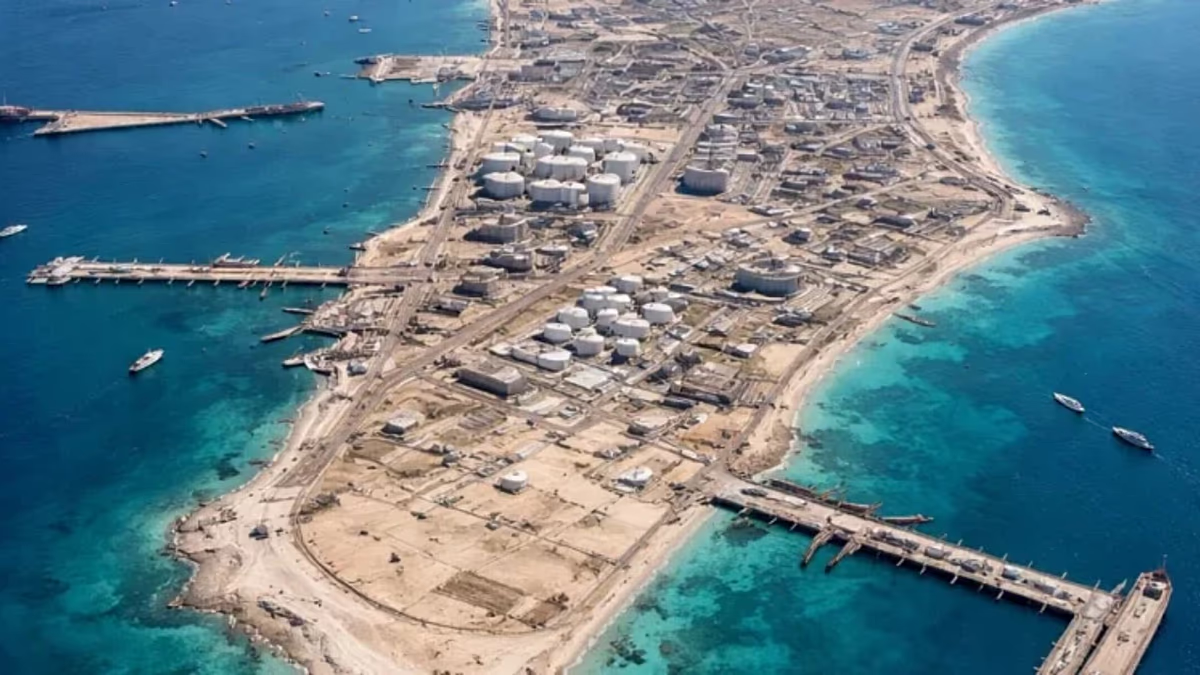
Understanding the gravity of this threat requires a look at Kharg Island itself. Located just 25 kilometers off the Iranian coast, it is far more than a dot on the map. It is Iran’s primary oil export terminal, a complex and vital economic organ. The island houses massive storage tanks, the endpoints of crucial pipelines from the mainland, and deep-water loading terminals capable of servicing the world’s largest tankers. It is, in essence, the bottleneck through which a significant portion of Iran’s economic lifeblood flows. While losing Kharg would not completely halt Iranian exports—alternative, smaller terminals exist—it would cripple them, dealing a devastating blow to the country’s already strained economy. The island is also a fortified military position, protected by air defense systems and installations manned by the Islamic Revolutionary Guard Corps (IRGC). Thus, Kharg represents a dual prize: a key to strangling Iran’s economy and a symbolic stronghold of its national sovereignty.
From a purely tactical military perspective, a US operation to capture Kharg Island would be a formidable but feasible challenge. The initial phase would involve a complex assault to neutralize the island’s air defenses, secure a beachhead, and land forces under heavy cover. The US military possesses the carrier strike groups, amphibious units, and aerial supremacy to attempt such a daring raid. However, the real difficulty begins immediately after the flag is planted. The extreme proximity of the island to the Iranian mainland presents a nightmare scenario for any occupying force. Kharg would sit well within range of a relentless barrage of Iranian artillery, ballistic missiles, swarms of drones, and cruise missiles. The surrounding waters could be harassed by fast attack boats and combat divers, while Iranian special forces could launch continuous infiltration attempts. Holding the island would mean sustaining what could become a bloody and costly siege, tying down US naval assets and troops in a vulnerable, exposed position.
This vulnerability presents Tehran with a profound and painful dilemma. If US forces were to dig in on Kharg, Iran’s instinct would be to unleash its full arsenal to drive them out. Yet, doing so carries the immense risk of destroying the very infrastructure the island exists to protect. Bombarding the island could ignite oil tanks, shatter loading gantries, and rupture pipelines—inflicting catastrophic self-inflicted damage on Iran’s own economic infrastructure. Therefore, Iranian strategy would likely pivot to a wider campaign of asymmetric pressure. This could involve targeting US supply convoys, warships in the Gulf, international tanker traffic to destabilize global oil prices, and firing missiles at American bases across the region. The goal would be to make the occupation so costly and destabilizing that Washington’s political will would crumble, rather than turning Kharg itself into a smoldering ruin.
However, there exists a grim and extreme counter-scenario that Iranian planners would undoubtedly consider. If the leadership in Tehran concluded that the island was irrevocably lost to American control, or that the US presence there posed an existential threat to the regime’s survival, their calculus could shift from preservation to sacrifice. In such a desperate circumstance, Iran might choose to deliberately destroy all or part of Kharg Island’s facilities. The logic would be one of devastating denial and disproportionate retaliation: if we cannot have it, neither can you, and you will pay a staggering price. By making the island inoperable, Iran could aim to trigger a global oil price shock, inflict significant casualties on concentrated US forces during the destruction, and unleash a political firestorm within the United States, turning what Trump might frame as a victory into a quagmire of blame and economic turmoil.
Ultimately, the future of Kharg Island is a precarious proxy for the future of US-Iranian relations. Trump’s threat, whether a serious strategic proposition or an extreme piece of brinksmanship, underscores how deeply intertwined military aggression and economic warfare have become. For Iran, Kharg is not merely a military facility or an economic asset; it is a point of national pride and sovereign identity. Any move against it would be perceived as an act of war targeting the nation’s very foundation. The course such a conflict would take is horrifyingly unpredictable, stretching from the waters of the Persian Gulf to the halls of global finance. It is a stark reminder that in the world’s most volatile region, the control of a single, small island can hold the potential to reshape the fate of nations and ignite a conflict with consequences far beyond its shores.