




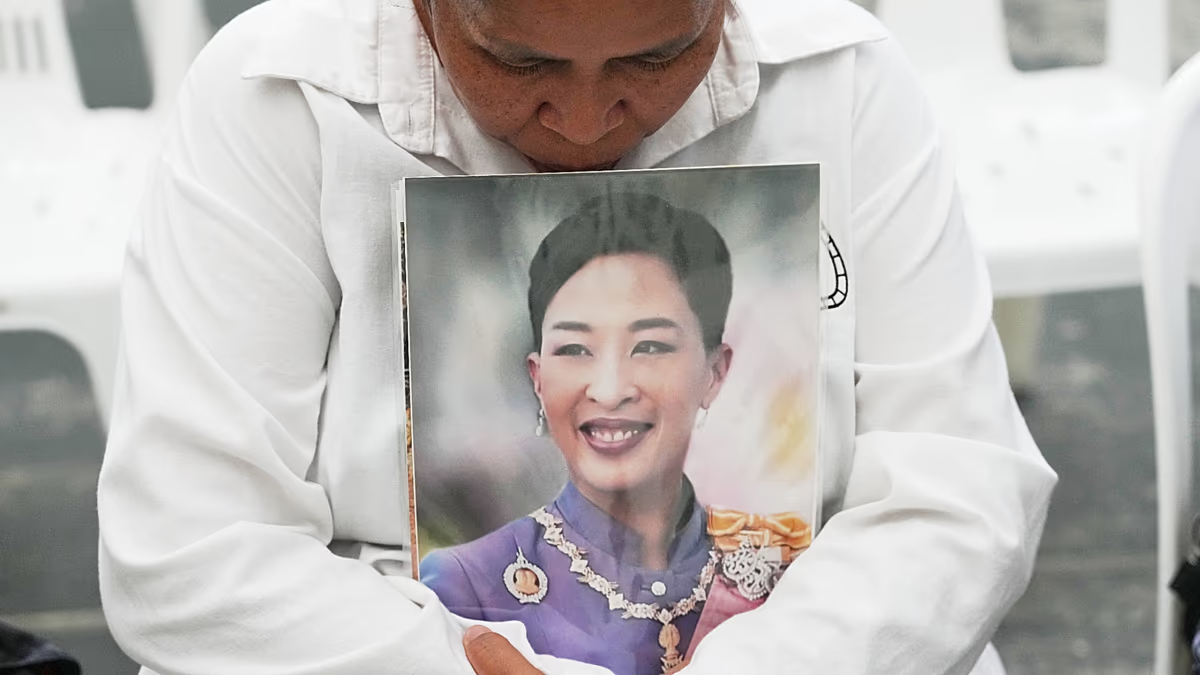
The passing of Her Royal Highness Princess Bajrakitiyabha Mahidol, known affectionately as Princess Bha, marks a profound moment of national mourning in Thailand. The Royal Household Bureau announced that the King’s eldest daughter passed away peacefully on Thursday evening at the age of 47, following a prolonged hospitalization that began in December 2022. She had been suffering from a serious abdominal infection and was reliant on medical support for her lung and kidney functions in her final years. In accordance with royal tradition, her body will lie in state at the Grand Palace in Bangkok, and her funeral will be conducted with the highest honours. This news is not merely an official announcement but, as Prime Minister Anutin Charnvirakul stated, “an immeasurable grief in the hearts of the entire nation.”
Princess Bajrakitiyabha was more than a royal figure; she was a dedicated legal scholar and a compassionate advocate for justice. Her academic journey was distinguished, beginning with a law degree from Thailand’s prestigious Thammasat University before she pursued higher studies at Cornell University in the United States, where she earned both a master’s degree and a doctorate. Her doctoral dissertation focused on the critical protection of the rights of the accused, a theme that would define her life’s work. This academic foundation was not an end in itself but the bedrock for a career committed to practical, humane reforms within the Thai legal system.
Her legacy is most vividly seen in her transformative advocacy for some of society’s most marginalized individuals. Princess Bha dedicated herself to improving the living conditions of women in prisons and was a powerful voice in campaigns to stem violence against women. Her efforts resonated on the global stage, leading the United Nations General Assembly to adopt the “Bangkok Rules,” a set of guidelines for the treatment of female prisoners that bears the imprint of her compassionate vision. Furthermore, a program fostering the exchange of legal scholars between Cornell University and Thailand was established in her name, ensuring her commitment to legal education would endure.
Her professional path elegantly blended diplomatic service with judicial reform. After an initial stint at the Thai Mission to the UN in New York, she returned home to serve as a public prosecutor, gaining firsthand insight into the judicial machinery. She later served as Thailand’s Ambassador to Austria from 2012 to 2014, showcasing her diplomatic acumen. However, her heart remained with criminal justice, and she eventually returned to Thailand to concentrate fully on these issues. Colleagues and observers noted her exceptional character; even Thai scholar Pavin Chachavalpongpun, a known critic of the monarchy, recalled meeting her and described her as someone who “treated every civil servant with kindness and respect.”
In his televised address, Prime Minister Anutin encapsulated the national sentiment, calling the Princess the “pride of Thailand.” He emphasized that her life’s work—”her commitment to building a society of kindness, justice, and equality”—would forever stand as a moral legacy and a guiding light for future generations. This sentiment was visibly echoed by the Thai people, as mourners gathered at Chulalongkorn Hospital, where she had been treated, clutching portraits of the late Princess, a silent testament to the deep and personal connection felt by many.
The loss of Princess Bajrakitiyabha leaves a void in Thailand’s pursuit of social justice. Her death concludes a brave, years-long struggle against illness, but her life story is one of unwavering principle and profound humanity. She translated her royal status and elite education into a force for tangible good, championing the rights of women and prisoners with quiet determination. As the nation prepares to bid her farewell with traditional royal honours, her true memorial lies in the ongoing work for a more just and compassionate society—the very cause to which she devoted her formidable intellect and her gentle heart.