


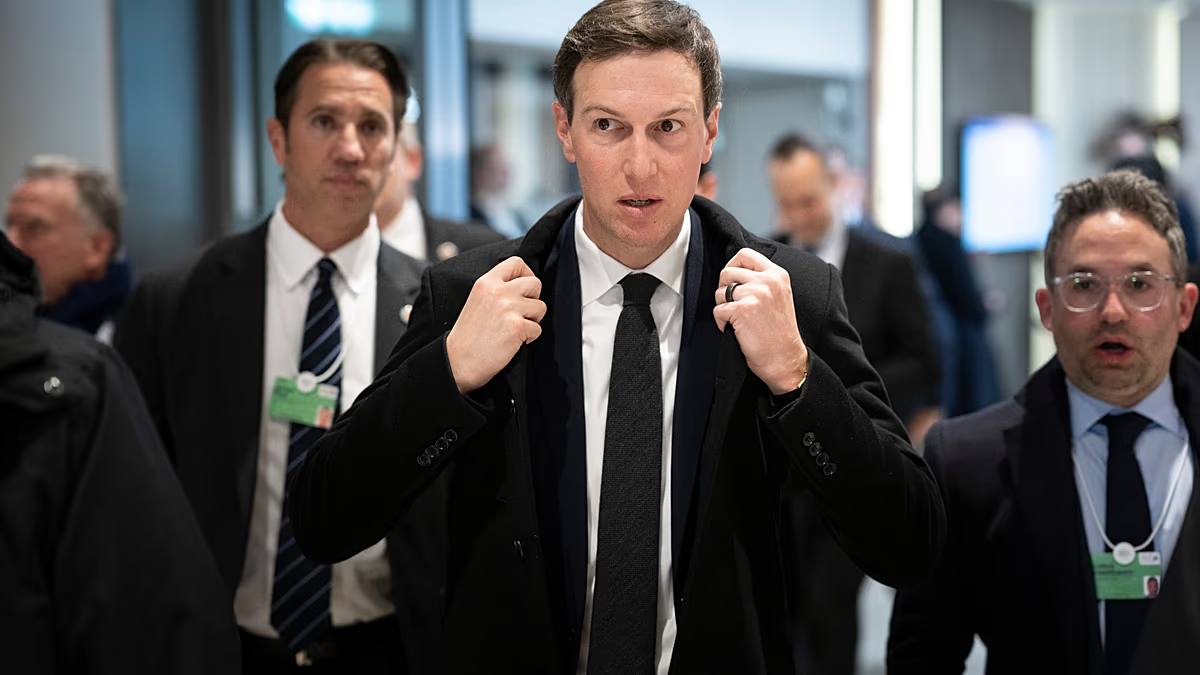
Paragraph 1: A Controversial Deal Sparks National Outcry
A massive luxury development project on Albania’s pristine Adriatic coast has become the unlikely focal point for nationwide protests and international scrutiny. The €1.4 billion proposal aims to transform Sazan Island into an exclusive resort complex, complete with hotels, private villas, a marina, and high-end apartments. However, this vision of opulence is fiercely opposed by environmental activists and local citizens, who argue it poses a grave threat to sensitive coastal ecosystems. The controversy intensified dramatically when it was revealed that the investment firm behind the venture, Affinity Partners, is led by Jared Kushner, the former senior White House adviser and son-in-law to former U.S. President Donald Trump. The deal has raised profound questions about transparency, environmental stewardship, and the blending of global political influence with private financial ambitions, casting a long shadow over the future of Albania’s coastline.
Paragraph 2: The Political Architect from Real Estate Royalty
To understand the significance of Kushner’s involvement, one must look at his journey from New York real estate scion to a central figure in American political power. Born into the wealthy Kushner family property empire, Jared Kushner leveraged his Harvard education and business acumen to expand the family holdings before making a surprising pivot into media by purchasing the New York Observer. His life became inextricably linked with the Trump dynasty upon his marriage to Ivanka Trump in 2009. Following Donald Trump’s 2016 election victory, Kushner, despite having no prior government experience, was installed as a senior White House adviser. He was entrusted with a stunningly wide portfolio, from brokering Middle East peace to overseeing criminal justice reform, making him one of the most influential—and controversial—architects of the Trump administration’s domestic and foreign policy.
Paragraph 3: A Legacy of High-Stakes Diplomacy and Scrutiny
Kushner’s time in the White House was a study in consequential and contentious diplomacy. He was a central figure in the historic Abraham Accords, which normalized relations between Israel and several Arab nations—an achievement hailed by supporters as a diplomatic breakthrough. Concurrently, his activities placed him under intense scrutiny. He featured prominently in the Mueller investigation into Russian election interference, where his contacts with Russian intermediaries were examined, though he faced no charges. Critics consistently argued that his powerful role, stemming from family loyalty rather than public service credentials, blurred ethical lines. This perception was compounded when his father, Charles Kushner—convicted years earlier for tax evasion and illegal campaign donations—received a presidential pardon from Trump and was later appointed Ambassador to France, intertwining personal, political, and business interests.
Paragraph 4: Capitalizing on Influence: The Affinity Partners Venture
After leaving government in 2021, Kushner swiftly returned to the financial world, founding the private equity firm Affinity Partners. The firm’s launch sent ripples through investment circles when it secured a $2 billion commitment from Saudi Arabia’s sovereign wealth fund, the Public Investment Fund—a transaction that raised eyebrows given Kushner’s close dealings with Saudi leadership while in office. This move cemented his transition from a political insider to a global dealmaker with a focus on investments in the United States, Israel, and the Gulf region. It is this very firm that is now financing the controversial Albanian coastal project, demonstrating how Kushner’s post-government career leverages the networks and geopolitical insights he cultivated during his White House tenure.
Paragraph 5: The Albanian Project: A Microcosm of Broader Tensions
The Sazan Island development is more than a local real estate dispute; it is a microcosm of global tensions between rapid, investment-driven development and environmental and social preservation. Protesters in Albania are not merely opposing a construction project; they are challenging a model of opaque, high-finance deal-making they fear will sacrifice public natural heritage for private gain. The involvement of a figure like Kushner—with his deep links to Middle Eastern wealth and American political power—amplifies these concerns, making the project a symbol of perceived elite impunity. Furthermore, Kushner’s recent formal appointment by Donald Trump as a Special Envoy for Peace adds another layer, situating his private business ventures alongside an official, ongoing role in international mediation, a duality that continues to provoke debate about the appropriate boundaries for former public servants.
Paragraph 6: An Enduring Figure at the Nexus of Power and Capital
In summary, Jared Kushner remains a singular and enduring figure who operates at the potent nexus of global politics, diplomacy, and finance. From his formative years in real estate and his transformative, polarizing role in the Trump White House to his current status as a well-connected international investor, his career trajectory defies conventional categorization. The Albanian property deal exemplifies the challenges and controversies that follow such a path, where business ambitions intersect with a legacy of political influence. As protests continue on the ground in Albania and scrutiny builds internationally, the saga underscores the complex and often contentious relationship between global capital, political access, and the communities and environments directly impacted by the deals that result.