




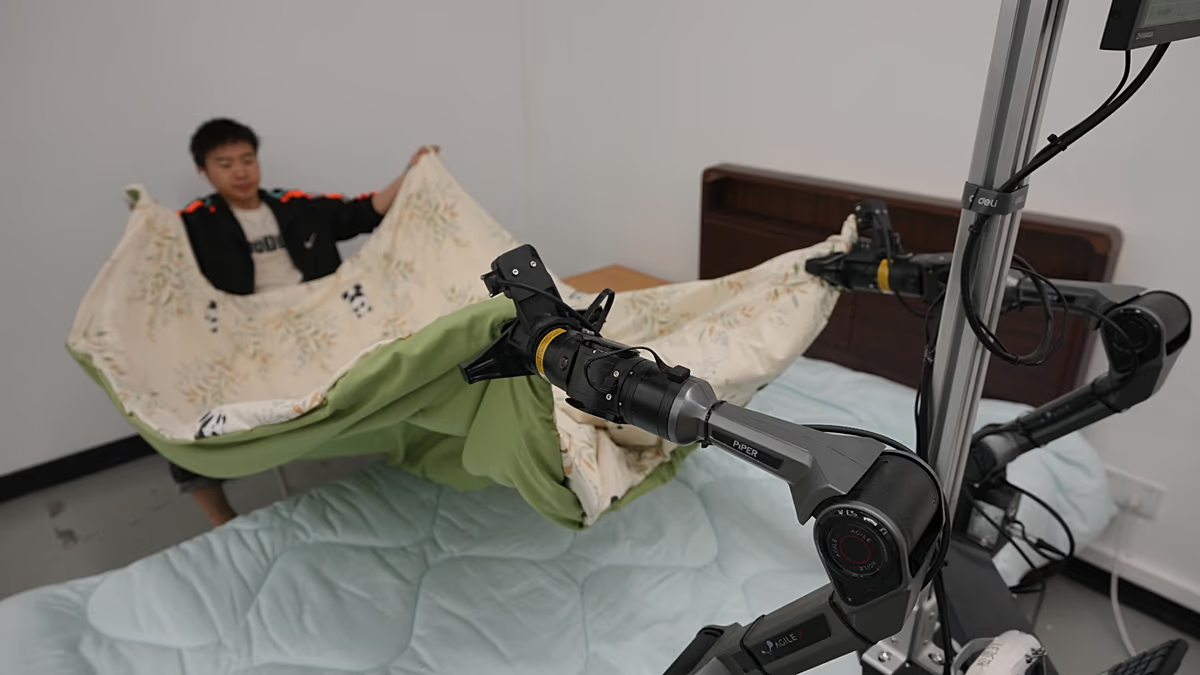
In a modest Beijing apartment, a quiet partnership is unfolding between human and machine. Lin Meiqiong, a 56-year-old professional cleaner, guides an AI-powered domestic robot through its tasks. While the robot’s mechanical arms glide across surfaces, picking up scattered items and carefully folding laundry, Lin remains a vigilant supervisor, stepping in whenever the machine hesitates or fumbles. For her, this new colleague offers a measure of relief—making certain chores slightly less physically demanding—but it is far from autonomous. Her presence is essential, highlighting that in the realm of domestic care, the human touch remains irreplaceable. This scene, once the stuff of science fiction, is now a tangible experiment in China’s bustling capital, signaling a cautious entry of advanced robotics into the intimate space of the home.
The technology behind this helper is a collaboration between the online service platform 58.com and robotics firm X Square. Equipped with cameras and agile mechanical limbs, the robot scans rooms in real time, identifying clutter and disorder with surprising accuracy. Its programming allows it to distinguish between a stray sock and a discarded paper cup, deciding which to discard and which to tidy. Yet for all its visual intelligence, the machine often struggles with basic manual dexterity—tasks as simple as grasping a delicate glass or smoothing the wrinkles from a shirt can become stumbling blocks. Engineers acknowledge these limitations openly, describing the current model not as a finished product, but as a data-gathering prototype. Its primary mission is to learn from real-world environments, collecting the nuanced information needed to train more capable future systems.
Since March, around 200 households in Beijing and Shenzhen have participated in this living laboratory, each paying a trial fee of 149 yuan for a three-hour session. For residents, it is a glimpse into a possible future—a chance to witness domestic robotics firsthand, with a human cleaner like Lin ensuring nothing goes awry. For developers, these visits are invaluable, generating a continuous stream of data from unpredictable, everyday settings. The long-term goal is what researchers term “embodied AI”—artificial intelligence that doesn’t just process information but interacts physically with the world, learning from movement, touch, and consequence. Every folded towel and every misjudged grasp feeds into algorithms, gradually teaching machines how to navigate the beautiful, unstructured chaos of human living spaces.
However, the path from prototype to common household appliance is lined with significant hurdles. Experts point out that safety and privacy concerns loom large—having a mobile, camera-equipped machine in one’s home raises valid questions about data security and physical safety. Moreover, the current gap between robotic and human capability remains vast. Where a human cleaner intuitively adjusts pressure when wiping a fragile picture frame or senses the best way to organize a child’s cluttered play area, the robot operates on pre-set logic, lacking adaptability and true understanding. These aren’t merely technical challenges; they speak to the profound difference between programmed function and lived experience, between executing a task and performing a service with care.
The implications of this technological shift extend beyond convenience, touching on deeper social and economic questions. For professionals like Lin Meiqiong, such robots could evolve into supportive tools that reduce physical strain and increase efficiency. Yet there is also an underlying anxiety about automation gradually encroaching upon human jobs, particularly in service sectors long defined by personal attention. Developers are quick to frame the technology as collaborative—a partnership that augments human labor rather than replacing it. Still, the broader adoption of domestic robots will depend not only on overcoming technical barriers but also on building trust, ensuring affordability, and redefining the value of human presence in automated spaces.
In the end, the quiet collaboration in a Beijing apartment is a microcosm of a larger transition. It reflects a world cautiously exploring how intelligent machines can share our daily lives, not as replacements, but as evolving companions in routine labor. For now, robots like the one working beside Lin remain learners—awkward, promising, and entirely dependent on human guidance. Their presence reminds us that the journey toward seamless human-robot coexistence is as much about empathy and ethics as it is about engineering. As this experiment continues, it will be shaped not only by algorithms and sensors, but by the people who teach, oversee, and ultimately decide what role technology should play in the heart of the home.