



Summary and Analysis of Recent U.S. Sanctions Against Cuba’s Oil Company
In a significant escalation of long-standing tensions, the United States government has imposed new sanctions targeting Cuba’s state-owned oil and gas company, Cubapetróleo (Cupet). This move, announced by U.S. Secretary of State Marco Rubio, frames the action as a response to historical grievances and current Cuban government practices. Rubio asserted that key Cupet assets were originally “unlawfully expropriated from American owners,” linking the sanctions to unresolved claims dating back to the early years of the Cuban Revolution. Furthermore, he launched a broader political accusation, charging the Cuban government with “weaponising energy.” In his statement, Rubio claimed that while the Cuban populace endures severe fuel shortages and widespread blackouts due to crumbling infrastructure, the island’s leadership deliberately diverts and hoards energy resources. These resources, he alleged without presenting specific evidence, are funnelled to military and security forces, sold for profit on secondary markets, and used as a tool for social control through rationing.
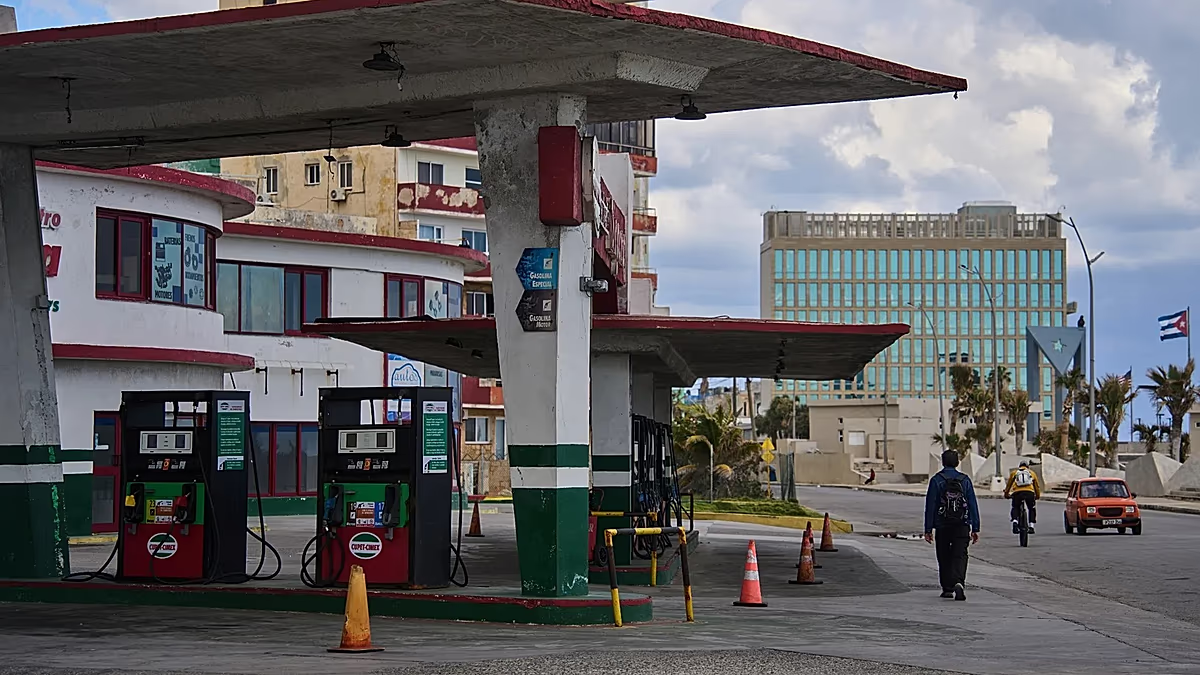
The Cuban government, which had not issued an immediate response to these latest measures, has a longstanding and consistent position on such U.S. actions. Havana views all sanctions as components of a comprehensive economic blockade designed to inflict collective punishment on the Cuban people, strangling the economy to create hardship and instability that would precipitate political change. The reality on the ground in Cuba underscores the severity of the energy crisis; Cupet’s public fuel sales are virtually non-existent, and strict rationing is in effect. The new sanctions drew sharp criticism from some policy analysts familiar with the island’s logistical constraints. Ricardo Herrero, of the nonpartisan Cuba Study Group, expressed confusion and concern, noting that private sector importers—previously encouraged by U.S. humanitarian exceptions—rely on Cupet’s storage and distribution infrastructure. He suggested the move either signals a much larger, undisclosed policy shift or represents a descent into “indiscriminate cruelty,” directly undermining efforts to provide relief to the Cuban population.
This sanctioning of Cupet is not an isolated event but part of a rapidly intensifying pressure campaign by the Trump administration. It follows by less than a week the direct sanctioning of Cuban President Miguel Díaz-Canel and other senior officials. The legal effect of the Cupet sanctions is to block all property and interests of the company found within U.S. jurisdiction or controlled by U.S. persons. Secretary Rubio framed this within the administration’s overarching goal, stating the desire is for “a new future for the Cuban people with greater economic and political freedom,” and vowing to continue targeting the regime’s ability to use energy trade to support its “corrupt agenda” and repressive apparatus. These measures compound the severe difficulties Cuba already faces under a decades-old U.S. embargo and a chronic lack of petroleum, as the U.S. continues to push for a fundamental transformation of the island’s socialist model.
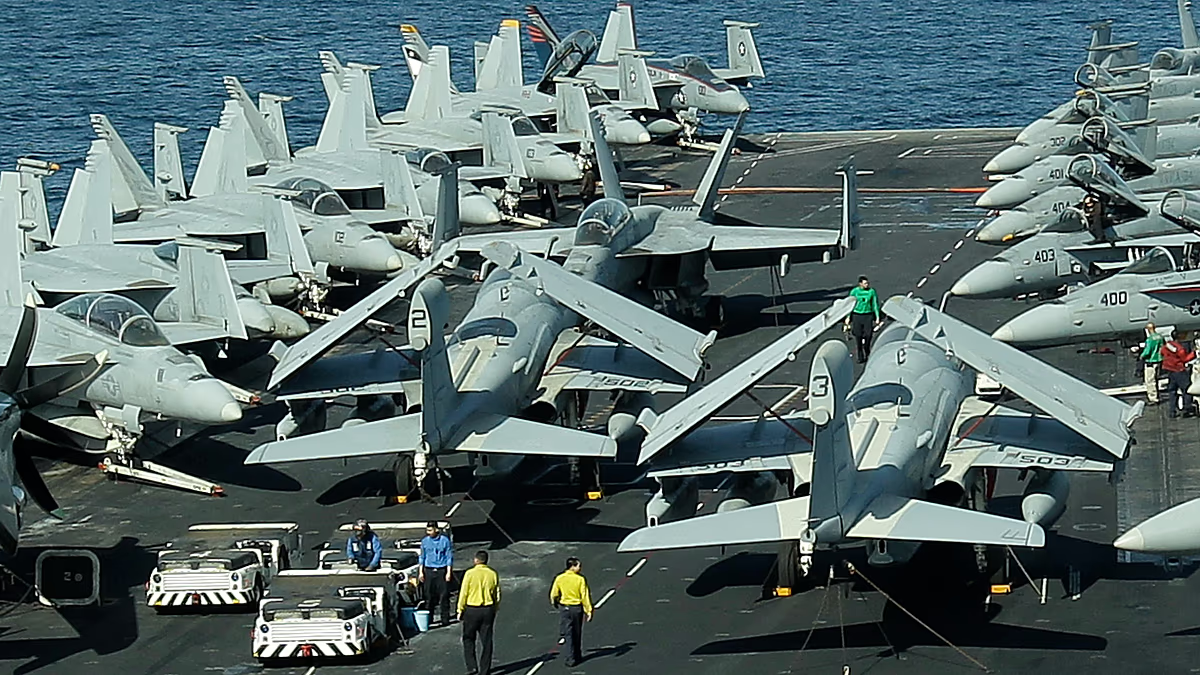
The practical consequences for everyday life in Cuba are dire and immediate. The nation has been gripped by a profound economic and energy crisis for years, leading to routine power outages. These blackouts have worsened significantly since late January, when President Trump threatened tariffs on any country supplying oil to Cuba, effectively further isolating the island from international energy markets. While both nations have acknowledged back-channel talks, their substance and scope remain unclear, offering little hope for diplomatic resolution. Meanwhile, the administration’s rhetoric has grown increasingly militaristic. President Trump has explicitly threatened military action against Cuba, framing it as a logical next step following interventions in other nations. Just last week, he stated that Cuba had “sort of collapsed” and promised, “we’re going to handle that as soon as we’ve finished” with operations in Iran, drawing a direct and alarming connection between disparate foreign policy fronts.
This series of actions marks a pivotal and dangerous hardening of U.S. policy. Moving beyond the broader embargo to directly sanction the head of state and the critical state energy enterprise represents a strategic escalation aimed at the regime’s core stability. However, the approach is fraught with humanitarian contradictions and risks. By targeting Cupet, the U.S. is impairing the very infrastructure needed for any fuel distribution, including that which might benefit the Cuban people or the emerging private sector. This creates a paradox where policy aimed at empowering the population may instead deepen their deprivation, potentially consolidating government control over scarce resources rather than weakening it. The accusations of energy being used as a tool of social control thus risk becoming a self-fulfilling prophecy, as extreme scarcity inevitably increases state management of daily life.
In conclusion, the new sanctions against Cupet signify a strategic intensification designed to exacerbate the Cuban government’s most acute vulnerability: energy. Yet, this policy advancement occurs alongside increasingly volatile rhetoric that raises the spectre of military confrontation. The combined effect is to heighten tension to its highest point in decades, while the humanitarian fallout disproportionately affects Cuban civilians. The administration’s stance appears to be one of seeking decisive capitulation or collapse of the socialist system, betting that maximum pressure will catalyze political change. However, this gamble disregards the complex history of U.S.-Cuba relations, the resilience of the Cuban state, and the profound suffering inflicted upon millions of ordinary people who become collateral in a prolonged geopolitical struggle. The path forward seems to offer either a breakthrough borne of unbearable pressure or a tragic deepening of a humanitarian crisis, with the latter appearing, at present, the more likely outcome.