

The Escalating Conflict: Trump’s Threat to Seize Iran’s Oil Lifeline
The already volatile situation in the Middle East has taken a perilous turn, with former US President Donald Trump vowing a significant escalation in the conflict with Iran. In a stark social media declaration, Trump announced plans for imminent, heavy strikes against Iran, followed by an even more ambitious goal: the seizure of Iran’s crucial oil infrastructure, specifically naming Kharg Island. This threat marks a dramatic intensification of military rhetoric and action, moving beyond targeted strikes to a declared objective of controlling a sovereign nation’s primary economic artery. The statement, framed as a continuation of policies seen in Venezuela, suggests a strategy of economic strangulation through direct military occupation of energy assets, a move that would fundamentally alter the nature of the conflict and its global implications.
The Prize: Kharg Island’s Critical Role
At the heart of Trump’s threat lies Kharg Island, a modest landmass in the northern Persian Gulf that serves as the beating heart of Iran’s oil economy. This island, though only about five miles wide, is an industrial powerhouse, featuring vast storage facilities, pipelines, and loading terminals. It is here that crude oil from Iran’s major fields converges before being shipped to global markets. An estimated 90% of Iran’s crude exports flow through Kharg Island, with China and other Asian nations being key destinations. For an Iranian government already under immense pressure, this infrastructure represents a lifeline; oil revenue remains a critical pillar of the national budget. An attack on Kharg would therefore be more than a military strike—it would be a direct assault on the economic survival of the Iranian state, with devastating consequences for its population.
A Cycle of Violence Spirals Toward Full-Scale War
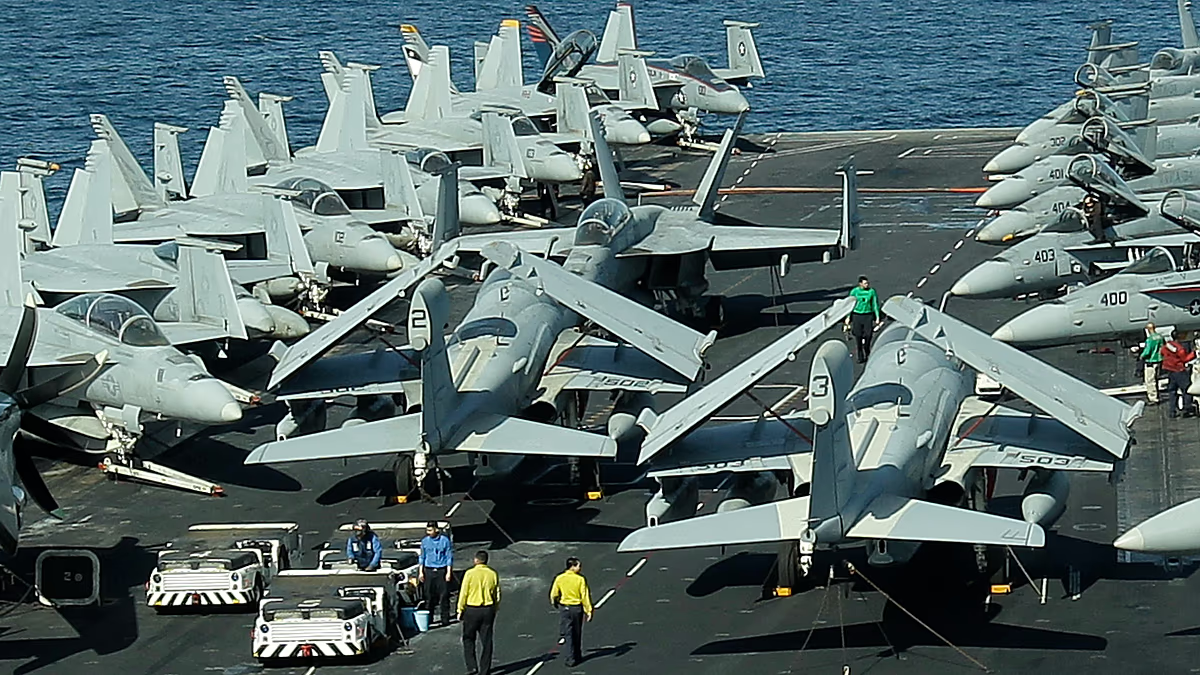
Trump’s proclamation did not occur in a vacuum. It came on the third consecutive day of reciprocal attacks between US and Iranian forces, a dangerous tit-for-tat that has eroded earlier, fragile attempts at de-escalation. The US strikes reportedly grew more intense, while Iranian forces retaliated against locations in neighboring Kuwait, Bahrain, and Jordan. Meanwhile, the US military enforced a stringent blockade of Iranian ports, going so far as to disable a tanker attempting to transport Iranian oil—an action emblematic of the economic warfare running parallel to the physical conflict. Tragically, this wider naval war has already claimed civilian lives, with an earlier attack on a merchant ship killing three Indian sailors. With diplomatic efforts stalled, each new strike pushes the region closer to the brink of a full-scale, open war, a scenario both sides have sought to avoid but now seem inexorably drawn toward.
The Strategic Chokepoint: The Strait of Hormuz
Compounding the crisis is the ongoing struggle over one of the world’s most vital maritime corridors: the Strait of Hormuz. Iran has wielded control over this narrow passage as a strategic card, severely restricting the flow of oil tankers and thus disrupting global energy supplies. This stranglehold has had ripple effects far beyond the Middle East, contributing to increased fuel prices and making basic goods more expensive worldwide. Iran’s recent announcement of a full closure of the strait—though its practical meaning was unclear given existing restrictions—underscored its leverage. The US has contested this control, with Trump claiming successful covert operations to sneak vessels through. This battle for the strait is a central, unresolved issue in any negotiation, symbolizing the deep trust deficit and the high economic stakes involved for the entire globe.
The Unresolved Shadow: Iran’s Nuclear Program
Looming behind the immediate firefight is the persistent and profound dispute over Iran’s nuclear ambitions. The US and Israel, citing Iran’s stockpile of highly enriched uranium, maintain that the ultimate goal of their military campaign, which began in late February, is to permanently prevent Iran from developing a nuclear weapon. Iran insists its programme is solely for peaceful, civilian purposes. This fundamental disagreement over intent and capability forms the bedrock of the conflict, fueling mutual suspicion and justifying, in the view of Washington and Tel Aviv, preemptive military action. The nuclear issue adds a layer of existential threat to the hostilities, making a simple ceasefire more difficult to achieve, as any pause could be interpreted as providing Iran with more time to advance its disputed nuclear work.
A World on the Brink
The convergence of these factors—the threat to seize core economic assets, the daily exchange of strikes, the battle for a global oil chokepoint, and the unresolved nuclear dilemma—paints a picture of a region teetering on the edge of a catastrophic expansion of war. Trump’s threat against Kharg Island is not merely another military warning; it is a blueprint for a profound escalation that would blur the lines between warfare and economic conquest. The Iranian government, with its back against the wall, faces an existential challenge to its sovereignty and economic survival. As diplomatic channels falter and the rhetoric hardens, the international community watches with apprehension. The consequences of the next move will extend far beyond the Persian Gulf, threatening global energy stability, regional security, and countless innocent lives caught in the crossfire. The path back from this brink seems perilously narrow.