




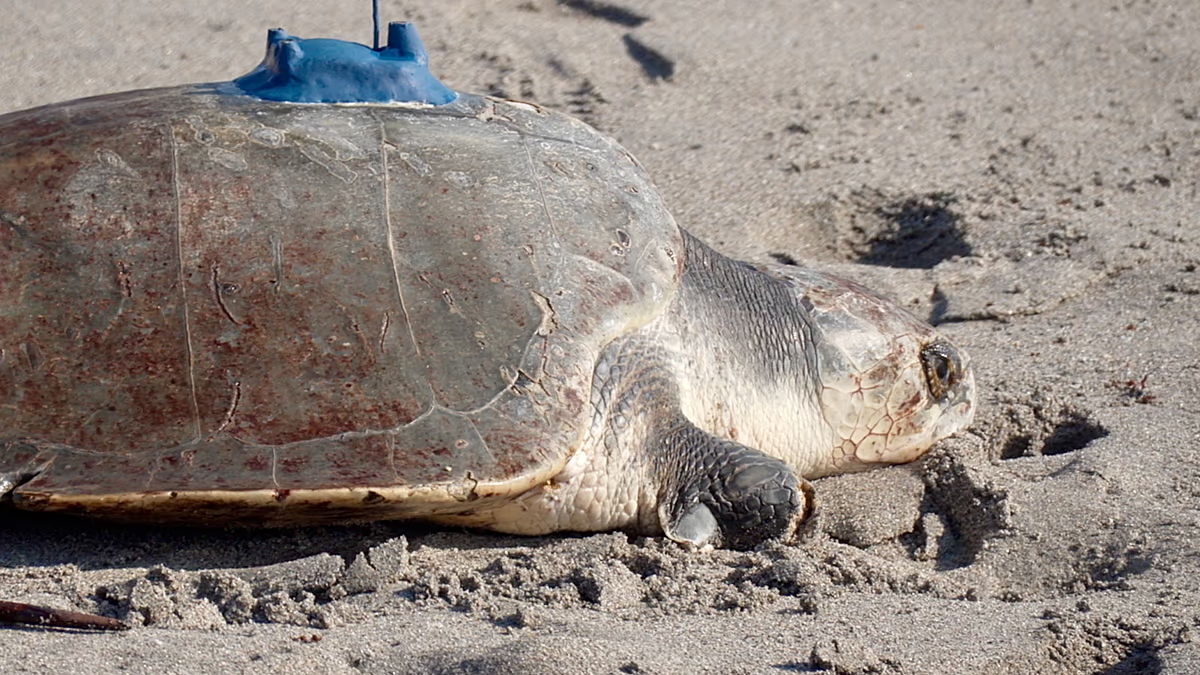
In an announcement that has captured global attention for its extraordinary nature, China’s Ministry of State Security has publicly accused foreign governments of employing marine life as espionage agents. According to a social media post published on June 12, 2026, international spy agencies are allegedly fitting sea turtles, fish, and other “relatively large marine animals” with sophisticated sensors. These creatures, dubbed “spy turtles” and “spy fish” by the ministry, are said to be deployed in specific Chinese waters. Their purported mission is to methodically collect sensitive oceanographic data—including precise measurements of water temperature, salinity, and current patterns—and transmit this information overseas via satellite. This startling allegation frames espionage not as a shadowy human endeavor, but as a clandestine operation conducted by the very fauna of the sea, blending Cold War-era intrigue with a bizarre, almost cinematic, sci-fi narrative.
Beijing contends that this captured data is far from benign scientific research. The ministry asserts that the intelligence gathered through these biological operatives is intended for a singular, hostile purpose: to meticulously create underwater maps of China’s coastline. By understanding the complex marine environment in such detail, foreign powers could theoretically identify vulnerabilities and weak points in China’s coastal defenses. The ministry’s statement explicitly frames this as “a serious threat to China’s national security,” suggesting that the knowledge of ocean currents or submerged channels could be used to plan covert naval incursions or submarine activities. Consequently, the call to action was clear and directed inward: Chinese citizens, particularly fishers, were urged to remain hyper-vigilant and report any unusual buoys or devices found at sea, while businesses were warned to conduct stringent security checks on any equipment imported from abroad.
This unusual episode did not occur in a vacuum; it is the latest volley in an escalating global exchange of espionage accusations. China itself has been frequently accused by Western nations of extensive spy operations targeting technological and military secrets. Just one month prior to the “spy turtle” announcement, Beijing angrily denounced the convictions of two men in the United Kingdom for spying on Hong Kong dissidents, labeling the case a “political farce” and criticizing Britain’s “erroneous practices.” Furthermore, in May of the same year, German police arrested a married couple on charges of spying for China, alleging they were seeking information on advanced technology with potential military applications. These reciprocal allegations highlight a world deeply mired in mutual suspicion, where technological advancement and national security are inextricably linked, and where every diplomatic relationship carries an undercurrent of clandestine rivalry.
The European front has been particularly active in this shadow war. Back in February, French authorities, as reported by Agence France-Presse, charged four individuals, including two Chinese nationals, with the suspected interception of sensitive military data. In the same month, Greek military authorities arrested an army colonel on suspicion of providing classified and top-secret information to China, according to a statement from the country’s General Staff of National Defence. This pattern of incidents underscores a sustained focus by Western intelligence agencies on what they perceive as Beijing’s aggressive efforts to acquire foreign military and technological secrets. China’s “spy turtle” claim can therefore be interpreted not just as a standalone accusation, but as a strategic counter-narrative—an attempt to reframe the global espionage conversation by presenting China not as a perpetrator, but as a victim of equally relentless and ingeniously invasive foreign operations.
Beneath the surface of this peculiar story lies a deeper truth about modern espionage and geopolitical tension. The very premise, while seemingly outlandish, speaks to the genuine paranoia and one-upmanship that defines contemporary state rivalries. In an era where drones, cyber-attacks, and satellite surveillance are commonplace, the idea of weaponizing nature represents a symbolic escalation, a metaphor for the lengths to which nations will go to gain an edge. It also reflects the immense strategic importance of oceanographic data in an increasingly contested maritime domain, particularly in regions like the South China Sea. Whether a literal belief or a deliberate propaganda tool, the narrative serves to bolster domestic security consciousness, rallying the public around the flag by invoking a novel and tangible threat, even if it arrives on the shell of a turtle.
Ultimately, the tale of China’s “spy turtles” is a fascinating window into the complex theater of 21st-century geopolitics. It blends genuine security concerns with elements of psychological operations and public messaging. While the literal image of turtles transmitting state secrets may strain credulity for many international observers, the underlying message is deadly serious: China views itself as being in a continuous, multi-front struggle for information supremacy. This incident, nestled among a flurry of more conventional espionage cases, reminds us that in the high-stakes game of global intelligence, the lines between science fiction and security reality are often blurred, and every new accusation, no matter how unusual, is another move in an endless, silent war waged beneath the waves and in the corridors of power.