

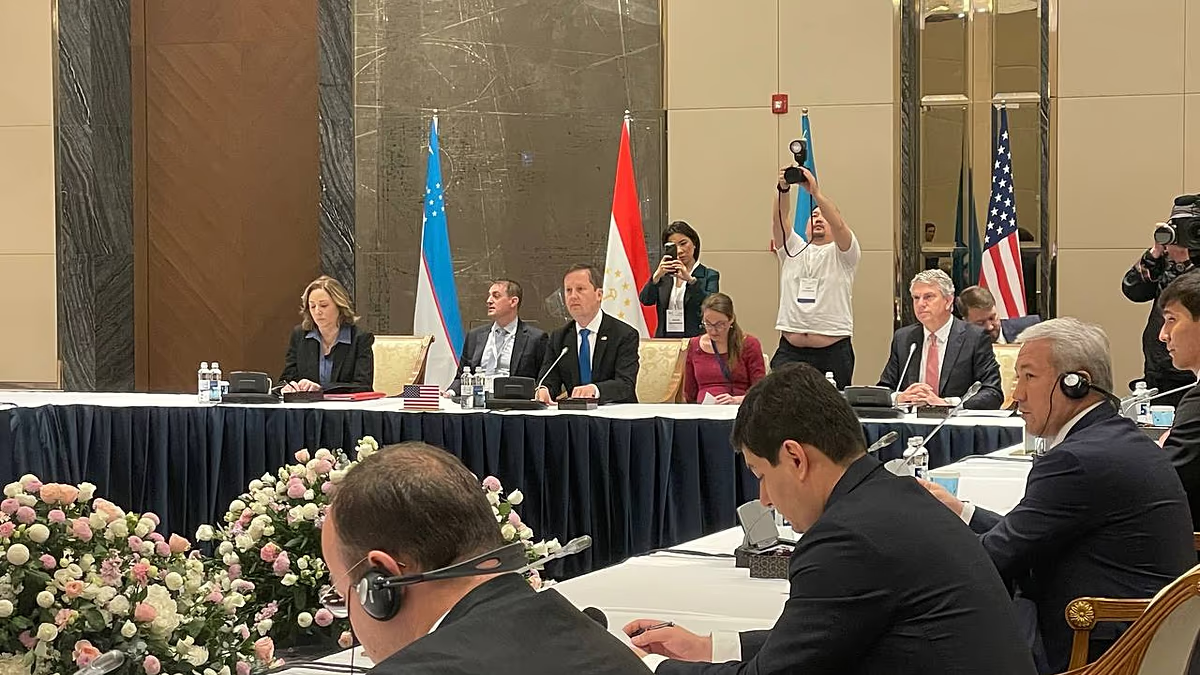
In a significant diplomatic and economic engagement, the United States has taken a major step to deepen its partnership with the resource-rich nations of Central Asia. US Special Envoy for South and Central Asia, Sergio Gor, recently convened the first in-person meeting of a critical minerals dialogue under the C5+1 framework, which brings together the five Central Asian republics—Kazakhstan, Uzbekistan, Kyrgyzstan, Tajikistan, and Turkmenistan—with the United States. This gathering marks a tangible move to fulfill a commitment made during last year’s historic C5+1 summit in Washington, hosted by then-President Donald Trump. Envoy Gor emphasized that the Trump administration had recognized Central Asia had been overlooked for too long and was determined to forge a new, more attentive relationship. The tone was set for collaboration, with Gor assuring Kazakh President Kassym-Jomart Tokayev that he had “a friend in the White House,” signaling a personal commitment to strengthening bilateral ties at the highest levels.
The driving force behind this renewed engagement is the immense and largely untapped mineral wealth of Central Asia, which has become a strategic priority for Western nations seeking to diversify their supply chains for critical raw materials. These minerals, essential for everything from smartphones and electric vehicles to advanced defense systems, are currently concentrated in a few global sources, creating vulnerability. Kazakhstan, as the regional leader, sits on a geological treasure trove, with over 9,500 identified deposits and more than 100 containing rare earth and other strategic minerals. The other Central Asian states also hold significant potential, offering the US a viable alternative to existing suppliers. However, unlocking this potential is not merely a matter of extraction; it requires a holistic partnership spanning the entire value chain, from modern geological surveys—many deposits were only preliminarily mapped in the Soviet era—to processing, refining, and ultimately delivering finished materials to global markets.
A central challenge, and a key area of cooperation, is logistics. As landlocked countries, Central Asian nations depend on complex transit corridors to reach international customers. The focal point of discussions is the Trans-Caspian International Transport Route, or “Middle Corridor,” which connects the region to Europe via the Caspian Sea, the South Caucasus, and onward links. Officials like Azamat Panbayev of Kazakhstan’s Ministry of Industry and Construction highlighted that developing this artery is a shared priority, noting its dynamic growth in cargo traffic. For the US, supporting the enhancement of this corridor is a strategic investment, ensuring that critical minerals can reliably bypass traditional routes and reach Western markets efficiently. This logistical partnership underscores a move beyond mere resource extraction toward building integrated, resilient trade infrastructure that benefits the entire region’s economic sovereignty and global connectivity.
From the perspective of Central Asian governments, particularly Kazakhstan, the US engagement is welcomed as a vital source of balance in a region historically dominated by Russian influence and increasingly courting significant Chinese investment. Said Sultanov, a mining industry expert in Astana, encapsulated this view, noting that the arrival of American companies creates a healthier, more competitive market environment. Kazakhstan’s ambition extends far beyond exporting raw ores; it seeks a transformative partnership. Officials have proposed joint ventures in processing facilities, extensive technology transfer, research collaborations, and workforce training programs. This model mirrors the successful US investment that revolutionized Kazakhstan’s oil and gas sector in the 1990s, and the nation now aims to replicate that success in mining. The groundwork is already being laid, with agreements worth over $20 billion discussed last year, including deals on uranium, tungsten, and rare earth elements.
Concrete progress is already evident on the ground. Investment in geological exploration in Kazakhstan has skyrocketed, more than tripling since 2018 to exceed $1 billion, attracting global mining giants like Rio Tinto and Barrick Gold. New, investor-friendly terms are being implemented, such as a landmark tungsten agreement where US-backed Kaz Resources Inc. will hold a 70% stake. This demonstrates a flexible approach designed to attract foreign capital and expertise while safeguarding national interests. Projects like the development of the Severniy Katpar and Verkhniy Kairakty deposits with Cove Capital are moving forward, promising to build domestic processing capacity. For Kazakhstan and its neighbors, this wave of investment is a pathway to technological modernization, high-skilled job creation, and a more diversified, high-value economy no longer reliant solely on raw commodity exports.
Looking ahead, critical minerals cooperation is firmly established as a cornerstone of the US-Central Asia relationship. With further C5+1 discussions planned this year, the dialogue initiated by Envoy Gor is poised to evolve into lasting, on-the-ground partnerships. This initiative represents a strategic recalibration: for the United States, it secures access to vital resources within a framework of mutual economic benefit and diplomatic partnership. For the nations of Central Asia, it represents a historic opportunity to leverage their natural endowments to attract diverse foreign investment, foster economic development, and enhance their geopolitical agency. By building connections across the value chain—from exploration to export—this collaborative framework promises not just to extract minerals, but to help build futures, transforming the region into a key node in the global supply chain of the 21st century.