



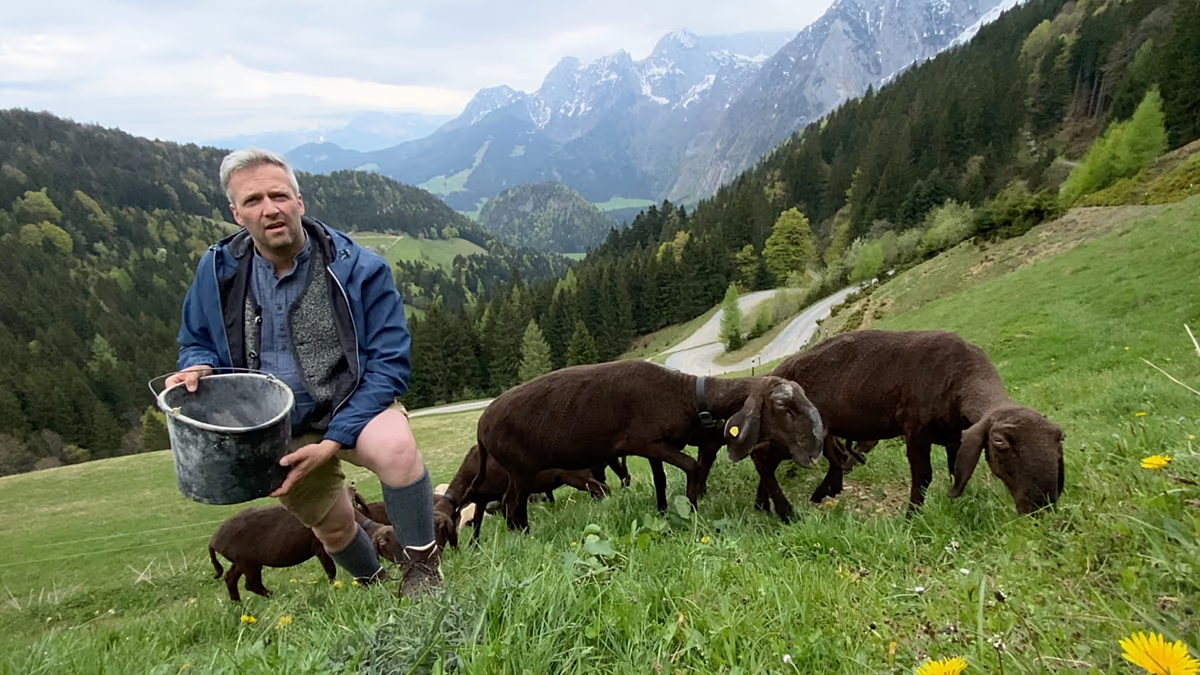
In the serene market town of Abtenau, near Salzburg, Josef Quehenberger, a 46-year-old former sales representative, finds deep fulfillment in his life as a tenth-generation farmer. His story is one of deliberate choice and profound connection to the land. Fifteen years ago, he left his previous career to take over the family farm, where he now tends to sheep, cows, and turkeys, embracing both traditional practices and innovative ventures like producing gardening pellets from sheep wool and delivering organic meat directly to customers. For Josef, the farm is a living testament to resilience, having endured epidemics, world wars, and societal upheavals. His hard work is imbued with a sense of duty and pride, a heartfelt commitment to steering this enduring legacy into the future. He embodies a quiet conviction that this life, though demanding, is inherently meaningful.
Josef is not alone in his passion. Abtenau, with its 6,000 inhabitants, is a thriving hub for over 200 farms, each contributing to a vibrant agricultural community. Johanna Wallinger, who settled here three decades ago, is a prime example. She has built a flourishing operation centered on 200 goats and her own cheese-making facilities. Johanna speaks with conviction about “authentic farming,” believing strongly in Austria’s potential to produce naturally and maintain a close, transparent relationship with consumers. This philosophy of authenticity and proximity is not just an ideal but a practiced reality, forming the bedrock of the local food ecosystem.
This ethos is powerfully manifested in the cooperative shop where Johanna and about 60 other local producers bring their meat, cheese, yogurt, vegetables, and herbs. The model is a classic “farm-to-fork” short-circuit, deliberately eliminating middlemen. As the shop’s general manager, Georg Buchegger, explains, the core idea is beautifully simple: to allow micro-enterprises to market their own produce so that the economic added value circulates and remains within the local community. This approach strengthens local economies, fosters direct connections between producers and consumers, and ensures that the story behind the food—the faces and the farms—is never lost.
Crucial to this thriving sector is a robust framework of public support, primarily channeled through the Salzburg Chamber of Agriculture. With 35,000 members, the Chamber acts as a comprehensive backbone for farmers, offering training, legal and business advice, guidance on subsidies, and promotional support. Its president, Rupert Quehenberger, readily acknowledges that local farmers face the same daunting challenges as their European counterparts: stifling bureaucracy and volatile markets. However, he identifies a distinctive local characteristic—their small-scale structure—as both an advantage and a disadvantage. While it prevents competition with industrial mass producers, it forces a focus on superior quality and traceability. The survival strategy, he notes, is ensuring that a product is “recognisable” and “has a face,” turning perceived limitations into a powerful market identity.
To institutionalize this value of local origin, Salzburg’s authorities have developed a coveted certification label. Managed by Salzburg Agrar Marketing, this label certifies the regional provenance of goods and is a key tool in enhancing their market appeal. Günther Kronberger, the Managing Director, notes the label’s impressive reach, covering thousands of certified products and hundreds of restaurants and public kitchens that commit to using a significant proportion of regional ingredients. This system of controlled certification provides a trusted guarantee to consumers and creates a reliable market for producers, effectively bridging the gap between the farm and the broader community.
Looking ahead, the region understands that its agricultural future depends on inspiring and training new generations. Austria boasts around 70 dedicated farming schools, including the Winklhof Farming School near Salzburg, which trains 260 students aged 14 to 17. Applications have skyrocketed in recent years, a hopeful sign for the sector. The school’s director, Georg Springl, emphasizes an education that shapes young people for both professional and personal life, teaching essential skills and a holistic understanding of their future role. This mission is taken seriously by practicing farmers like Johanna Wallinger, who sees it as her responsibility to project a positive and joyful vision of the profession. Her concluding reflection captures a essential truth: “If you just complain all the time or see the disadvantages, then the next generation won’t enjoy the job either.” It is this forward-looking spirit of pride, community, and purposeful support that secures a resilient future for this enduring way of life.