



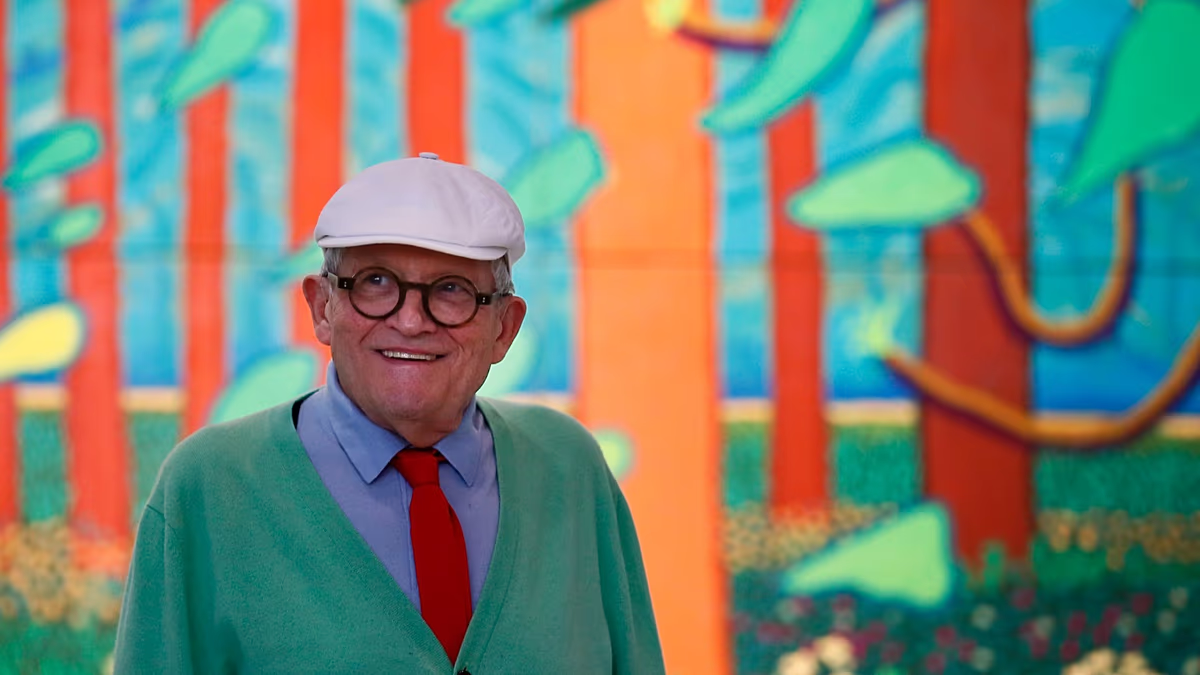
The art world has lost one of its most luminous and enduring lights with the passing of David Hockney at his London home, just weeks shy of his 89th birthday. As confirmed by his publicist, Erica Bolton, Hockney’s death marks the end of an era for an artist whose joyful, inventive, and deeply human work captured the imaginations of millions across the globe. More than just a painter, Hockney was a beloved cultural figure whose career, spanning over six decades, was a continuous, vibrant exploration of how we see the world around us. From the smoky industrialism of his native Bradford to the dazzling pools of Los Angeles and the rolling landscapes of Yorkshire and Normandy, Hockney transformed his personal vistas into universal celebrations of color, light, and life itself.
Hockney’s artistic journey began at the Royal College of Art, where he emerged as a leading figure in the British Pop Art movement. However, it was his 1963 move to Southern California that truly defined his early career and public persona. Captivated by the stark geometry, brilliant light, and hedonistic spirit of Los Angeles, he produced some of his most iconic works, such as A Bigger Splash (1967), which immortalized the glamour and tranquility of the suburban swimming pool. In a 1979 interview with the Los Angeles Times, he captured his affection for the city, stating, “I’m excited every day… I never find anything dreary in Los Angeles.” Equally significant was his courageous and candid depiction of queer love and intimacy at a time when homosexuality was still criminalized in Britain, challenging conservative social attitudes through the quiet power of his art.
Never one to be confined by geography or convention, Hockney’s later years saw a profound return to the European countryside, where he found fresh inspiration in the pastoral beauty of Yorkshire’s hills and, later, the serene vistas of Normandy. This period underscored his status as one of Britain’s most celebrated artists, with his works achieving staggering commercial success; his 1972 masterpiece Portrait of an Artist (Pool with Two Figures) sold for $90.3 million in 2018, setting a record at the time for a living artist. As historian Simon Schama eloquently noted, the global adoration for Hockney’s work stems from its fundamental “expectation of pleasure.” His art, in all its phases, was a generous invitation to share in his delight, making his popularity both profound and perfectly understandable.
What set Hockney apart was his relentless, joyous curiosity and his refusal to settle into a single, recognizable style. He was a virtuoso of many mediums, mastering and innovating within pen and ink, photography, printmaking, opera set design, and photographic collage. In his later decades, he embraced digital technology with the enthusiasm of a young pioneer, creating vibrant, large-scale works on his iPad. This practice connected him with a new generation of admirers, culminating in works like the epic, 70-meter-long A Year in Normandie, a digital scroll that paid homage to the Bayeux Tapestry and Chinese painting traditions. His creative spirit remained entirely contemporary, as evidenced by his 2022 portrait of pop icon Harry Styles, displayed in his acclaimed ‘Drawing from Life’ exhibition.
This boundless inventive energy led art curator Norman Rosenthal to hail Hockney as “the Picasso of our times,” a comparison that speaks to his revolutionary impact on visual culture. Like Picasso, Hockney fundamentally changed how we perceive our world, whether through the fractured perspective of his photo collages or the radiant simplicity of his iPad landscapes. His work was a lifelong experiment in seeing, driven by an insatiable desire to capture the experience of looking. Even in his eighties, he maintained a rigorous daily practice, telling The Sun in 2017, “It’s my work that keeps me young… Sixty years of getting up every day and doing exactly what I want to do.”
David Hockney’s legacy, therefore, is not merely a collection of beautiful images, but a philosophy articulated through color and form: a profound belief in the importance of paying attention, finding beauty in the everyday, and embracing new tools to express timeless wonder. He traversed continents and mediums, yet his subject was always the same—the radiant, fleeting, and exquisite experience of being alive. He leaves behind a world brightened by his vision, a testament to a life and career dedicated to the pure, unadulterated pleasure of creation. His work remains a permanent invitation to open our eyes and see the world with the same vibrant, hopeful curiosity that he did, every single day.