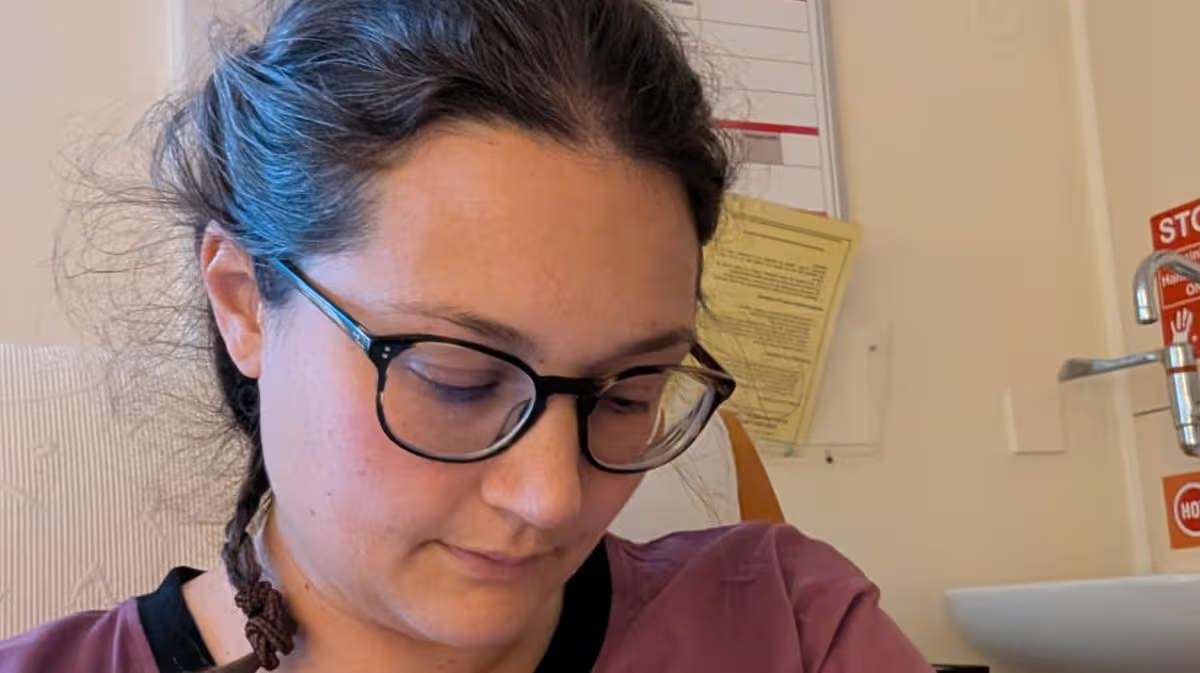


Behind the towering walls and razor wire of Britain’s women’s prisons exist lives shrouded in myth and stereotype. A new book, Inside: Women Behind Bars, by authors Jonathan Levi and Dr. Emma French, challenges these perceptions by offering unprecedented insight into this hidden world. Through interviews with former staff, governors, and prisoners themselves, the authors reveal the jarringly ordinary human realities behind some of the nation’s most notorious female felons, while also casting light on the silent majority of women who populate these struggling institutions. The portrait that emerges is one of profound contradiction, where infamous monsters are encountered as unassuming elderly inmates, and where a system in crisis manages to function as a makeshift hospital, refuge, and nursery all at once.
Perhaps no moment captures this dissonance more powerfully than an encounter at New Hall Prison in West Yorkshire. An elderly inmate, described as slight and mumsy, with skinny legs and a noticeable tummy, shuffled to a fellow prisoner’s door the night before her release. She offered heartfelt advice: “If you end up with a bad man, then run away from that man and run to the police… Wherever you’re going, whatever you do, I hope you don’t come back here.” The woman speaking was Rose West, a serial killer who, alongside her husband Fred, committed atrocities that horrified the nation. The recipient of this counsel was stunned, describing it as “surreal.” For the authors, this moment illustrates a critical gap: the monstrous public persona versus the underwhelming, aged reality after decades inside, and perhaps even a flicker of regret for a life consumed by evil.
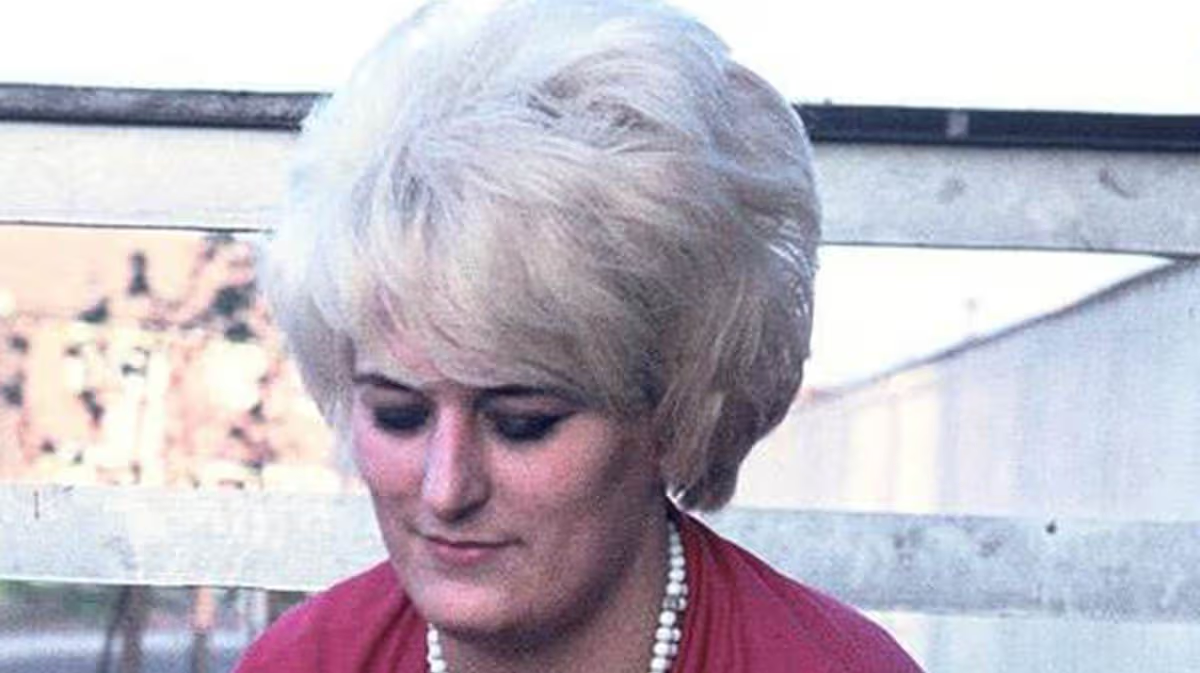
The book delves into the prison personas of other infamous women, consistently finding a chasm between their media images and the observed daily realities. Former governor Vanessa Frake Harris, who ran Holloway’s segregation unit, recalls West as “very quiet; a thinker,” a far cry from the violent psychopath of popular portrayal. She recounts the blank, emotionless response West gave upon being told of Fred’s suicide. Similarly, the terrifying visage of Myra Hindley’s police mugshot—a cultural shorthand for evil—belied the woman described by retired prison officer Debbie James as “very agreeable, mild and inoffensive” in later life, a trusted hospital orderly with “ordinary eyes.” Yet, as author Emma French notes, Hindley’s name retained such power that she became “the prisoner who could never be freed,” her notoriety an inescapable life sentence of its own.
This dynamic of notoriety is explored through figures like Joanna Dennehy, one of only three women in British history to receive a whole-life order. Described by her trial judge as “cruel, calculating, selfish and manipulative,” she was known in prison for her detailed escape plots and gym-honed physique. Former inmate Neah Tuohy, however, did not find her scary, noting her petite frame. As former governor Suzy Dymond-White explains, such infamy becomes a perverse currency, elevating status within the prison pecking order. Dennehy herself acknowledged an obsession with her own profile. These chapters reveal how the legend of the prisoner often exists separately from the living, breathing person serving the time, each shaping the other in complex ways.
Yet, as compelling as these stories are, the authors stress that the Wests and Hindleys are the extreme exceptions. The true heart of the book lies in the everyday, unspoken stories of the roughly 3,600 women incarcerated in England and Wales, over three-quarters of whom are imprisoned for non-violent offences. The authors argue that the women’s prison system, small and hidden, is forced to act as a multi-service agency—a detox unit, a mental health facility, a refuge—while being a system originally designed for men and now in crisis, plagued by self-harm and scarce resources. For many inmates, motherhood continues from behind bars, involving the agonizing management of birthdays, homework, and family ties from a distance. The profoundly moving account of Yvonne Simpson, who gave birth in custody and hid her postnatal depression for fear of her baby being taken away, only to be released alone with her belongings piled on a double pushchair, epitomizes these hidden struggles.
In the end, Inside: Women Behind Bars serves as a powerful correction to public perception. It does not seek to sanitize or excuse horrific crimes, but to contextualize them within a broader, more tragic landscape. The system described is one that holds the uniquely abhorrent alongside the desperately vulnerable—women who stole to feed an addiction, who were coerced by partners, or whose mental illness went untreated. As Emma French soberly concludes, the line between these populations is often perilously thin, a matter of circumstance, bad decisions, or bad relationships. The book’s greatest service is its humanization of a world we rarely see, reminding us that behind the headlines of monstrosity lies a spectrum of flawed, complex, and damaged humanity, all contained within a system barely holding itself together.