

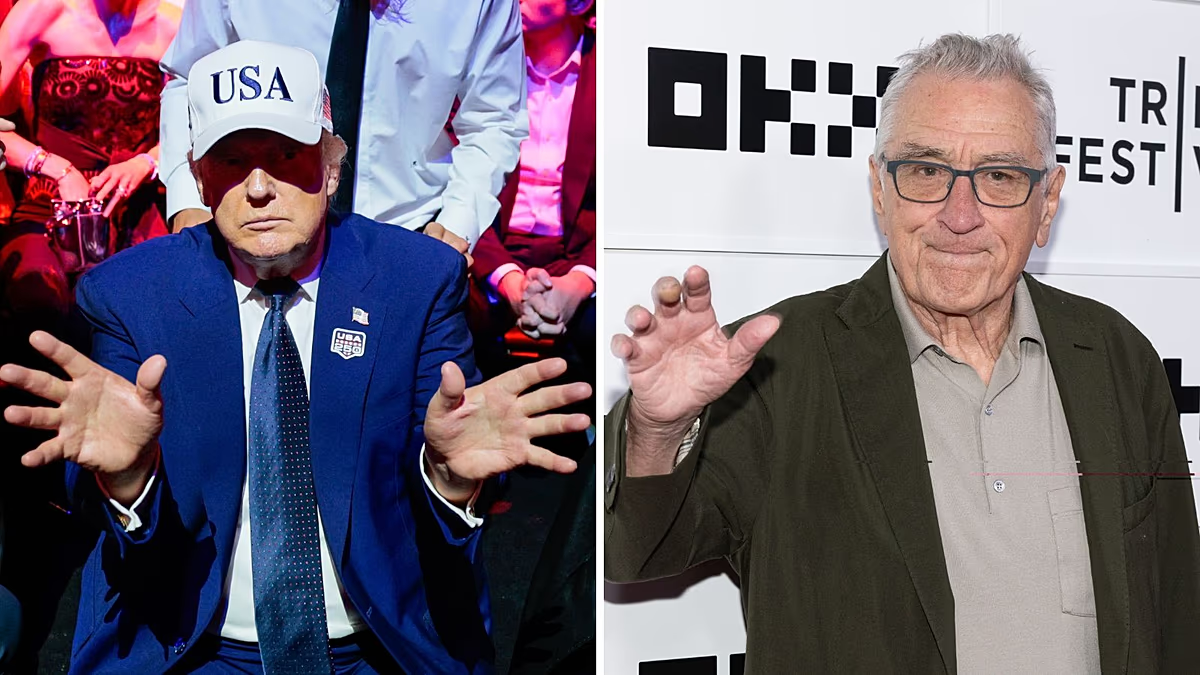
In a striking act of political counterprogramming, Academy Award-winning actor Robert De Niro took the stage at a New York City “Rise Up” event, positioned as a direct alternative to celebrations for Donald Trump’s 80th birthday. The gathering, framed as a celebration of the First Amendment, provided a platform for the 82-year-old cinematic icon to deliver a searing, deeply personal condemnation of the former president. De Niro, framing himself as a near-absolutist on free speech, argued that the principle demands a vigorous response to dangerous rhetoric. He wielded his own speech as a weapon, bluntly illustrating his point by quoting Trump’s recent claim that he doesn’t think about Americans’ financial situation. To that, De Niro responded with a coarse, cinematic callback: “Shut the fuck up,” a line echoing his character from the 1988 film Midnight Run. The audience, energised, later erupted into a chant of the same phrase when De Niro cited Trump’s comment, “I love the inflation.”
De Niro’s critique quickly escalated from specific quotes to a broader, more visceral metaphor for the national mood. He expressed a profound alienation, comparing contemporary patriotism to the traumatic dynamic of domestic abuse. “I hate to say it, but loving our country is starting to sound like an abused spouse saying they love their abuser,” he stated, framing his following remarks as a list of grievances he could not forgive. This powerful analogy served as the emotional foundation for a sweeping indictment of policy and leadership, connecting historical actions with present-day governance under Trump’s influence. The actor did not merely critique a political opponent; he portrayed him as the culmination of a national betrayal.
The heart of De Niro’s speech was a litany of what he described as national sins, passionately delivered as reasons he could no longer profess love for his country. He cited “stupid and inhumane wars” costing countless innocent lives, the stripping of healthcare from millions to enrich a wealthy elite he termed the “Trump-Epstein class,” and the deployment of “masked militias” to commit violence and separate families. Each accusation built toward his ultimate target, culminating in the declaration that he could not love a country “led by a racist, misogynist, xenophobic tyrant.” His final, pointed conclusion left no room for ambiguity: “I can’t love the country that’s led by Donald Trump and his sycophant Congress.” The speech was not a policy white paper but an raw emotional appeal, ending with a plaintive wish: “I want to love my country again. I want my country back.”
This public denunciation is far from an isolated incident for De Niro, but rather the latest escalation in a long-running, highly personal feud between the actor and the former president. Earlier this year, following President Biden’s State of the Union address, Trump included De Niro on a list of “lunatic” opponents he suggested should be deported—a list that shockingly included sitting Democratic Congresswomen and American citizens Ilhan Omar and Rashida Tlaib. In a social media post, Trump disparaged De Niro as “Trump Deranged,” “sick and demented,” and a person with an “extremely Low IQ.” He further compared the actor unfavorably to comedian Rosie O’Donnell, another frequent critic, in a stream of insults characteristic of his rhetorical style.
The reference to Rosie O’Donnell underscored another layer of the conflict, touching on Trump’s longstanding pattern of threatening critics with severe, often legally dubious consequences. Last year, Trump had threatened to revoke O’Donnell’s U.S. citizenship—an action explicitly prohibited by a decades-old Supreme Court ruling—after she announced her move to Ireland following his re-election. This context reveals that De Niro’s speech, while uniquely vivid, exists within a broader ecosystem of mutual hostility where political disagreement routinely descends into deeply personal vilification and hyperbolic threats from the former president, challenging norms of public discourse.
Ultimately, De Niro’s “Rise Up” appearance transcends a simple celebrity political endorsement. It represents the intense polarization defining American public life, where cultural icons become frontline combatants in a war of narratives. His use of Hollywood nostalgia, raw emotional analogy, and unvarnished profanity was calculated to cut through the noise, reflecting a segment of the electorate that views Trump not just as a political adversary but as an existential threat to the nation’s character. Whether seen as a courageous stand or partisan grandstanding, the event crystallizes a moment where entertainment, personal grievance, and high-stakes politics are inextricably fused, with the battle for the country’s soul being fought as fiercely on cultural stages as in legislative halls.