

In a landmark ruling that has intensified the national debate over protest, security, and human rights, London’s Appeals Court has upheld the British government’s controversial ban on the activist organization Palestine Action. This decision, delivered on Monday, affirms the 2025 proscription of the group under the UK’s Terrorism Act, making membership or expressed support for it a criminal offence carrying a potential prison sentence of up to 14 years. The ban, which has already led to approximately 3,000 arrests, places Palestine Action on the same official blacklist as militant groups like Hamas and Hezbollah. The group’s co-founder, Huda Ammori, had challenged the proscription as a disproportionate infringement on human rights—a view temporarily upheld by the High Court earlier this year. However, the Appeals Court has now reversed that ruling, concluding that the government’s decision was lawful. In her statement, Judge Sue Carr dismissed the group’s comparison of itself to historical civil disobedience movements like the suffragettes, characterizing it instead as a “covert organisation operating with secret cells” that employs violence against property.
The government’s case, championed by Foreign Secretary Yvette Cooper, rests on the assertion that Palestine Action is not a peaceful protest movement, but a violent organization whose full nature may not be understood by all its supporters. Since its founding in 2020, the group’s stated mission has been to disrupt global complicity in what it calls Israel’s “genocidal and apartheid regime,” a stance that gained significant traction following the outbreak of the Gaza war after October 7, 2023. Its primary targets have been UK-based factories linked to the Israeli defence company Elbit Systems, which it accuses of supplying weapons used in the conflict. The group’s tactics, which often involve property damage and high-profile disruptions, have been the focus of the state’s legal argument. The court’s ruling validates the government’s position that these methods cross the line from protest into terrorism, thereby justifying the severe legal restrictions imposed.
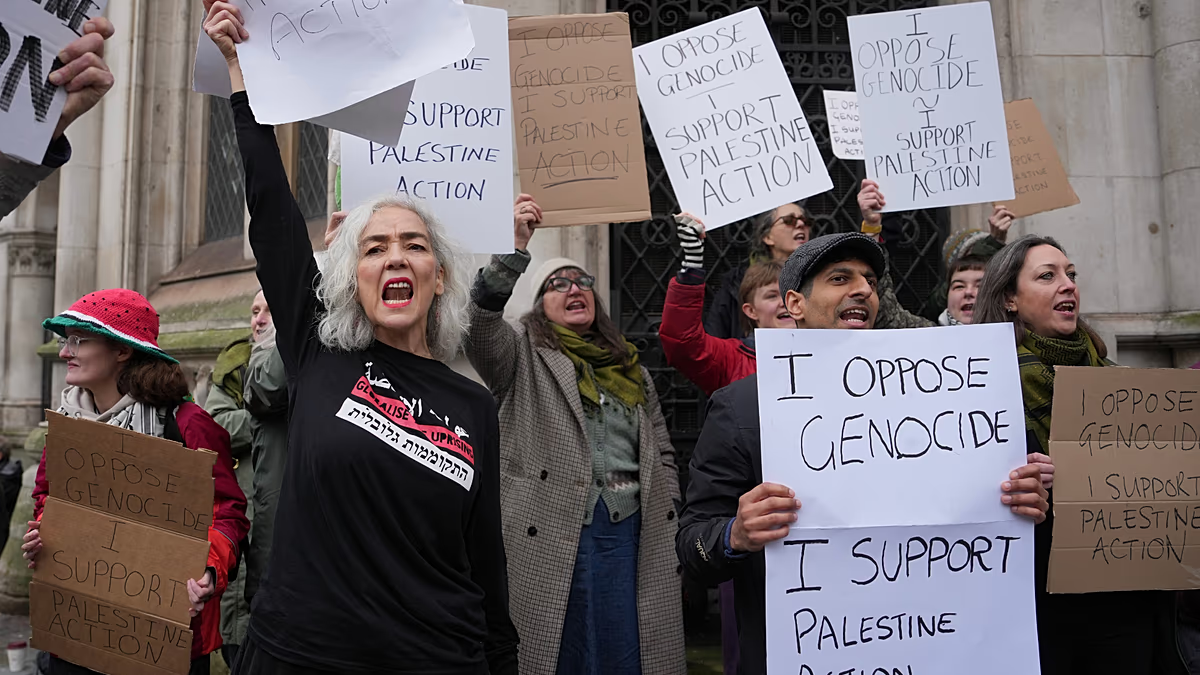
The human impact of this ban is vast and deeply personal, stretching far beyond the organization’s leadership. Among the thousands detained are students, elderly citizens, and a wide spectrum of individuals who have participated in or openly supported the group’s cause. Their arrests frequently occur at demonstrations where individuals hold signs stating, “I oppose genocide, I support Palestine Action”—an act now deemed a terrorism offence. Hundreds now face criminal charges and await court hearings, their lives placed on hold. This sweeping application of the law has sparked profound concerns among civil liberties advocates, who argue that equating non-violent solidarity with a proscribed group to terrorism dangerously chills free speech and the right to protest. The courtroom has become a battleground not just over one group’s methods, but over the fundamental boundaries of dissent in a modern democracy.
The legal context surrounding this appeal was immediately underscored by a separate, starkly relevant case concluded just days prior. On the preceding Friday, four Palestine Action activists were sentenced to prison terms ranging from four years and eight months to seven years and eight months for a 2024 raid on an Elbit site near Bristol. Dressed in red boilersuits, the activists caused over a million pounds worth of damage to drones, computers, and equipment, clashing with security and police in the process; one activist struck a police officer with a sledgehammer, resulting in a fractured spine. The defendants stated their intention was to dismantle weaponry they believed was destined for use in Gaza. This case provided a concrete, dramatic example of the very actions the government cited in its proscription argument, vividly illustrating the tension between the activists’ view of their work as morally necessary disruption and the state’s categorization of it as serious, violent criminality.
This domestic legal struggle unfolds against the immense backdrop of the ongoing Israel-Gaza war, which forms the essential motivation for Palestine Action and the emotional core of its support. The war, triggered by the Hamas attack of October 7, 2023, and followed by Israel’s extensive military campaign, has ignited global debate and protest. The International Court of Justice is currently hearing a case alleging that Israel’s actions constitute genocide, having already indicated a “plausible risk” of such crimes. This international legal perspective is the very framework within which Palestine Action and its supporters justify their urgency and their targeting of arms manufacturers. The UK court’s ruling, therefore, represents a decisive national institution rejecting that a violent direct-action campaign, even one motivated by such grave international allegations, can operate outside the bounds of terrorism law.
Ultimately, the Appeals Court decision solidifies a new and severe reality for protest movements in the United Kingdom. By upholding the terrorism proscription, the ruling grants the state powerful tools to dismantle Palestine Action, criminalizing not only acts of property destruction but also the very expression of support for the group. It draws a firm line, legally distinguishing between acceptable civil disobedience and what it deems covert, violent extremism. For the government, it is a necessary step to protect security and order. For the group and its myriad supporters, it is an alarming escalation that reframes political activism as terrorism and silences criticism of a foreign conflict. As the hundreds of pending cases move through the courts, the reverberations of this ruling will continue to shape the limits of protest, the definition of violence, and the price of solidarity in a deeply polarized world.