


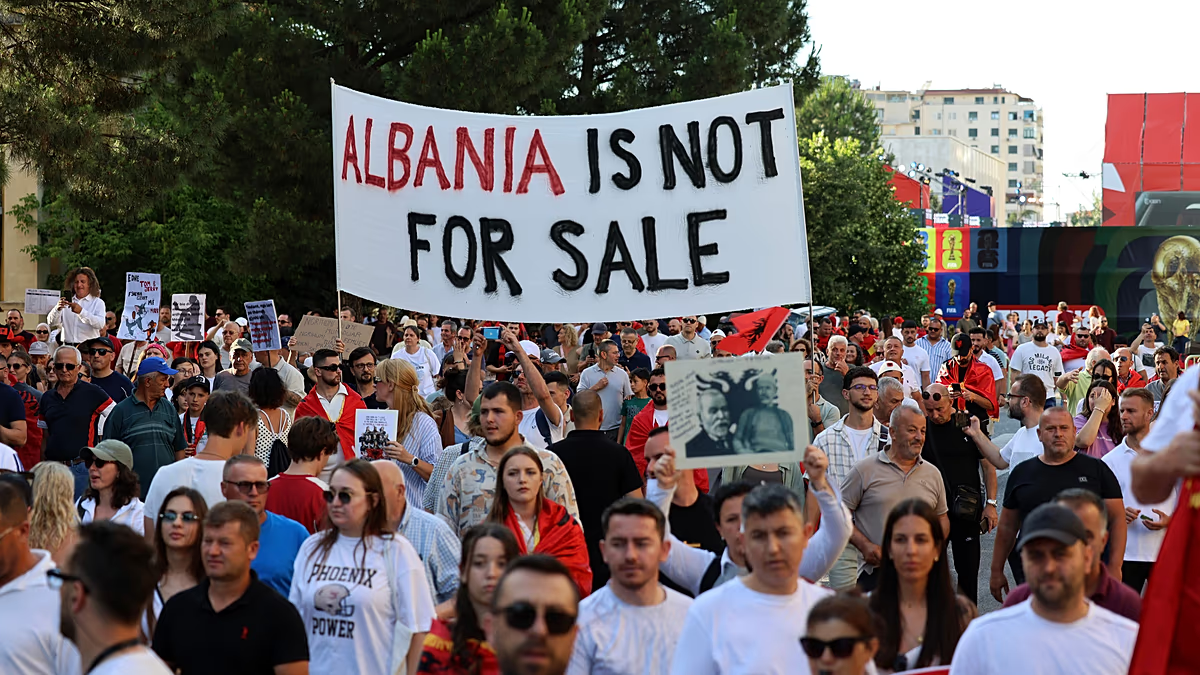
For fourteen consecutive nights, the heart of Tirana has transformed into a pulsating arena of civic dissent. Each evening, thousands of Albanians gather, their voices unified by the shrill sound of whistles and the silent, poignant presence of cardboard flamingos held aloft. This sustained mobilization represents one of the most significant waves of public protest in recent Albanian history, and its catalyst is a single, colossal project: a $4.6 billion luxury tourism development planned for the protected Vlorë coastline on the Adriatic Sea. What began as an environmental outcry has evolved, day by day and night by night, into a broader political confrontation, exposing deep fissures in Albanian society over governance, sovereignty, and the very vision for the country’s future.
The core of the controversy lies in the ecological sanctity of the project site. The plan, linked to an investment vehicle of Jared Kushner, former U.S. President Donald Trump’s son-in-law, envisions turning an abandoned island and its adjacent shoreline into a hotel complex. This area is not a barren tract of land but a region of immense natural importance, featuring a sensitive lagoon ecosystem that serves as a critical haven for migratory birds, including the iconic pink flamingos. For protesters and environmental organizations, this development symbolizes an unacceptable sacrifice of national natural heritage on the altar of foreign investment. They see it as a direct threat to protected species and a fragile coastal environment, fearing irreversible damage for the sake of luxury resorts that may cater primarily to a global elite, rather than fostering sustainable tourism for all Albanians.
Prime Minister Edi Rama’s government presents a starkly different narrative, framing the Kushner investment as a transformative opportunity. Officials argue that a project of this scale and prestige will fundamentally alter Albania’s tourism map, bringing unprecedented economic growth, jobs, and international attention. Furthermore, they posit that such large-scale foreign investment strengthens Albania’s credentials and its path toward accession to the European Union. In defending the project, Rama has struck a defiant tone, vowing not to “step back” and attempting to discredit the protests by suggesting they are fueled by malicious cyber activists operating from abroad. This dismissal, however, has failed to quell the unrest; instead, it has seemingly galvanized the demonstrators, whose numbers have only grown.
As the nights have passed, the character of the protests has subtly shifted. While placards depicting flamingos and chants about protecting nature remain central, the demands have broadened into overtly political territory. The call to simply “halt the project” is now increasingly accompanied by louder, more resonant cries for Prime Minister Edi Rama’s resignation and for early elections. This evolution reflects a deep-seated public frustration that transcends the single issue of the coastal development. For many protesters, the project has become a potent symbol of a governing style they perceive as opaque, dismissive of public consultation, and prone to prioritizing deals with powerful foreign interests over the welfare of citizens and their environment. The protest has thus become a vessel for wider grievances about democracy and accountability.
The movement’s resonance extends beyond Tirana’s city center, highlighting social and historical complexities. Solidarity rallies have emerged in Albanian communities across Europe, particularly in neighboring Greece. There, the issue intersects with the sensitive matters of property and minority rights. Members of Albania’s Greek minority have voiced strong objections, pointing to longstanding, unresolved court cases over land ownership in areas tied to broader tourism developments in the south. They argue that properties expropriated or transferred to the state in past decades under contested circumstances are now being parcelled for development before legal disputes are settled. This layer adds a profound historical dimension to the protests, intertwining environmental concerns with unresolved questions of justice, restitution, and the rights of minority communities.
In essence, the nightly demonstrations in Tirana are about far more than a resort. They represent a fundamental debate over Albania’s destiny. On one side stands a government championing a vision of rapid modernization and economic acceleration through mega-projects and foreign capital. On the other stands a growing segment of the public advocating for a different model—one that prizes environmental stewardship, transparent governance, and inclusive, sustainable development. The cardboard flamingo, held high in the evening air, is no longer just a bird; it has become a multifaceted symbol of national heritage, of a public’s right to be heard, and of a demand for a future where progress does not come at the cost of plundering natural treasures or bypassing democratic principles. The whistles blowing through Tirana are a call for a recalibration of priorities, echoing a desire for a development path that all Albanians can truly own.