


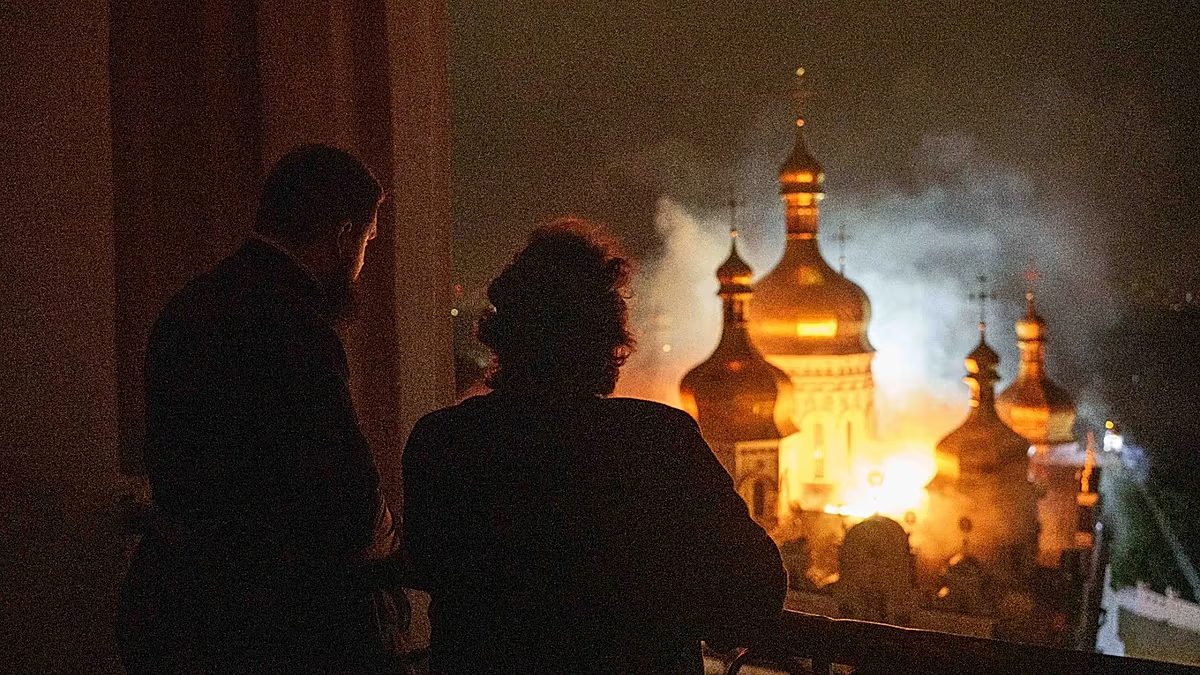
In the early hours of Monday, as air raid sirens wailed across Ukraine, a new depth of horror unfolded in the capital. The first explosions were followed by images, circulating with grim speed on social media, showing flames engulfing the iconic golden domes of the Kyiv-Pechersk Lavra. For a nation already enduring relentless bombardment, the sight of this sacred complex—a UNESCO World Heritage site known as the Monastery of the Caves—under direct attack delivered a uniquely painful shock. Beyond the immediate terror for those seeking shelter, including tens of thousands huddled in metro stations, this was an assault on the very soul of Ukrainian history. President Volodymyr Zelenskyy swiftly condemned the strike as one of Russia’s “most serious crimes against Christian culture,” framing it as a deliberate attack on a universal heritage. His visit to the smoldering site, alongside Prime Minister Yuliia Svyrydenko, underscored the national trauma, even as the cathedral’s bells defiantly continued to ring out over Kyiv.
The Kyiv-Pechersk Lavra is far more than an architectural monument; it is the spiritual and cultural heart of Ukraine, a living chronicle in stone and faith. Founded in the 11th century during the era of Kyivan Rus—the medieval predecessor state to both modern Ukraine and Russia—the sprawling complex of churches and monastic cells, some hidden within labyrinthine caves, represents an unbroken lineage of Eastern Orthodox Christianity rooted in Kyiv. For Ukrainians, it is a profound symbol of identity and continuity, a direct link to a past that predates the rise of Moscow. As ancient icons and relics were frantically evacuated by staff, the world understood the magnitude of the loss. French Foreign Minister Jean-Michel Blanchet likened the bombing to an attack on Notre Dame in Paris, a comparison that vividly conveyed its cultural gravity. This was not collateral damage; it was an erasure of memory.
The international reaction, particularly from the G7 leaders gathering for a summit, reflected a recognition that this strike crossed a profound line. Zelenskyy’s appeal for “decisive and substantive” responses—specifically enhanced air defense and increased pressure on Moscow—highlighted how such cultural devastation is wielded as a weapon of war. Ukraine’s Foreign Minister announced the initiation of urgent procedures through UNESCO, framing the attack as “state barbarism” that demanded a global response. French President Emmanuel Macron affirmed that the bombing only strengthened allies’ resolve to support Ukraine and pursue peace, stating that nothing could justify an assault on “our shared universal heritage.” The attack transformed ancient church walls into a stark diplomatic battleground, proving that the destruction of history is a present-day crime against humanity.
Within Ukraine, the emotional and symbolic resonance of the attack is immeasurable. As articulated by prominent human rights defender and Nobel laureate Oleksandra Matviichuk, Russia deliberately targeted a site built “when Moscow itself did not yet exist.” This strikes at the core of the war’s ideological dimension: a conflict over history, sovereignty, and identity. For the Kremlin, which has long propagated a myth of unified Slavic origin under Moscow’s dominion, the Lavra stands as an inconvenient truth—a testament to Ukraine’s distinct and ancient civilization. Destroying it is an attempt to sever that tangible connection, to negate a legacy that challenges Russia’s historical narrative. Every missile that hits its walls is thus an attack on Ukrainian selfhood, making the pain felt not just in Kyiv but in every corner of the nation.
The religious dimension of the attack adds another layer of profound tragedy. The head of the Orthodox Church of Ukraine, Metropolitan Epiphanius, was among the first to confirm the strike, pleading for prayers to save the shrine from destruction. His condemnation of Russia’s crime “against Christianity” highlights a bitter ecclesiastical schism mirrored in the war. Matviichuk noted pointedly that “the church in Russia has been taken over by the security services,” explaining why Russian priests bless the very weapons now destroying Christian sanctuaries in Ukraine. This perversion of faith for imperial aggression makes the Lavra’s burning a potent symbol of a broader spiritual conflict—a clash between a church weaponized for state power and one defending its community and heritage from annihilation.
Yet, from the ashes and anguish, a powerful declaration of resilience emerges. The immediate response was not one of despair, but of action: firefighters battling the flames, volunteers rescuing artifacts, and leaders walking among the damage. The unwavering message, from the government to civil society, is one of defiant reconstruction. “We will rebuild the Lavra,” Matviichuk asserted, promising accountability for those who support a state “fighting against God and the churches.” This promise to restore what was broken embodies the Ukrainian spirit throughout this war. The Lavra’s bells, ringing out even in damage, become a metaphor for a nation that refuses to be silenced or erased. Each stone that will be rebuilt asserts that history, identity, and faith are not so easily destroyed, and that the deepest foundations of a people will ultimately endure beyond the reach of any missile.