



A significant shift is brewing within the European Union regarding its trade relationship with Israel, specifically concerning goods produced in settlements located in the occupied Palestinian territories. After months of internal stalemate, the European Commission is now being compelled to act. According to diplomatic sources, the EU’s executive body is expected to present a range of options for restricting imports from these settlements ahead of a crucial meeting of foreign ministers in mid-July. This move comes in response to sustained pressure from a majority of member states who argue that such trade, with communities widely considered illegal under international law, must be curtailed. The push signifies a growing impatience within Europe with the status quo and a desire to translate long-standing legal positions into concrete policy, moving beyond symbolic labelling requirements.
The urgency for action has been amplified by recent reports and legal clarifications. A recent investigation by an advocacy group suggested that agricultural products from the occupied territories are frequently entering the EU market mislabelled as “Product of Israel,” thereby circumventing existing 2019 labelling rules from the European Court of Justice. Furthermore, a 2024 advisory opinion from the International Court of Justice reinforced the international consensus that Israeli settlements are unlawful. Compounding this, recent Israeli measures aimed at tightening its control over the West Bank and East Jerusalem are seen by many EU capitals as direct contraventions of the Oslo peace accords. These developments have created a potent mix of legal, ethical, and political impetus for the EU to re-examine its economic ties to these territories, with the Commission now tasked with formulating practical measures to address what member states see as a failure of compliance and a breach of international norms.
At the heart of the current EU debate is a complex procedural dispute that has effectively stalled progress: whether restricting trade with settlements constitutes a “sanction” or a routine trade policy measure. The European Commission has historically been reluctant to propose tariffs, arguing that such actions would be punitive and therefore require unanimous approval from all 27 member states—a consensus that is currently unattainable. However, a powerful bloc of countries, including France and Sweden, contends that tariffs are a standard trade instrument, falling under the EU’s common commercial policy. This would allow for adoption by a qualified majority, a far lower threshold. This view is bolstered by the Council’s own Legal Service, which has reportedly challenged the Commission’s stricter interpretation. France’s foreign trade minister encapsulated this position, framing trade restrictions not as an “aggressive” act but as a “normal” application of policy in line with international law.
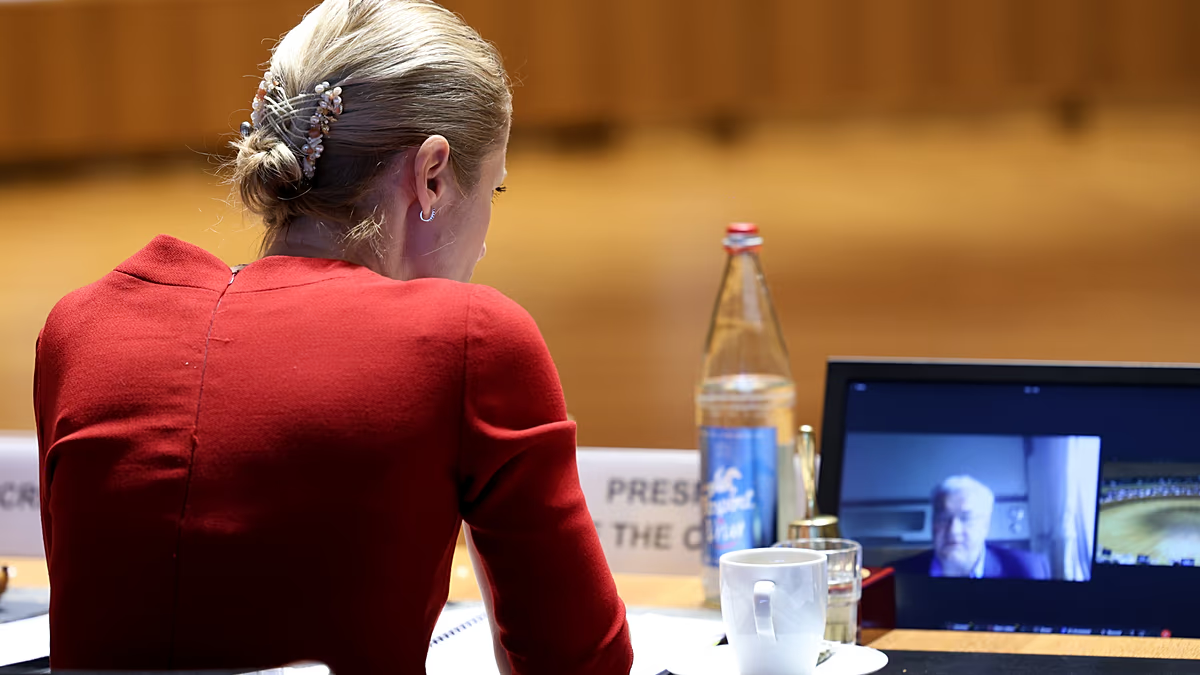
The political landscape within the EU has also evolved, making action more feasible. A significant hurdle was removed in May when Hungary, under its new government, lifted a veto held by former Prime Minister Viktor Orbán, allowing the bloc to unanimously adopt sanctions against extremist settlers and their supporting organizations. This breakthrough demonstrated that consensus on issues related to the occupation is possible and has likely empowered those seeking broader economic measures. EU foreign policy chief Kaja Kallas, conveying the clear message from ministers, has committed to taking the request for options back to the college of Commissioners, emphasizing the need for “clear” proposals. This creates a tangible deadline and a expectation for the Commission to move beyond its cautious stance and provide member states with a viable roadmap for action in July.
Israel, for its part, firmly rejects the foundational premise of the EU’s deliberations. The Israeli government does not accept the characterization of these communities as “illegal settlements,” instead regarding them as legitimate or temporary sites. Any move by the EU to institute targeted trade restrictions would undoubtedly be condemned by Jerusalem as a politically motivated measure that discriminates against Israelis and undermines the economic foundations of these communities. Such a policy would mark a substantial escalation from the existing labelling requirements, representing a direct financial disincentive aimed at the settlement enterprise itself. The prospect of these restrictions adds a new layer of tension to EU-Israel relations, potentially affecting broader diplomatic ties at a time of profound regional instability.
As the July meeting approaches, the onus is now on the European Commission to craft legally sound and politically actionable proposals. The options may range from enhanced enforcement and stricter certification requirements to prevent mislabelling, to the more contentious imposition of tariffs or import bans on goods originating from settlements. The coming weeks will reveal whether the Commission prioritizes the legal arguments of the majority of states and the Council’s own advisors, or maintains its more conservative, unanimity-driven approach. The outcome will be a critical test of the EU’s ability to align its external trade policy with its stated commitments to international law and the long-held goal of a two-state solution. Whatever is proposed will set the stage for a definitive political clash among member states, determining whether Europe will finally employ tangible economic tools to address the ongoing expansion of settlements it deems unlawful.