



In what now feels like a distant chapter of our shared history, Moderna emerged as a beacon of hope during the Covid-19 pandemic. The company’s mRNA-based Spikevax vaccine arrived in Europe with remarkable speed, offering a crucial tool in the global fight against the virus less than a year after the first lockdowns. This achievement catapulted the then-fledgling biotech firm, which had only gone public in 2018, into the global spotlight. However, the trajectory of such success is rarely a straight line. In the years since the pandemic’s peak, Moderna has experienced a predictable yet challenging decline in its valuation, as the urgent, pandemic-driven demand for its flagship product has subsided. This transition marks a critical inflection point for the company, moving from a singular, historic mission back to its original, broader vision.
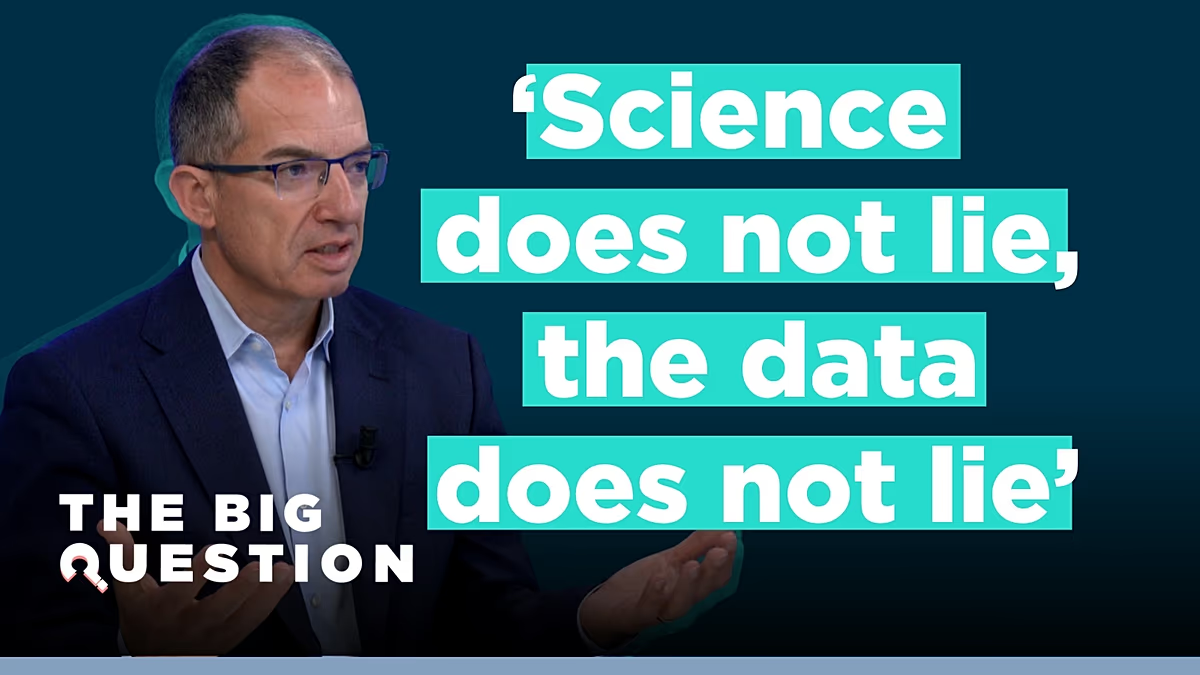
Modern’s CEO, Stéphane Bancel, frames the pandemic effort as a “detour”—a profound duty to humanity—from which the company is now returning to its core mission. He emphasizes that Moderna was founded on a fundamental belief: that mRNA technology is a powerful platform capable of creating medicines across a wide spectrum of diseases, from cancer to rare genetic conditions. The post-pandemic period, therefore, is not an end but a recalibration. The company is actively diversifying its portfolio, with four infectious disease vaccines already approved in Europe and more advanced trials underway. The goal is clear: to leverage the foundational mRNA platform that proved itself during Covid to address a multitude of other pressing health challenges, thereby rebuilding sustainable growth beyond the extraordinary circumstances of the pandemic.
A pressing concern for Bancel, a European himself, is the continent’s preparedness for future health crises. He warns that the landscape has become alarmingly fragile. With BioNTech’s decision to close its German manufacturing sites and shift Comirnaty vaccine production to its US partner Pfizer, continental Europe is left without any significant mRNA manufacturing capacity. “If something big were to happen like a pandemic,” Bancel notes, “we will be able to go even faster than we went in 2020 because now we have a manufacturing infrastructure” in places like the US, Canada, the UK, and Australia. Yet, for Europe, this infrastructure is now lacking. Moderna is actively seeking partnerships with the European Union and individual governments to establish local production, arguing that such sovereign capability is essential for health security. The stark reality, as he puts it, is that Europe could face a serious threat without the industrial base to mount a rapid, on-the-ground response.
Central to Moderna’s renewed strategy is its ambitious work in oncology, with the hope that advances here could revitalize both patient outcomes and the company’s market prospects. A prime example is its investigational vaccine for Lynch syndrome, a genetic condition that significantly increases the risk of various cancers by impairing the body’s DNA repair mechanisms. This represents a paradigm shift from treatment to prevention—using mRNA technology to potentially stop cancer before it starts in high-risk individuals. Success in this and other cancer vaccine programs would not only be a monumental medical breakthrough but also demonstrate the versatile power of the mRNA platform beyond infectious diseases. For Moderna, diversifying into such high-impact therapeutic areas is the key to moving past the “boom and bust” cycle associated with its Covid product and establishing a stable, growing pipeline of innovative medicines.
The journey ahead is one of transformation, from a pandemic hero to a diversified healthcare innovator. Bancel acknowledges that the steep drop in Covid-related sales was expected, but he is confident that 2026 marks the beginning of a return to overall sales growth, driven by the expanding portfolio. The narrative is shifting from a single blockbuster to a broad platform capable of generating multiple solutions. This evolution mirrors the natural lifecycle of a pioneering biotech company: leveraging a landmark validation of its technology to fuel long-term, sustainable research and development across numerous fronts. The challenge lies in executing this transition successfully in the public eye, where quarterly valuations often clash with the long timelines of clinical research.
Ultimately, Moderna’s story is a testament to the dual pressures and promises of modern biotech. It carries the legacy of a company that changed the world during a crisis, while simultaneously navigating the arduous path of proving that its technology has enduring, life-saving applications far beyond that singular event. The company’s future hinges on its ability to replicate its initial success across new, complex disease areas, all while advocating for a more resilient global health infrastructure. As Bancel’s discussion underscores, the work is about building upon a proven foundation—transforming the extraordinary into the routinely extraordinary, for the sake of patients worldwide and for the security of regions like Europe that must not be left vulnerable in the face of the next great health challenge.