



The Changing Face of European Homeownership
Across the European Union, the dream of owning a home remains a reality for the majority, with 68.5% of households living in owner-occupied properties as of 2025. However, this marks a subtle but notable shift from a decade prior, representing a 2.2 percentage point decline since 2010. This overall figure masks dramatic national variations, painting a continent of stark contrasts. On one end of the spectrum, Slovakia exhibits a near-universal culture of ownership with a rate of 93.8%, while in Germany, renting is the dominant tenure for a majority, with only 47.2% of households owning their homes. This divergence sets the stage for a deeper exploration into not just who owns, but when they come to own, revealing a complex tapestry woven from economic realities, cultural traditions, and family dynamics.
The European First-Time Buyer: A Portrait Averages
When do Europeans typically take their first step onto the property ladder? Across 23 nations surveyed, the average age is 31.3 years. Yet, this average, much like the ownership rates themselves, conceals wide disparities. In Malta, the path to ownership is quickest, with first-time buyers averaging just 28 years old. At the other extreme, the process is most protracted in Switzerland and Greece, where the average age rises to 34.7 years. This nearly seven-year gap underscores that the journey to homeownership is profoundly influenced by local conditions. As Michael Polzler, CEO of RE/MAX Europe, notes, while pure affordability is a critical determinant, it is far from the only factor. The age at which one buys is also heavily shaped by the degree of family financial support and deep-seated cultural norms regarding the acceptability of renting as a permanent lifestyle.
A Tale of Two Economies: The UK and Germany
A compelling comparison emerges between Europe’s largest economies, the United Kingdom and Germany, which embody two fundamentally different approaches to housing. The UK boasts one of the youngest average ages for first-time purchase at 28.4 years, a figure matched only by Luxembourg. This early access is significantly propelled by robust family support; over half (53%) of British adults aged 18-34 receive financial help via gifts or inheritance, providing a crucial springboard onto the market. Conversely, Germany presents the latest average age among major economies at 33.6 years—a full 5.2 years later than their British counterparts. This delay is less a story of economic failure and more one of cultural choice and system design. Germany’s strong tenant protections and rental stability have fostered a society where renting is widely viewed as a respectable, long-term alternative to owning. This is reflected in the data: 69% of young Germans surveyed are renters, compared to a 38% average across Europe.
The Mediterranean Model and Central European Trends
Southern and Central European nations illustrate additional nuanced patterns. Spain and Italy show moderately young purchase ages (30.9 and 32.8 years, respectively), but the path there is distinctive. In these countries, it is common for young adults to remain in the family home until age 26, three years beyond the European average. This extended co-residence facilitates significant savings but can simultaneously delay the independent move into homeownership. France, where young people leave home at the average European age of 23, sees a slightly older purchase age (32.5 years), potentially linked to lower levels of direct family financial aid for property purchase. Moving east, nations like Hungary (28.5 years) and the Netherlands (28.8 years) join the ranks of the earliest buyers, while countries such as Czechia, Poland, and Turkey see averages climb into the mid-thirties, reflecting diverse economic pressures and market structures.
The Power of Youth: Early Buyers and Late Starters
Delving into specific age brackets reveals even more about national trajectories. The UK stands out for youth engagement, with a remarkable 40.2% of first-time buyers purchasing their first home by the age of 25—meaning two in five achieve this milestone early. Conversely, Greece has the lowest share in this youngest bracket, at just 12.1%. When considering the broader under-35 category, the contrasts intensify. In Luxembourg, the Netherlands, the UK, and Hungary, over 80% of first-time buyers have purchased by age 35. Greece, Switzerland, and Turkey tell a different story, where only around half of buyers have entered the market by that age, indicating that for nearly half the population, homeownership is a goal achieved in later adulthood. The European average for under-35 ownership sits at 69.5%.
A Crisis Context and the Lack of a Simple Formula
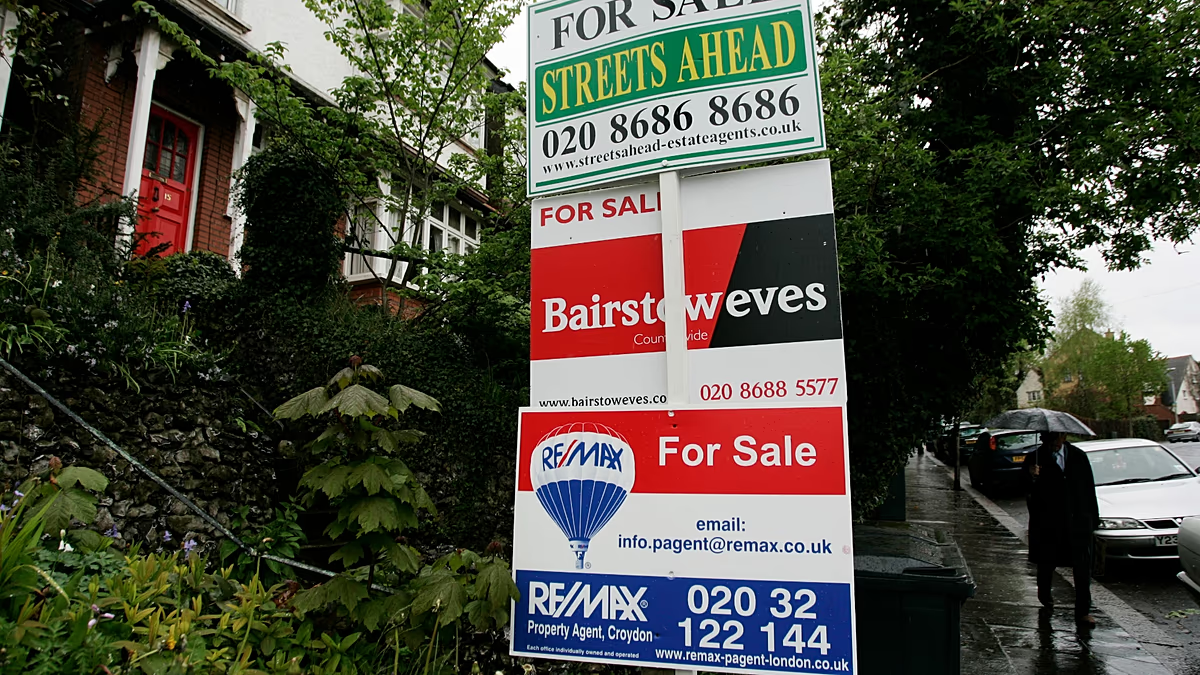
It is crucial to view these trends within the broader context of a European housing crisis, characterized by soaring prices and rising costs that challenge affordability continent-wide. Interestingly, analysis finds no direct correlation between the average age of first purchase and a country’s overall homeownership rate. High-ownership nations like Slovakia can coexist with both early-purchasing cultures and late-purchasing ones elsewhere. This absence of a simple formula confirms that homeownership is not a monolithic experience but a multifaceted outcome. It is forged in the interplay between hard economics—prices, wages, and interest rates—and softer, powerful forces: the strength of family networks, the security offered by rental markets, and the cultural weight placed on owning a home versus other life priorities. Together, these factors determine not just if Europeans own, but when, painting a rich and varied picture of aspiration and attainment across the continent.