



Steven Spielberg’s latest cinematic offering, Disclosure Day, has soared into theaters with a formidable $93 million global debut, proving the director’s enduring box office appeal. The film marks a thematic homecoming for the 79-year-old master storyteller, returning him to the subject of human contact with extraterrestrial life—a realm he helped define. This time, the narrative is framed as a whistleblowing thriller, uncovering a government conspiracy to hide the truth about alien visits to Earth. While the film is poised to become his most successful original title in the U.S., critical reception has been notably mixed. Some point to an uneven script and a third act that veers into sentimental parody, yet even his detractors concede that Spielberg remains virtually peerless in balancing mass entertainment with prestige craftsmanship. In an era often dominated by cynical, hyper-rational worldviews that dismiss empathy as a liability, Disclosure Day arrives as a poignant, if imperfect, reminder that communication and compassion are humanity’s ultimate evolutionary strengths.
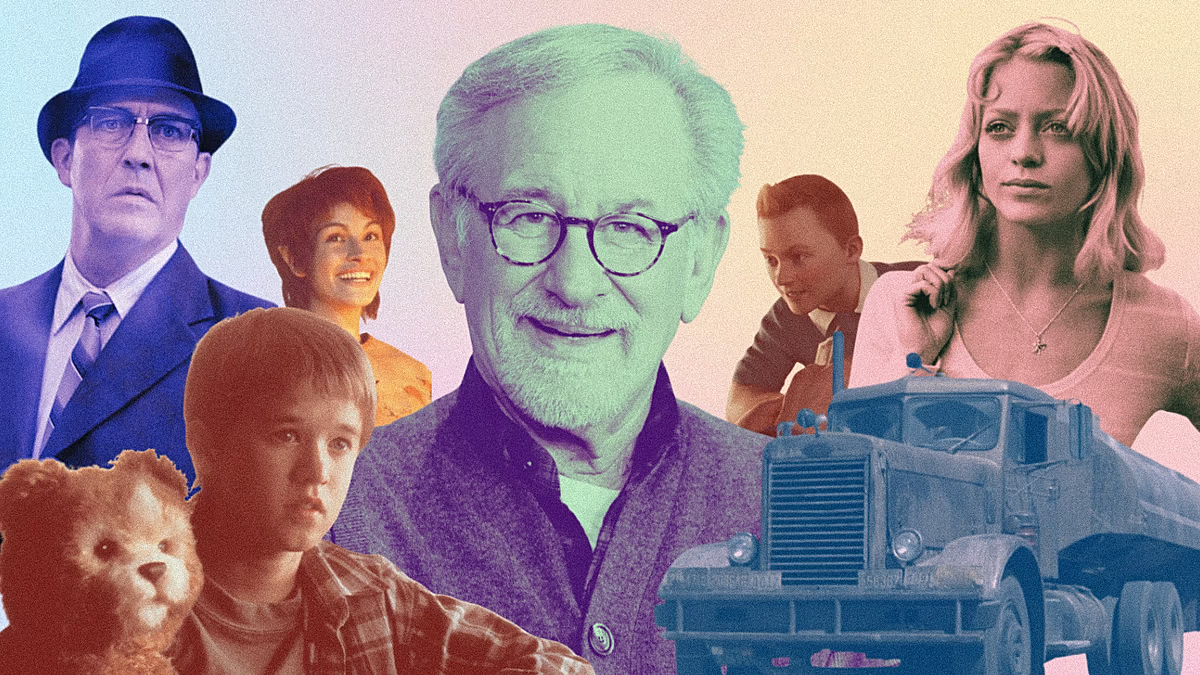
Over a staggering 55-year career encompassing 37 feature films, Spielberg has not just participated in Hollywood—he has fundamentally reshaped it. His filmography is a cultural touchstone, comprising era-defining blockbusters like Jaws and Jurassic Park, stirring historical dramas such as Schindler’s List, sci-fi landmarks from Close Encounters of the Third Kind to Minority Report, and timeless family classics like E.T. the Extra-Terrestrial. Yet, for every iconic title that dominates the conversation, numerous other works in his canon possess equal brilliance but have, for various reasons, drifted into the shadows of his monumental legacy. In the spirit of his new extraterrestrial adventure, it’s worth journeying past the obvious landmarks to rediscover these hidden gems—films that reveal different facets of his genius and perhaps, in some cases, resonate even more powerfully today.
Our first stop is the stripped-down, relentless thriller Duel (1971). Originally a television movie, it stands as a masterclass in sustained tension and economical storytelling. Directed by a then-25-year-old Spielberg, the film follows a motorist terrorized by a malevolent, unseen truck driver on a desolate highway. Adapted from a Richard Matheson story, its genius lies in its terrifying simplicity. The truck itself becomes a primordial, almost prehistoric antagonist—its motives as inscrutable and instinctual as a shark’s. Spielberg uses every tool at his disposal—editing, sound, and claustrophobic framing—to wring unbearable suspense from the premise, proving even at this embryonic stage his innate understanding of cinematic fear. Duel is the raw, pulsing nerve center from which his later, more polished blockbusters would grow.
Following this, The Sugarland Express (1974) often gets overlooked, sandwiched as it is between Duel and the earth-shattering success of Jaws. Yet, as Spielberg’s first theatrical feature, it is a fascinating blueprint for the director he would become. Based on a true story, it follows a couple (Goldie Hawn and William Atherton) who take a police officer hostage in a desperate bid to reclaim their child from the state. While its tone occasionally wobbles between comedy and drama, Spielberg’s burgeoning talent is unmistakable. His camera work is dynamic and immersive, capturing the dusty, sun-baked atmosphere of Texas, while his perspective remains deeply humanistic. He portrays his flawed protagonists not as cold outlaws, but as misguided souls acting from love, foreshadowing the empathetic, character-driven heart that would beat at the core of even his largest spectacles.
Jumping ahead, Hook (1991) remains one of Spielberg’s most passionately defended and misunderstood films. Even the director has expressed dissatisfaction with the final product, but its reputation has warmed over time. This bold reimagining of Peter Pan—featuring Robin Williams as a grown-up, workaholic Peter who has forgotten his past—is a lavish, candy-colored exploration of lost wonder and reluctant adulthood. While its visual effects were of its time, its emotional core is timeless. Dustin Hoffman’s gloriously theatrical Captain Hook and the film’s heartfelt message about reconnecting with one’s inner child now feel like a poignant counterpoint to modern cynicism. It is a film of immense ambition and genuine warmth, whose cultural footprint, evidenced by the simple joy of shouting “Rufio!”, is far larger than its initial reviews suggested.
Perhaps no film in Spielberg’s catalog feels more prescient today than A.I. Artificial Intelligence (2001). A project originally developed by Stanley Kubrick and passed to Spielberg, it is a haunting, profoundly sorrowful fairy tale about a robotic boy, David (Haley Joel Osment), programmed to love. The film marries Kubrick’s cold, philosophical gaze with Spielberg’s signature emotionality, creating a unique and challenging tone. In an age where AI development accelerates daily and human interaction is increasingly mediated by technology, A.I.’s questions are no longer speculative—they are urgent. What does it mean to be real? Can consciousness be manufactured? The film’s devastating conclusion suggests that our capacity for love and connection is our true, irreplaceable essence, a message that serves as both a warning and a fragile hope in our current moment.
Finally, two later-career works demand rediscovery. Munich (2005) is arguably Spielberg’s most morally complex and politically brave film. A tense espionage thriller about Israel’s covert response to the 1972 Olympic massacre, it gradually morphs into a devastating meditation on the cyclical, soul-corroding nature of revenge. Its technical craft is impeccable, but its power lies in its refusal to offer easy answers, presenting violence as a contagious disease that consumes all who wield it. In contrast, The Adventures of Tintin (2011) is pure, unadulterated joy—a motion-capture adventure that showcases Spielberg’s peerless sense of kinetic fun. With its breathless, virtuoso camera work, swashbuckling set pieces, and affectionate humor, it is a reminder of the director’s childlike wonder and his unparalleled skill as a pure visual storyteller. Both films, in their own ways, demonstrate that even decades into his career, Spielberg never ceased exploring new genres and challenging his own artistic boundaries. While Disclosure Day continues his legacy of looking to the stars, these lesser-celebrated films remind us that his most profound explorations have always been of the human heart, mind, and spirit right here on Earth.