



The Evolving Price Tag of the White House Ballroom
Amidst a backdrop of domestic economic anxiety and international conflict, a significant renovation project at the very heart of American governance has become a focal point of political and public scrutiny. US President Donald Trump’s ambitious plan to construct a grand ballroom at the White House, a project he has championed as a physical symbol of his legacy, is now shrouded in controversy over its true cost and funding. Initially presented as a $200 million endeavor funded entirely by private contributions, the project’s financial reality has expanded considerably, with recent reports suggesting a total cost nearing $600 million. This substantial escalation, coupled with revelations that taxpayers are bearing a significant portion of the burden, stands in stark contrast to the President’s repeated public assurances and has ignited a fierce debate about presidential priorities and transparency.
A Promise of Private Grandeur Meets Financial Reality
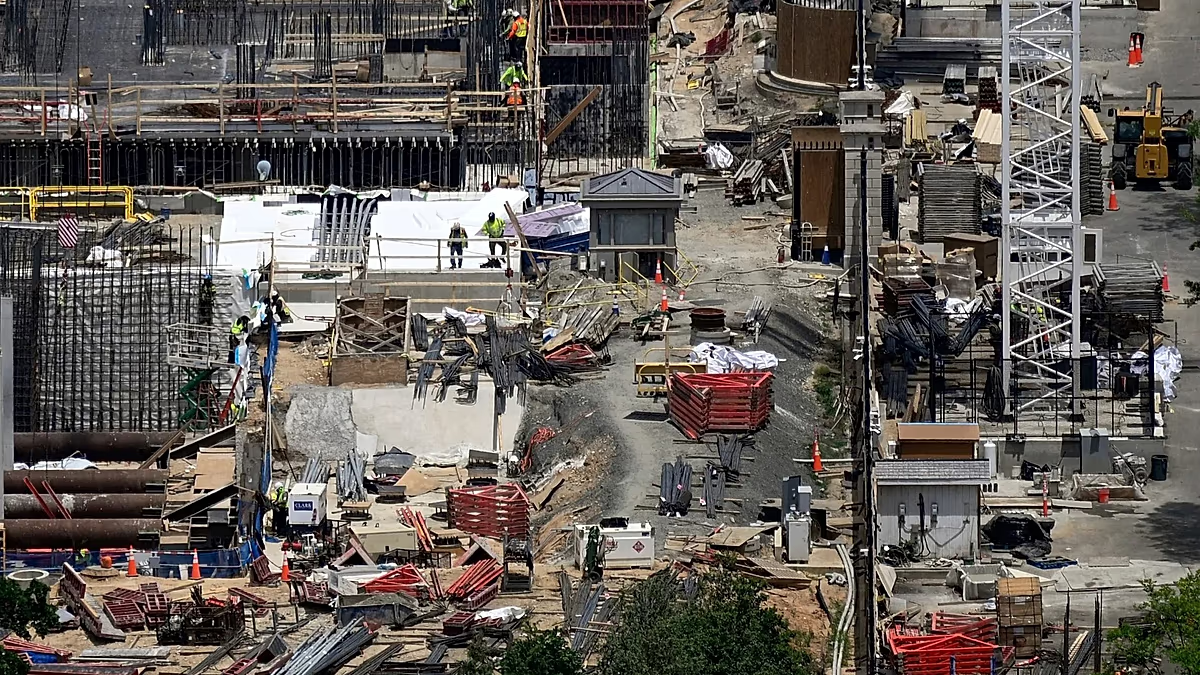
From its inception, President Trump framed the ballroom as a gift to the nation, a necessary upgrade for hosting state dinners and prestigious events, financed by his own wealth and that of like-minded private donors. He consistently touted figures of $200 million, then $400 million, emphasizing the project would be “tax-payer free.” However, investigative reporting has uncovered a different story. Internal documents from Clark Construction, the project’s contractor, reveal a detailed estimate prepared for the administration that pegs the total cost at approximately $600 million. More critically, a financial summary indicates that only about $293 million of that sum is expected from private sources, leaving a gap of over $300 million to be covered by public funds. This discrepancy between public pronouncements and internal accounting raises profound questions about the flow of information from the White House to the American people.
The Disconnect Between Words and Actions
The timeline of events deepens the controversy. While President Trump was publicly reiterating the $400 million “tax-payer free” figure as recently as late March, his administration had, according to logs of contractor invoices, already approved numerous payments to Clark Construction using public money, totaling tens of millions of dollars. This sequence suggests a conscious effort to maintain a narrative of private funding even as taxpayer dollars were actively being spent. In response to inquiries about these financial documents, the White House issued a statement clinging to the $400 million private funding figure, while the builder declared project details confidential. This lack of clear, reconcilable information from official channels fuels perceptions of opacity and undermines public trust.
Political Repercussions and Legal Hurdles
The ballooning cost and funding controversy have not gone unnoticed by Trump’s political opponents. Democratic lawmakers have seized upon the gilded ballroom project as emblematic of a leader they argue is detached from the everyday struggles of citizens facing rising living costs. Within his own party, Republicans reportedly fear that voter concerns about economic pressures, exacerbated by soaring fuel prices linked to the ongoing Iran war, could be amplified by such lavish, taxpayer-subsidized renovations, potentially harming their prospects in the upcoming midterm elections. Furthermore, the project itself is mired in legal challenges. A judge ruled in March that construction above ground must halt, a decision currently on hold pending an appeal. The administration has defended the ballroom’s urgency by citing a security incident, arguing that a proper, secure venue is needed for large events.
A Symbolic Battle Over Presidential Legacy
The ballroom dispute transcends mere budgeting; it has become a powerful symbol in the nation’s cultural and political discourse. For President Trump, it represents a permanent, luxurious imprint on the White House, a tangible manifestation of his tenure and a purported enhancement of the nation’s ceremonial capabilities. His enthusiastic tours of the construction site, where he proclaimed the project a “gift to the United States of America,” underscore this personal investment. For critics, however, the structure symbolizes misplaced priorities—a monument to extravagance built while many Americans grapple with economic uncertainty. The very term “gilded ballroom” evokes an era of stark inequality, framing the project not as a national gift but as an elitist indulgence.
The Core Issues: Transparency, Priority, and Trust
Ultimately, the controversy surrounding the White House ballroom crystallizes several critical issues for the American public. It is a test of governmental transparency, revealing a troubling gap between official statements and documented financial realities. It is a debate over national priority, questioning whether such a substantial investment of public and private resources is the best use of funds during a time of broader economic and social challenges. Most fundamentally, it is a challenge to public trust, as the evolving narrative and legal entanglements create a cloud of uncertainty around an initiative launched from the nation’s highest office. As the legal appeals continue and the midterm elections approach, the story of the ballroom—its cost, its funding, and its symbolism—will remain a potent emblem of the tensions between presidential vision, fiscal responsibility, and the expectations of the electorate.