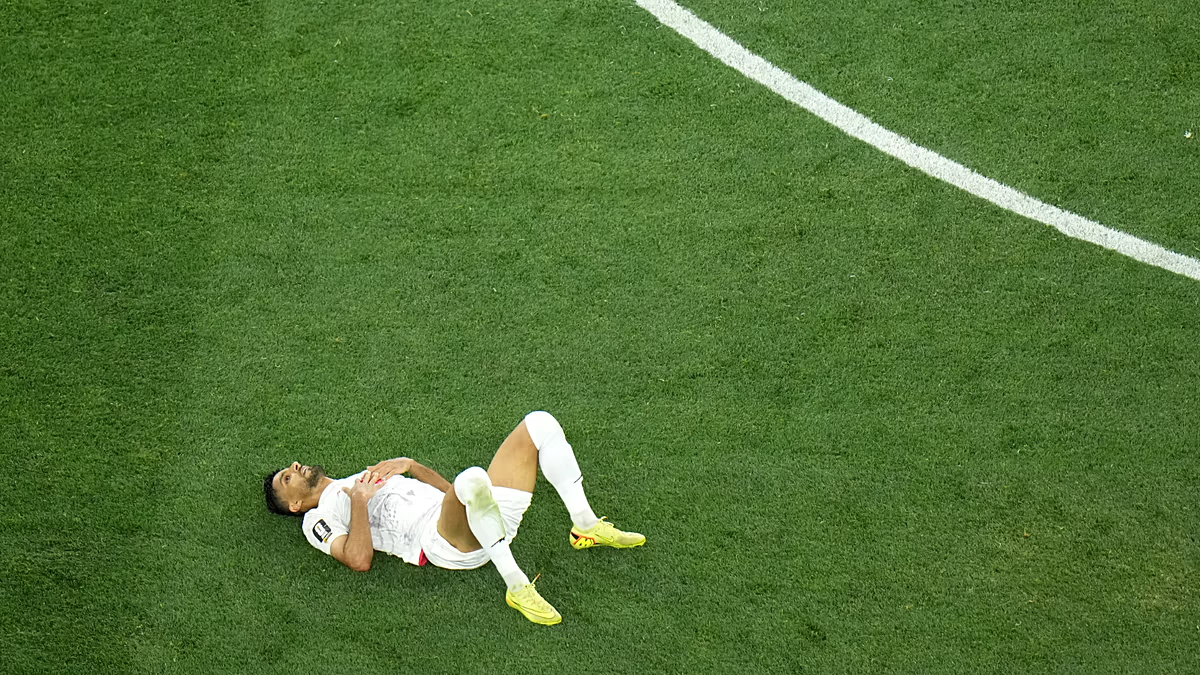


The Iranian national football team’s 2026 World Cup campaign began not just with a dramatic 2-2 draw against New Zealand on the pitch, but with a maelstrom of logistical chaos and political tension off it. Hours after the final whistle in Inglewood, California, head coach Amir Ghalenoei stood before the media, voicing a profound sense of grievance. His team, he revealed, had been ordered to immediately leave the United States and fly back to their training base in Tijuana, Mexico, denying them the standard post-match recovery period in their Los Angeles hotel. Through an interpreter, Ghalenoei expressed bewilderment and frustration, stating, “They didn’t even give us time to recover… I think our team is perhaps the most oppressed in the World Cup.” This sudden, unexplained directive, which followed a grueling five-hour border crossing the day before the match, left the squad physically depleted and feeling that external forces were controlling their fate, casting a shadow over their tournament from the very start.
This operational turmoil exists within a deeply charged political context that has defined Iran’s participation. The team’s very presence in the United States for Group G matches came after FIFA rejected a request to move their games elsewhere, following the outbreak of war between the US, Israel, and Iran months prior. This geopolitical backdrop manifested powerfully outside the stadium, where Southern California’s large Iranian diaspora became a stage for profound internal conflict. Hundreds of protesters, many waving the pre-revolutionary Lion and Sun flag, gathered to denounce the Islamic Republic, arguing that the team represented the Tehran regime. For them, supporting the squad was unthinkable; as one protester, Rameileh Jaffrey, stated, “They are not my team. They are a government team.” The atmosphere was tense, with altercations between protesters and fans, and even the snatching and destruction of an official Iranian flag.
Inside the stadium, this division was audible. A section of Iranian fans booed their own national anthem, a silent protest against the government, yet erupted in cheers for the goals scored by Ramin Rezaeian and Mohammad Mohebi. This complex dynamic highlighted the struggle of many to separate national pride from political opposition. Some attendees, like protester Ella Bah, entered the stadium not to cheer but to be a visual “voice for the people inside Iran,” hiding alternative flags beneath their clothing. The players themselves were caught in this crossfire, forced to navigate a sporting event that felt anything but ordinary. After the match, goalscorer Ramin Rezaeian, named Man of the Match, diplomatically addressed the schism, saying, “We will solve the problems related to our country ourselves,” while thanking fans for appreciating the team’s fighting performance on the field.
The challenges extended far beyond fan sentiment, deeply impacting the team’s administrative and logistical framework. The Iranian Football Federation was operating at a severe handicap, as its president, Mehdi Taj, and secretary-general were barred from the United States after their visa applications were rejected. Furthermore, in a bizarre administrative snafu, defender Mehdi Torabi was issued only a single-entry US visa, which expired the moment the team flew to Tijuana, putting his participation in future US-based matches in jeopardy. Coach Ghalenoei pointed to these issues as evidence that Iran was “the most underdog team at the World Cup,” calling for greater support from FIFA. Even a post-match visit from FIFA President Gianni Infantino, who praised the players for being “stronger and greater than all the issues,” could not immediately solve these concrete, disruptive problems.
Amidst this unprecedented pressure, the players attempted to assert their primary identity as athletes. Captain Mehdi Taremi, reflecting on the cumulative exhaustion of travel hassles and political strife over the preceding months, emphasized their mission was to “pursue peace and happiness, which are also values promoted by FIFA.” When probed for a political message, he deflected with a weary smile, affirming, “I am a footballer, not a politician. We are here to play football.” This sentiment underscored the team’s desire to find sanctuary in sport, even as the world around them insisted on a political narrative. Their resilient comeback to draw twice against New Zealand was, in Ghalenoei’s view, “the best game of the World Cup group stage,” a testament to their focus amidst distraction.
As Iran looks ahead to its crucial match against Belgium in Los Angeles, the squad’s journey remains a fraught balancing act. They carry the hopes of a nation divided, face unique and burdensome logistical hurdles, and compete under a global spotlight intensely focused on politics rather than sport. Their opening match was not merely a football game; it was a microcosm of a team striving to represent a country in profound conflict, both internally and externally. Their campaign is a test of athletic resilience against a tide of circumstance, where every pass and play is set against a backdrop far larger than the game itself. Their true opponent may not just be the team on the other side of the pitch, but the immense weight of history and politics they are compelled to carry.