

The G7 Summit in France today served as a crucial platform for two key Western leaders, President Donald Trump of the United States and Prime Minister Keir Starmer of the United Kingdom, to outline their distinct but interlinked approaches to a critical and volatile region: the Middle East. Against a backdrop of heightened regional tensions, their remarks underscored a shared commitment to stability, yet revealed the differing priorities and diplomatic tones of their respective administrations. While both leaders addressed threats emanating from Iran, their focal points diverged significantly, painting a picture of a multifaceted international challenge requiring both uncompromising deterrence and coordinated, multilateral navigation.
President Trump’s comments were characterized by a stark and unambiguous warning directed squarely at Tehran’s nuclear ambitions. Speaking with his characteristic bluntness, the President left no room for misinterpretation regarding the American red line. “The only thing that really matters to me,” he stated, “is Iran will never have a nuclear weapon.” He emphasized that any Iranian move to develop, purchase, or otherwise acquire a nuclear weapon would result in what he termed “unbelievable consequences” and “the ultimate consequences.” His most vivid phrasing—that if Iran pursued this path, “all hell will rain down on them”—was a potent, if undiplomatic, reinforcement of a long-standing U.S. policy of prevention. This rhetoric signals a continued, and perhaps intensified, maximum-pressure campaign aimed at completely halting Iran’s nuclear program through the threat of overwhelming retaliation, a stance that forms a cornerstone of the current U.S. strategy in the region.
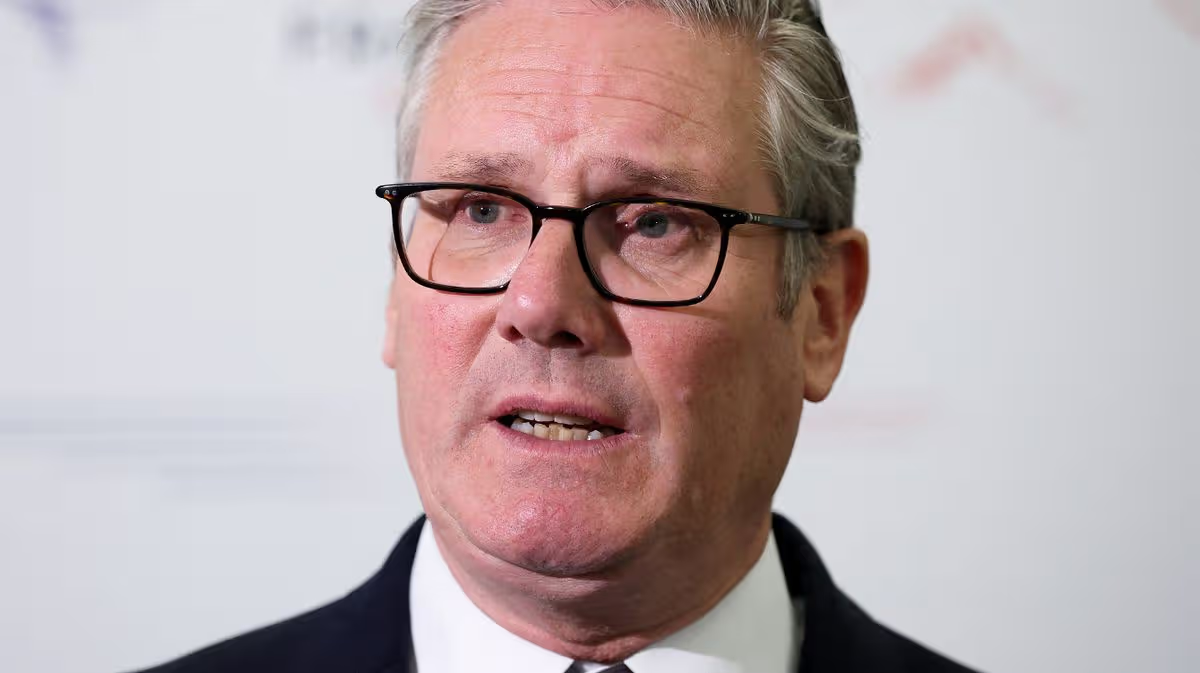
In contrast, Prime Minister Keir Starmer’s address, while acknowledging the broader context of Iranian activity, focused on a more immediate and tangible economic crisis: the closure of the Strait of Hormuz. He detailed a collaborative effort spearheaded with French President Emmanuel Macron, forming “a group of countries prepared to play their part in terms of reassurance to get vessels through the Strait.” For Starmer, this was not merely a geopolitical issue but a domestic economic imperative. He explicitly linked the strait’s blockage to direct impacts “on our economy and on every household across the country,” framing the UK’s participation in a multinational task force as a necessary safeguard for global trade and national prosperity. His language was one of collective action and “reassurance,” highlighting a commitment to preserving the free flow of commerce through one of the world’s most vital maritime chokepoints.
The divergence in emphasis between the two leaders is illuminating. Trump’s focus was strategic and existential, targeting the foundational threat of nuclear proliferation. Starmer’s was operational and economic, addressing the symptom of that tension—regional aggression that disrupts global shipping. These are not contradictory positions, but rather two sides of the same coin. Iranian provocations, which may include harassing commercial vessels or mining waterways, are often tools of leverage within the broader confrontation over its nuclear program. The strait’s closure is a direct manifestation of the very instability that the U.S. seeks to mitigate through its deterrent threats. Thus, the UK-led naval mission can be seen as managing the immediate fallout of the regional standoff, while the U.S. posture aims to confront what it perceives as the root cause.
Together, these statements outline a potential, if unspoken, division of labor within the Western alliance. The United States appears to be anchoring the strategy of deterrence, maintaining a position of ultimate military consequence to dissuade Iran from crossing the nuclear threshold. Meanwhile, the United Kingdom, in close partnership with European allies like France, is stepping forward to coordinate the pragmatic, collective security response required to keep international trade lanes open and functional. This duality reflects the complex nature of modern statecraft: the need for both the stark clarity of deterrence and the nuanced, collaborative work of crisis management and economic protection.
The summit therefore provided a clear snapshot of transatlantic priorities in a tense moment. President Trump’s message was one of solitary, formidable warning, underscoring a unilateral willingness to enact severe penalties. Prime Minister Starmer’s was one of allied burden-sharing, emphasizing the UK’s “full part” in a concerted international effort to alleviate a specific economic and security blockage. Their combined remarks highlight the multifaceted challenge posed by Iran, demanding a response that simultaneously addresses long-term strategic threats and immediate economic disruptions. The path forward for the G7 will depend on its ability to harmonize these two approaches—the uncompromising deterrent and the multinational patrol—into a cohesive and effective strategy for regional stability.